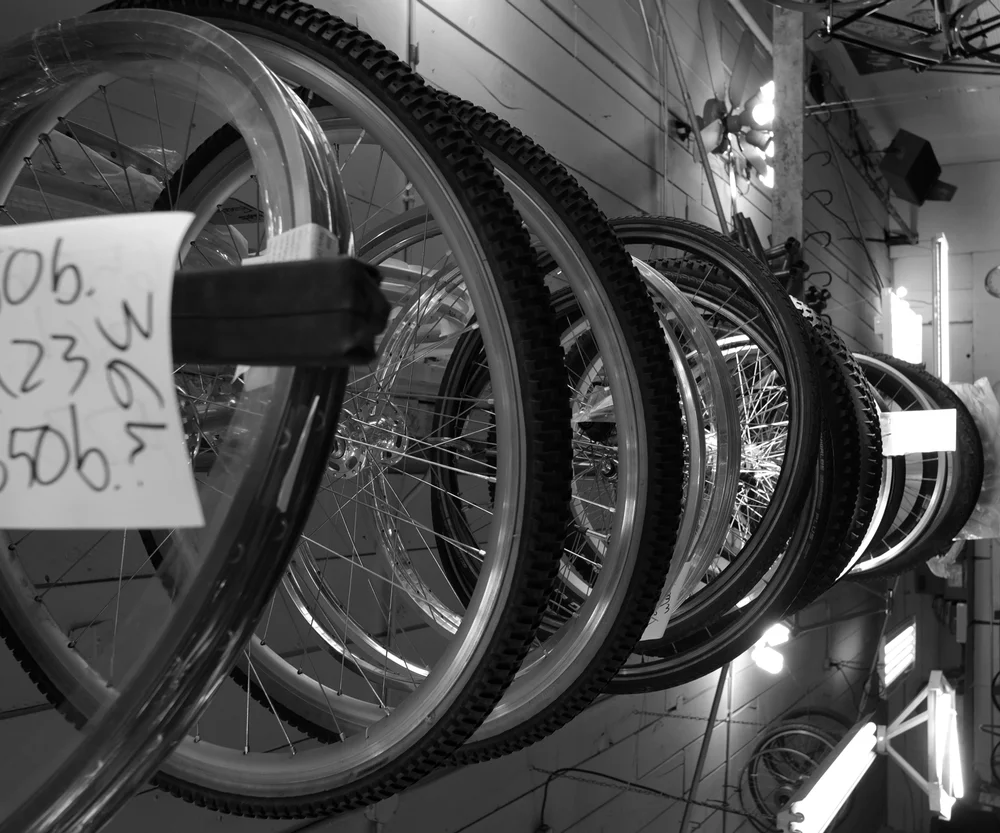
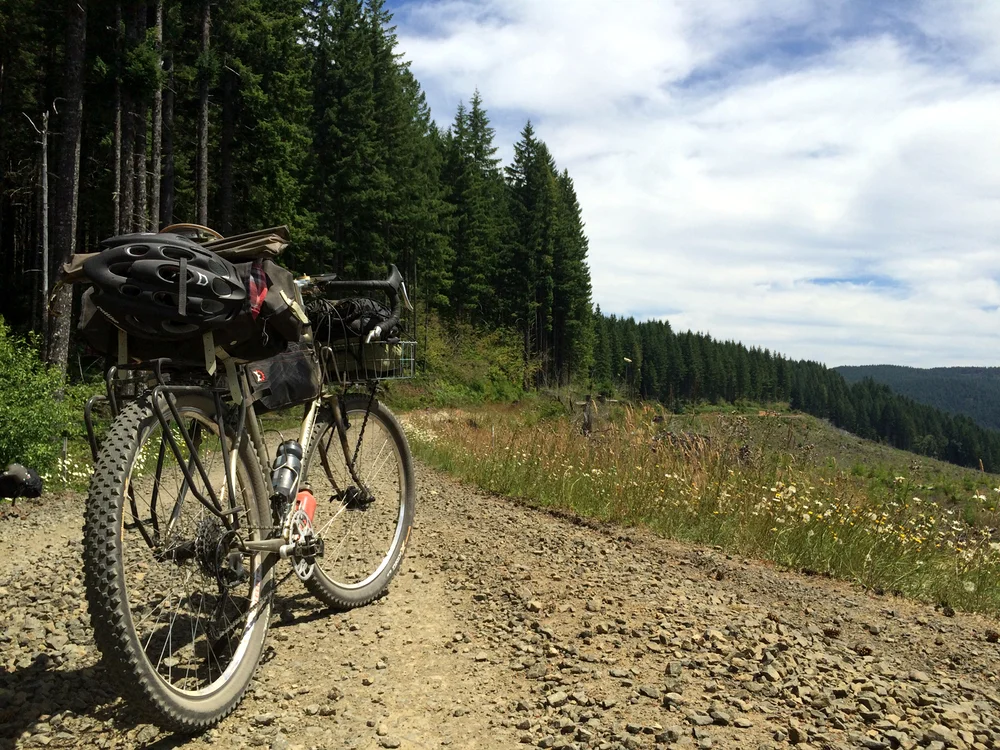
But anyway, while shopping for bikes we were helped by a very friendly salesperson, I’ll call him Stephen. When picking out Natacha’s bike, one of the first things that Stephen told us was this: “All the bike companies are transitioning over to the 650b wheel size. 26 inch wheels are going to be obsolete.” I did a sort of auditory double-take. “What?” I thought. “Are you serious?”
Looking around, it seemed that he was. Serious, I mean. All the newest adult mountain bikes on the floor of the shop had 650b, or 27.5 inch wheels. I don’t read the magazines, I don’t follow market trends. I’m around bike people enough, and have plenty of friends working at shops, so I’ve heard talk about the rise in popularity of the 650b wheel size. But not on this scale, or maybe I wasn’t listening very well. We’ve been talking about this wheel for several years now. Coming to find out that this once very niche market has gone totally mainstream and now in fact has supplanted both the 29er and the 26er wheel sizes seemed a little crazy. Like, if you’ve got a friend who’s always turned up his nose at grape Kool Aid, ever since you can remember he went for either cherry or lemon-lime, ever since you were little kids. And now, suddenly he’s got the tell-tale grape mustache, and all he ever talks about anymore is how grape Kool Aid is the shit, it’s the only beverage worth drinking, he won’t let his mom buy anything else, there’s nothing else like it, etc., etc.. It makes you shake your head because there’s something kind of sad about it. And in fact it might hint at some sort of, I don’t know, instability in your friend.
There’s absolutely nothing wrong with 650b as a wheel size. I personally really like it for the applications that I use it for. To my mind, and in my opinion, for most people who ride bikes as commuters, go on light tours, or for whom a bike is very part time recreation, for anyone buying “entry level,” or even “mid level” bikes, and even many versions of the “high end” bikes, wheel size ought to be proportionate to the frame size. Smaller bikes, smaller wheels; larger, larger. That’s a general rule of thumb, not a law set in stone. In this way, you can nail the frame geometry and get the best ride quality and most desirable handling characteristics. There’s some room to play in bike design, of course, and the way a bike feels is very subjective. To my mind, again, the way a bike handles is way more important than the way a distant factory is tooled, and the consequent pushing and shoving of marketers.
When the entire market shifts in this way, and broad claims are made, such as the one that “twenty-six inch wheels are on their way to obsolescence,” I immediately become suspicious. Was that just a blanket statement by a salesperson who was more concerned with selling his shop’s products? Or was his statement an example of the voice of the industry?
These industry-wide re-inventions seems to happen in regular enough cycles that it might be possible to name it. There’s a sort of herd-induced excitement whenever anything “new” catches on in the bike world. In very loose historic terms, in the 1970’s and 80’s it was BMX; in the 90’s, mountain bikes and a little later downhill bikes; in the early 2000’s, 29ers were all the rage (before hitting the main stream, that was most of what I built); mid-to-late 2000’s hand made custom bikes became very popular; and somewhere in there plastic bikes started to really take off; in the early 2010’s it was fat bikes, commuter bikes, and especially in Europe and Asia, electric bikes. And now, here we are in 2015 and our wheel size has settled into the era of the 650b. That’s great. A new trend has arrived. No judgement, I’m just noticing.