Ahearne Cycles

Nothing Ever Stays the Same

Joseph Ahearne4 Comments

If I’m looking to escape Portland’s cold and rain for a few weeks in the winter, Mexico is one of my favorite destinations. If I only have a short time I usually I head straight for the coast, either somewhere in the Yucatan, or anywhere along the Pacific coast of the mainland. Swimming in warm blue water, reading and sleeping on the beach, shifting gears into that sort of languorous beach vibe that typically resides wherever there are palm trees and salt water — this is about the quickest antidote I can think of to the dark, humid damp that descends upon Portland for the winter months. Don’t get me wrong — I love the rain. But I love it more when I can step out of it for a while. 

This time, though, I decided to stay inland, at least at first. I wanted to explore someplace new. The beach will be there for me, at least until it isn’t — I heard on the radio a few weeks ago that with climate change and rising sea levels, we’re going to start losing beaches all around the world. Hundreds of thousands of miles of beaches are expected to be submerged within the next couple of decades. But…

Neighborhood Way

We’re Riding Bikes

Guadalajara is a big city — second largest in Mexico. It’s inland from the coast by maybe 150 miles, situated in the highlands. Famous for its tequila, there are blue agave farms all over the surrounding countryside. The air is drier, the climate more moderate than in other places I’d visited in Mexico. I don’t know how accurate this is, but it felt similar in size to Seattle. And, Guadalajara is the first place I’ve been in Mexico that has cycling infrastructure, which was part of the curiosity that drew me there. 

Guadalajara has bike lanes on many of the major roadways, signs on certain back roads that gave priority to bikes, and a bike share program. And, amazingly — build it and they shall come — people rode their bikes. Not that drivers necessarily respected the bike lanes, or biker’s right-of-way, nor pedestrians for that matter. But the city has made the effort, and as I well know from Portland bicycle commuting, these things take time, and continual energy to make them work. 

One of the best things about cycling in Guadalajara was every Sunday, all year round, they close about 60 km of major roadways to car traffic, and open them to cyclists, pedestrians, skaters & roller bladers, etc. If you want to see the routes, visit the website for Via Recreativa. Every Sunday, from 8 a.m. to 2 p.m. it’s like a giant mobile street party that stretches over a significant portion of town. Thousands of people come out, and there is nothing better, in my opinion, than to allow people to slow down and take over the roads in this way to build community and help people feel “safe” on the streets. Each week I picked a different direction, and after a few weeks had cycled the entire length and breadth of the route. I liked the city all the more for being able to participate in this. 

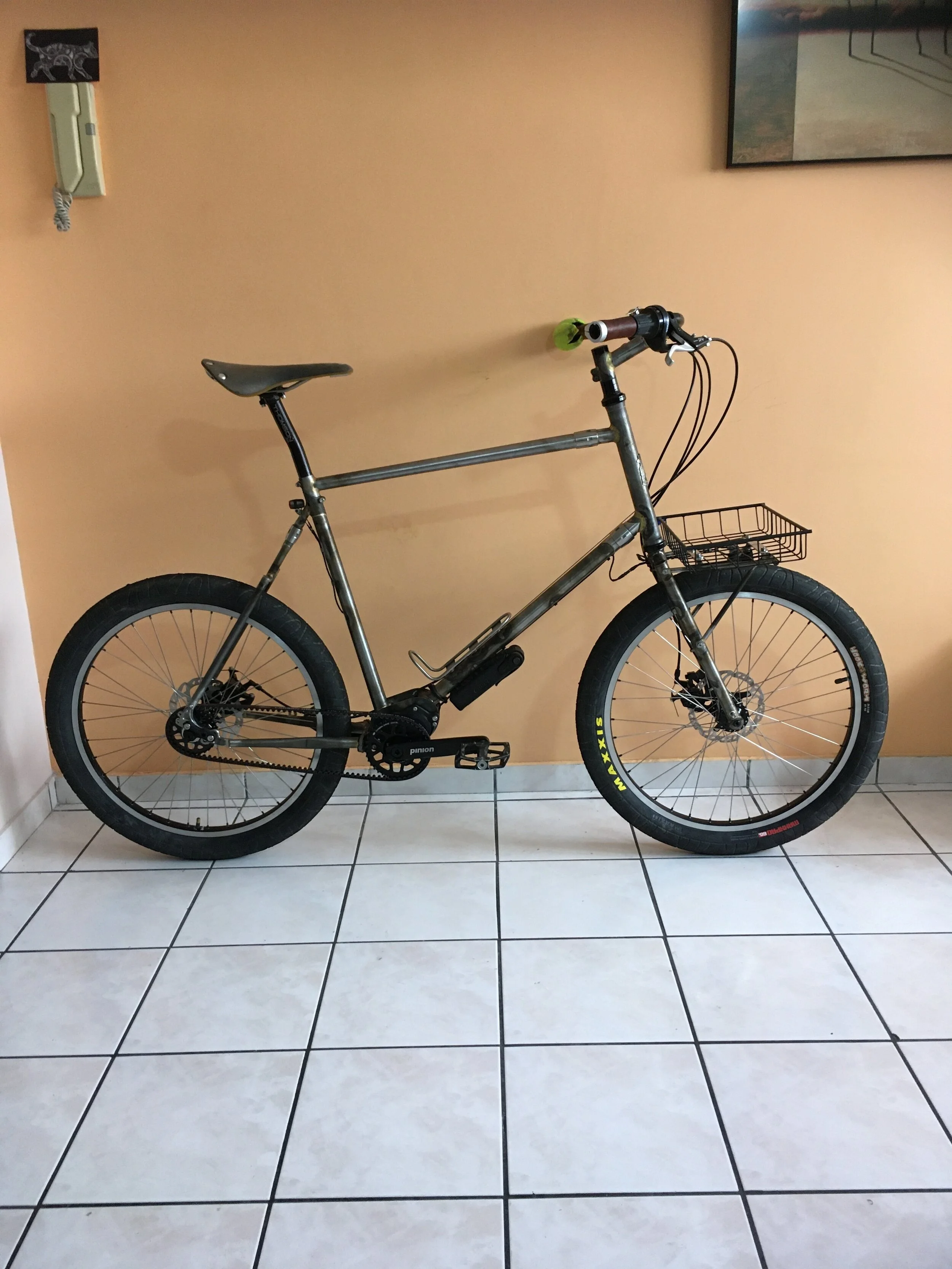
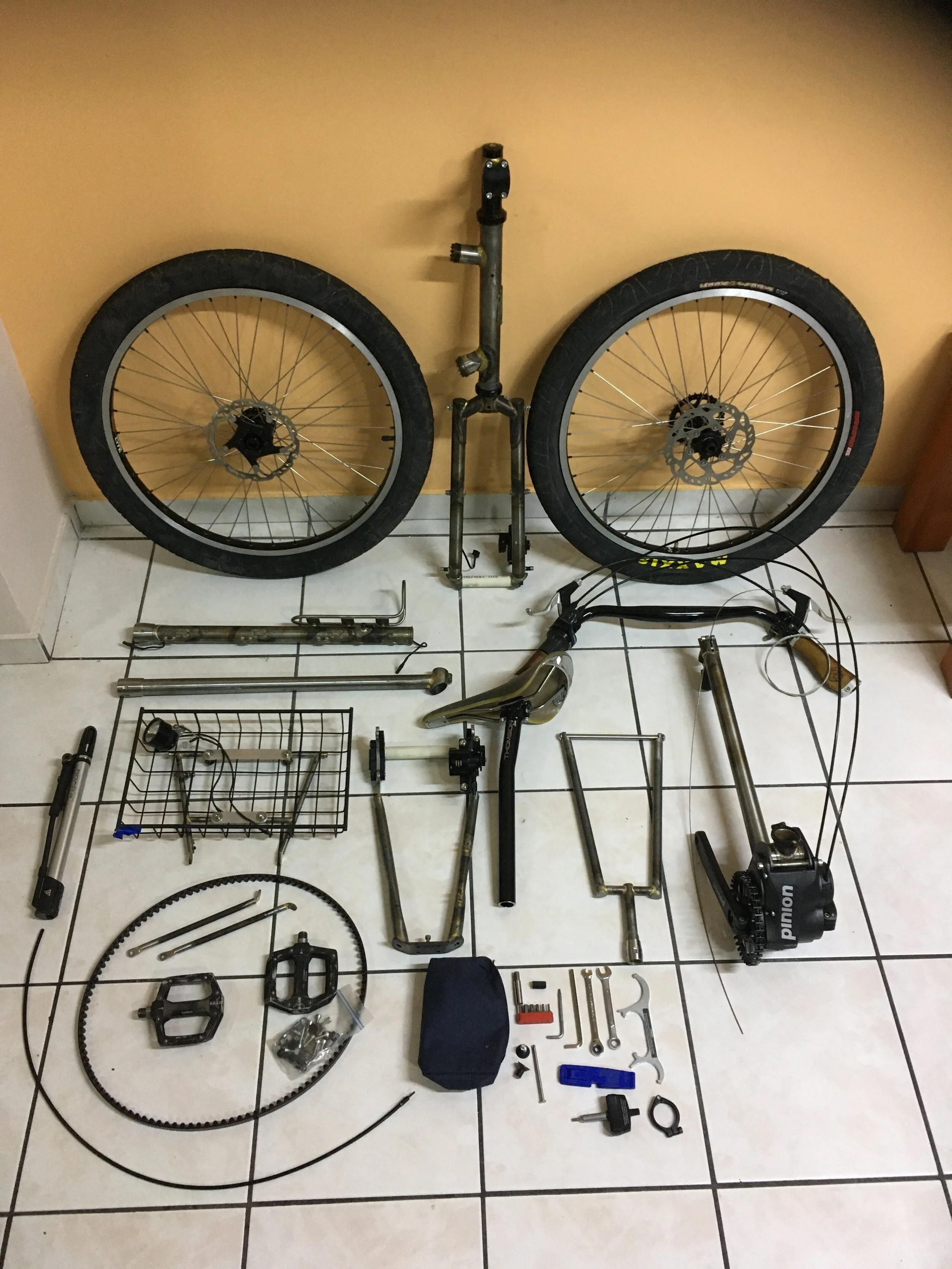
I built a travel bike specifically to take with me on this trip. It’s one of those bikes I’ve been thinking about, piecing together in my mind over the past few years, and it seemed like the right time to put it together. I wanted something that didn’t compromise ride quality for packability, and I knew that with the variety of roads I’d need big, comfortable tires. At first I was going to build it as a single speed, but then I thought the versatility of having at least a few gears would make the bike more practical in the long run. I decided on the Pinion 9 speed gearbox — plenty of gear range to get me up and down any hills. 
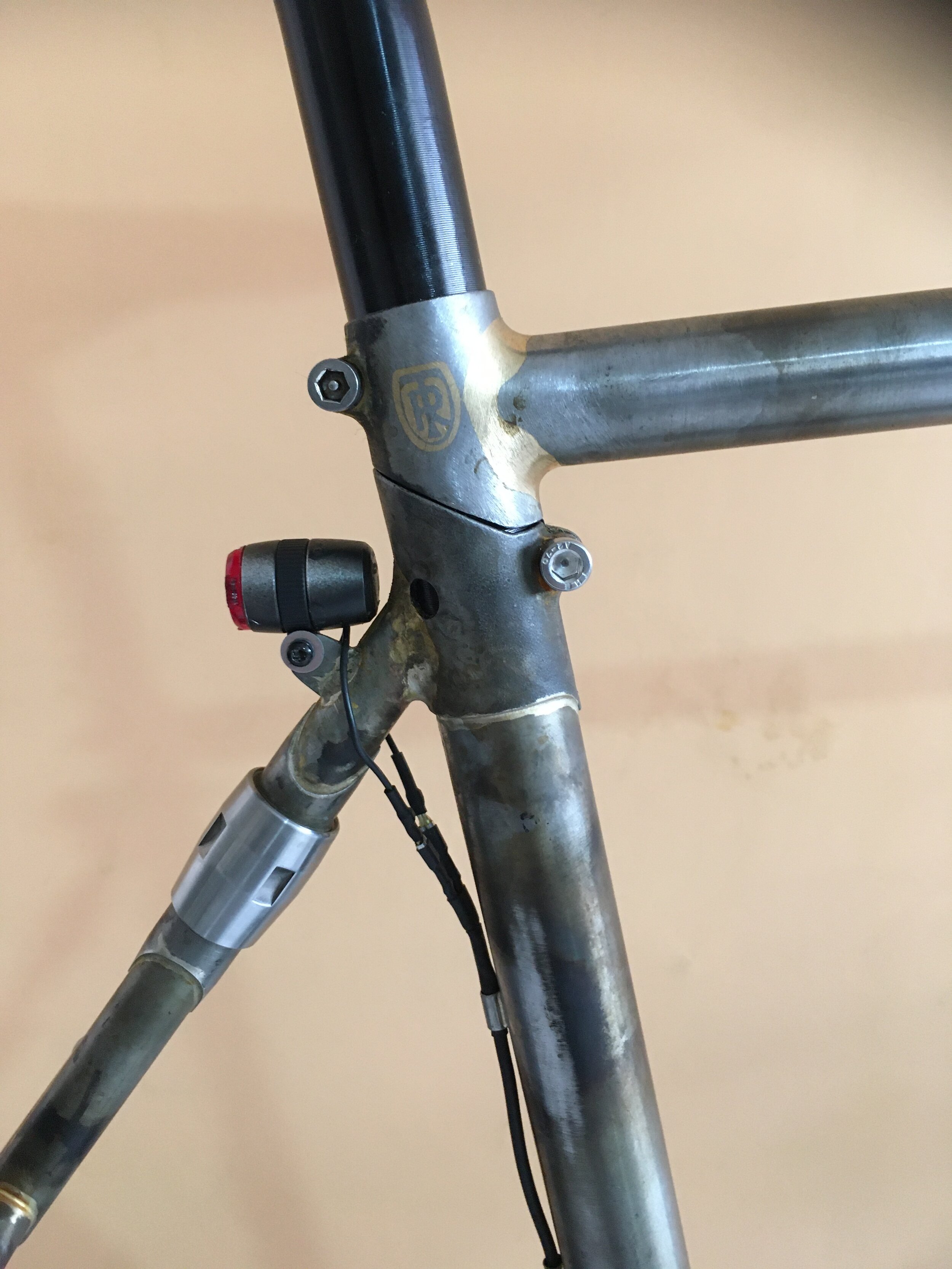
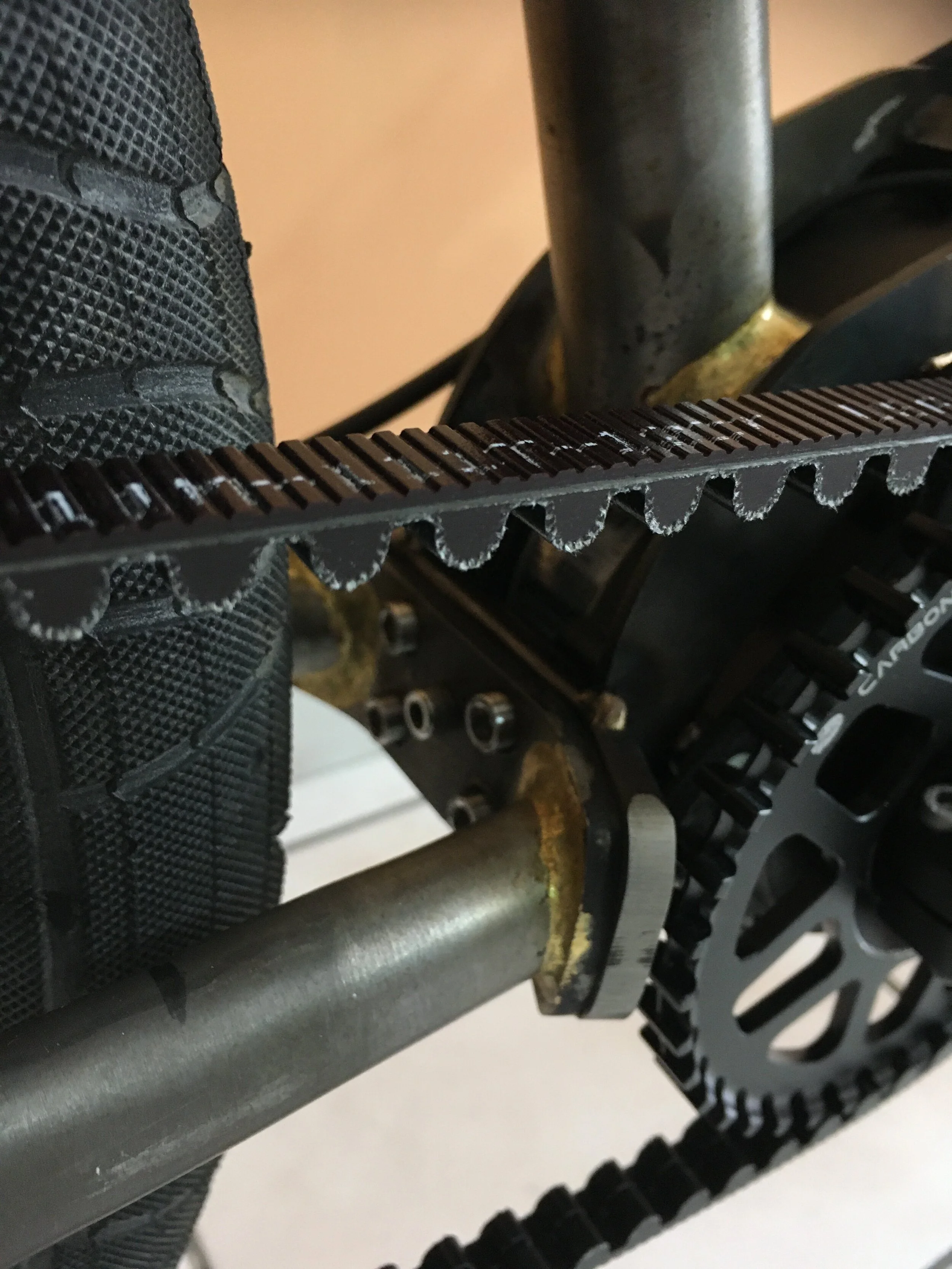
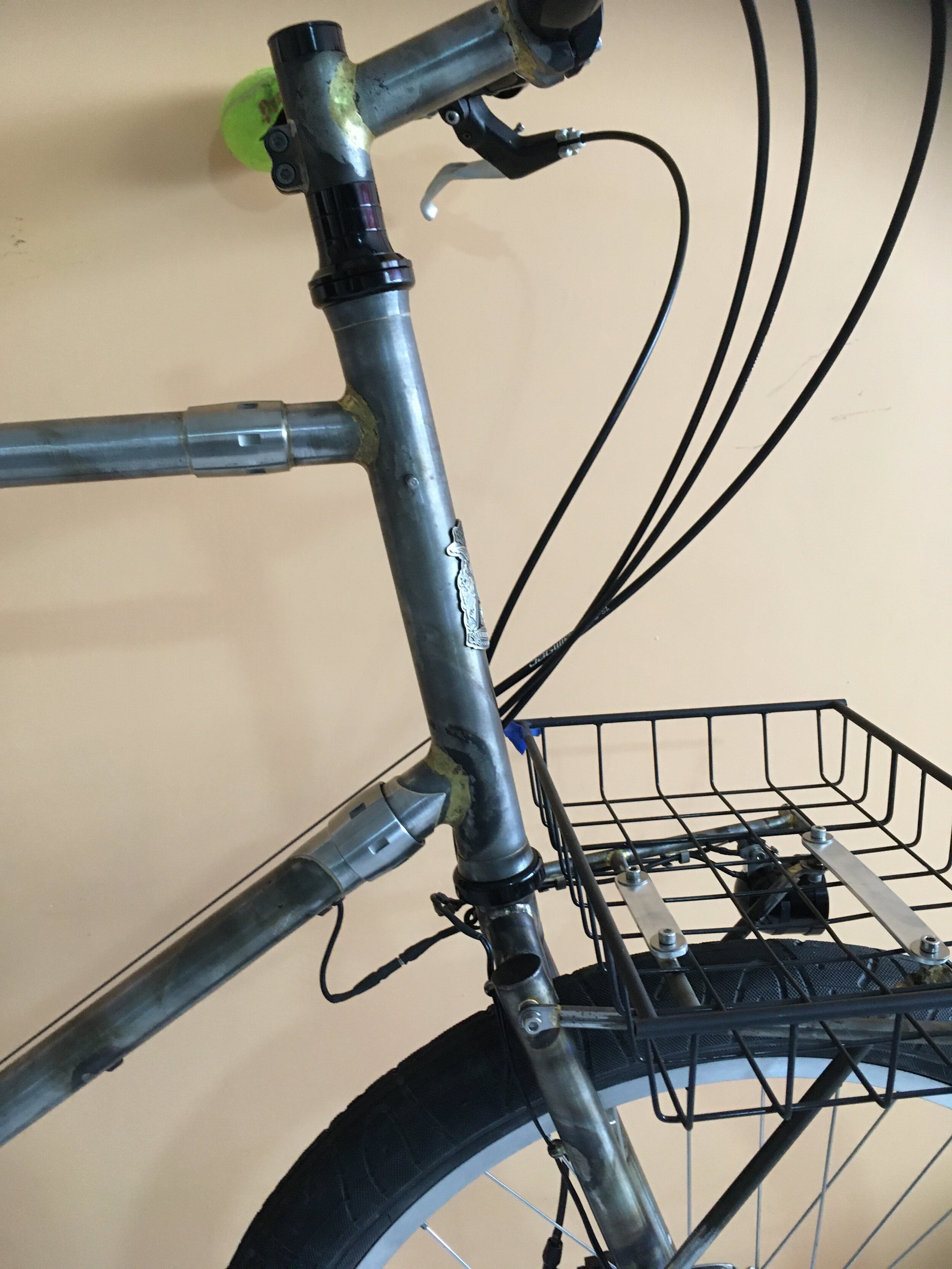
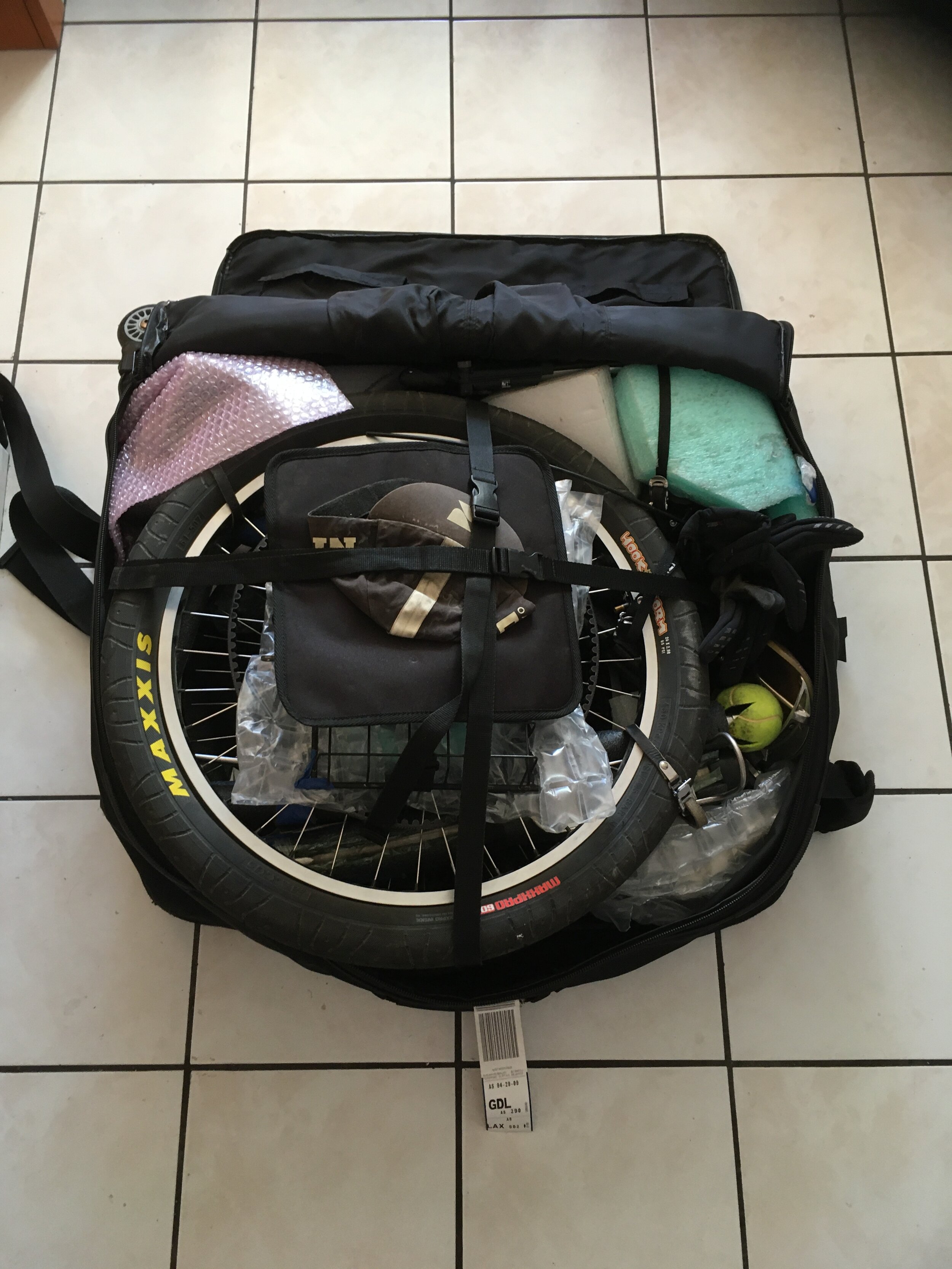
This bike is a little crazy, how it breaks apart: two S&S couplers up near the head tube, a Ritchey breakaway seat tube and down tube coupler, a coupler on the seat stays, bolt breaks at the rear dropouts, and even the chain stays are removable. The biggest part to pack are the wheels — 24” rims with 2.5” tires. Bomb-proof wheels, they’re heavy, but I don’t have to worry about them getting damaged in transit. I was grateful for the gears — Guadalajara is mostly flat, but on my explorations I did periodically find myself on some long steady inclines. Building and disassembling the bike, including packing and unpacking, took me about 1.5 hours each way. I could have done it faster, perhaps, but I was in no hurry. If I built it again there are a couple of small things I would change, but not much — all in all the bike was a success. And it was a perfect bike for exploring the city, and for commuting to and from my Spanish lessons. 

Old Wall

That’s right, while I was in Guadalajara I took a half-immersion course, 2.5 hours per day of lessons at a school affiliated with the university. I’ve taken a lot of Spanish over the years, and I’m still far from fluent. But everything seems to help. Of course it’s not easy, at least, not for an aging person like me. I may be slow, but I tend to retain what I’ve learned pretty well. I’m better when I practice, but that’s like anything. It’s the same with bike building or paragliding or computer programming or yoga or chess or woodworking or writing: If you hate it or are afraid, or just don’t care, you’re never going to progress. It requires enough discipline to persevere from moment to moment, for years, even when tired, or feeling bored or lost or frustrated; in my case, to view the language like a puzzle that I really want to solve, even knowing it could take a lifetime or more to “get there,” wherever “there” is. Fluency, or something close to it. 
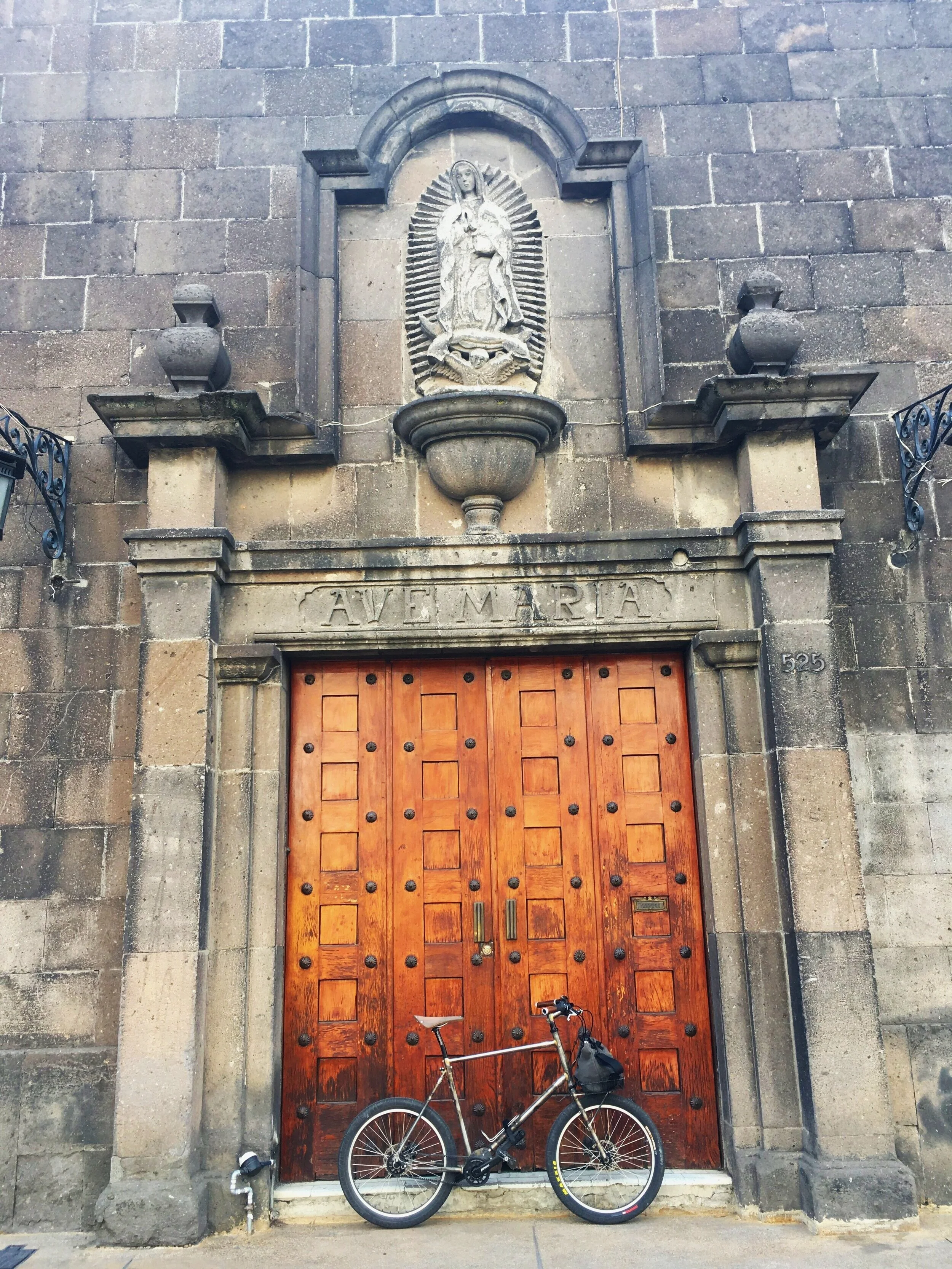
Old Door

Old Door

The other goal I set for myself in Mexico was to give myself time to write. I’ve written this long, book-like thing, a memoir, and it still needs a lot of time and editing. So, that’s what I did — edited and rewrote. Isolation in a distant land, where my phone doesn’t work and internet access isn’t reliable, where there’s no one knocking on my door, and no bicycle work that I can go escape into — it can feel pretty lonely, but it does wonders for the written word (at least, that’s what I keep telling myself). Writing is the hardest thing I’ve ever done. Maybe not moment to moment, but definitely cumulatively. For what its worth, the Spanish lessons were a good reason to get out of the house, and out of my head after several hours of writing. My choice was that, or or lots of cerveza, and of these two options only one is really sustainable. 

Crossed Paws

I left Guadalajara early one morning last week, and as the taxi drove me across town to the airport I had a brief moment of nostalgia that I felt I hardly deserved. My time was so short. As we passed the big blue cathedral on Calzada Federalismo I thought about the skaters I’d watched in the park just across, and the huddle of black and orange cats I’d seen pressed up against a tree, sleeping. We passed one of the backroads I’d frequently taken on my bike and I thought of the patches of graffiti that were within a few blocks, one in particular of a giant fish with a man on its back, riding it like a jockey. 

Fish Jockey

In the cab we passed the flower market on the other side of the road, with their elaborately sculptured bouquets, and the tortillaria where I’d bought tostadas and met the old man who told me in broken English that his name was Eugene, he was 87 years old, he’d lived in Chicago twenty years ago. “Welcome to my city!” he’d said proudly, sticking out his gnarled old hand for me to shake. 

Un Amigo Sucio

These moments and memories stacked one with another as my taxi drove me onwards, and I knew they didn’t mean much, except these are the very first grains of the structure that would, if I stayed, eventually build a community. But whose to say — maybe I’m building my world community. 

The whole trip came and went in that one taxi drive, and even now as I sit at my writing table in Portland, the distance grows and the memories that don’t get built into stories are already fading. It’s been just over a week, and how much have I already forgotten? The language is the medium, the stories are where the memories stay alive. 

Sunset at the Ocean, Sayulita Beach

I did make it to the coast for a short time, to Sayulita and San Pancho, hip little towns north of PV. Whatever sun color my skin acquired is quickly fading to my usual winter paleness. Yesterday there was snow on the ground when I woke. This morning it’s mostly gone. I’m kind of sick, but on the mend, some kind of flu, and just about everything in Portland is closed down as we all go into a nation-wide quarantine. This virus is a great equalizer — it doesn’t matter who you are or what you look like or where you live, we’re all susceptible, and we’re all at least a little bit scared. I feel for everyone whose lives are being deeply affected by this, either directly by the sickness itself, or by job closures, or the falling off of business. These are some wild times we’re in. 

One hope I have is that this shake-up we’re receiving will cause us (we the people) to step back from the usual noise and political shouting and remember that at the end of the day we’re all alike, because we’re all human. We all essentially want the same things: to be healthy, happy and free. And we need to figure out how to get there, together. Because of course it is possible. 

Freo

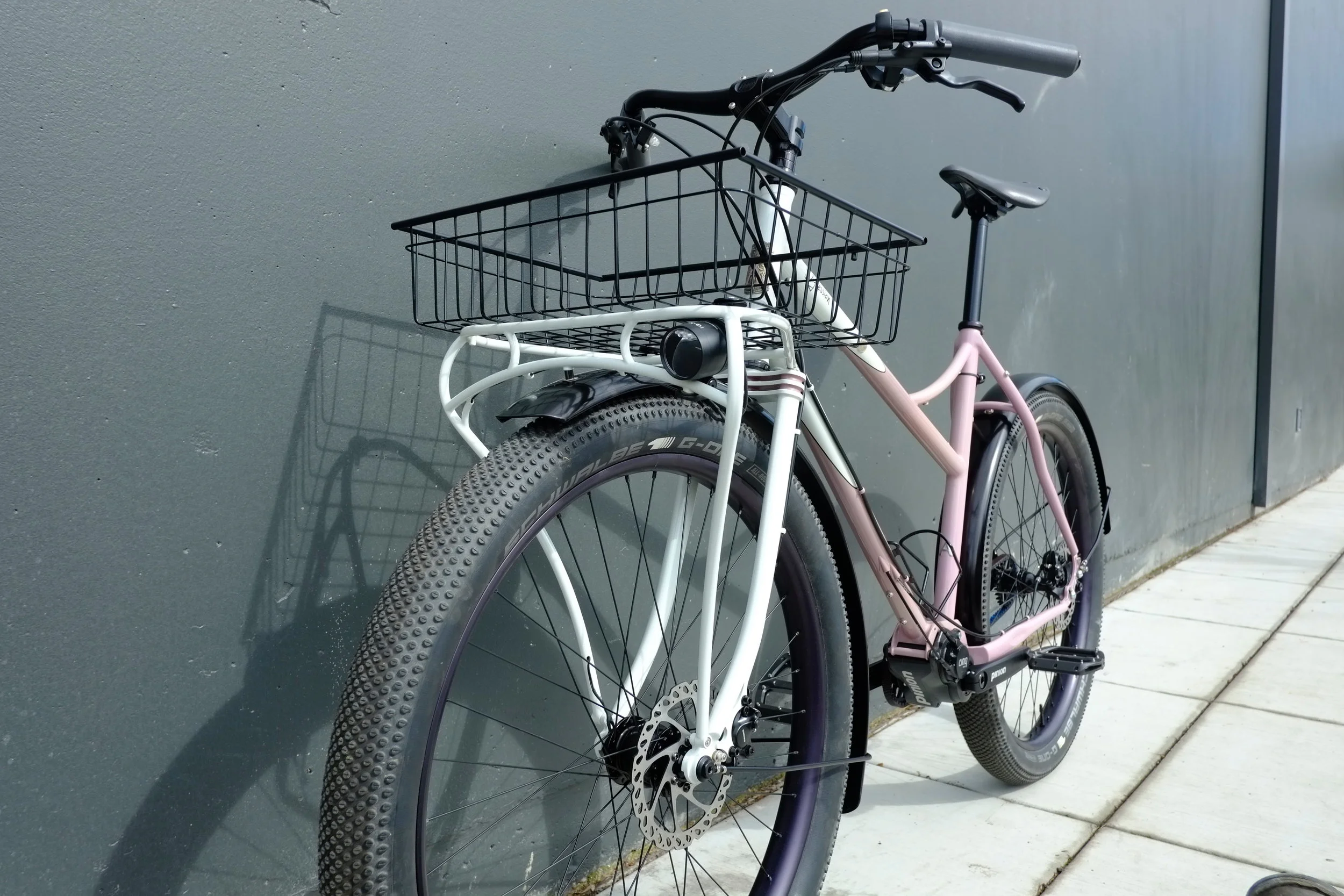
I don’t know if I have the virus, but I’m staying pretty isolated right now. I feel like I’m getting better, a little more each day. I’ve been spending a few hours each day at the shop — my cave — working on the next bike. It’s Pinion commuter, belt drive, disc brakes, generator front hub to power lights front and rear. A straight up functional bike for life. After my trip it feels good to put my hands back on the tools I know so well, to let the tool-smart part of my brain come back online. I brazed a fork crown to a steerer yesterday, the torch felt comfortable and familiar in my hand, the dialogue between hot steel, flux, and molten brass. A language that I’m very familiar with.

Watching

At home we have a new cat. A big orange fellow named Freo; 19 pounds of furry love. He likes sharing the bed, walks across my chest while I sleep, puts his nose to mine and purrs until I wake up and pet him. Selfish beast.

Let’s be safe out there, alright? Keep it simple and do good things for your health, everyday. If you’re up for it, go for a walk, or for a bike ride. Stretch, and keep breathing deep into your lungs. You’re lucky to have them. 

It’s a scary time, for sure, but remember to be grateful for the good things you have. 

As they say: This too shall pass. 

Another Passing Day
Digression — Does it matter how a bike is branded?

Joseph Ahearne5 Comments

A brand is a story. It tells us something about the company behind the products we use, and ride.

Digression vs. Primary Concern

When I break tradition by not branding my bike in a certain way, I’m telling a different kind of story.  Or I’m asking a different set of questions. 

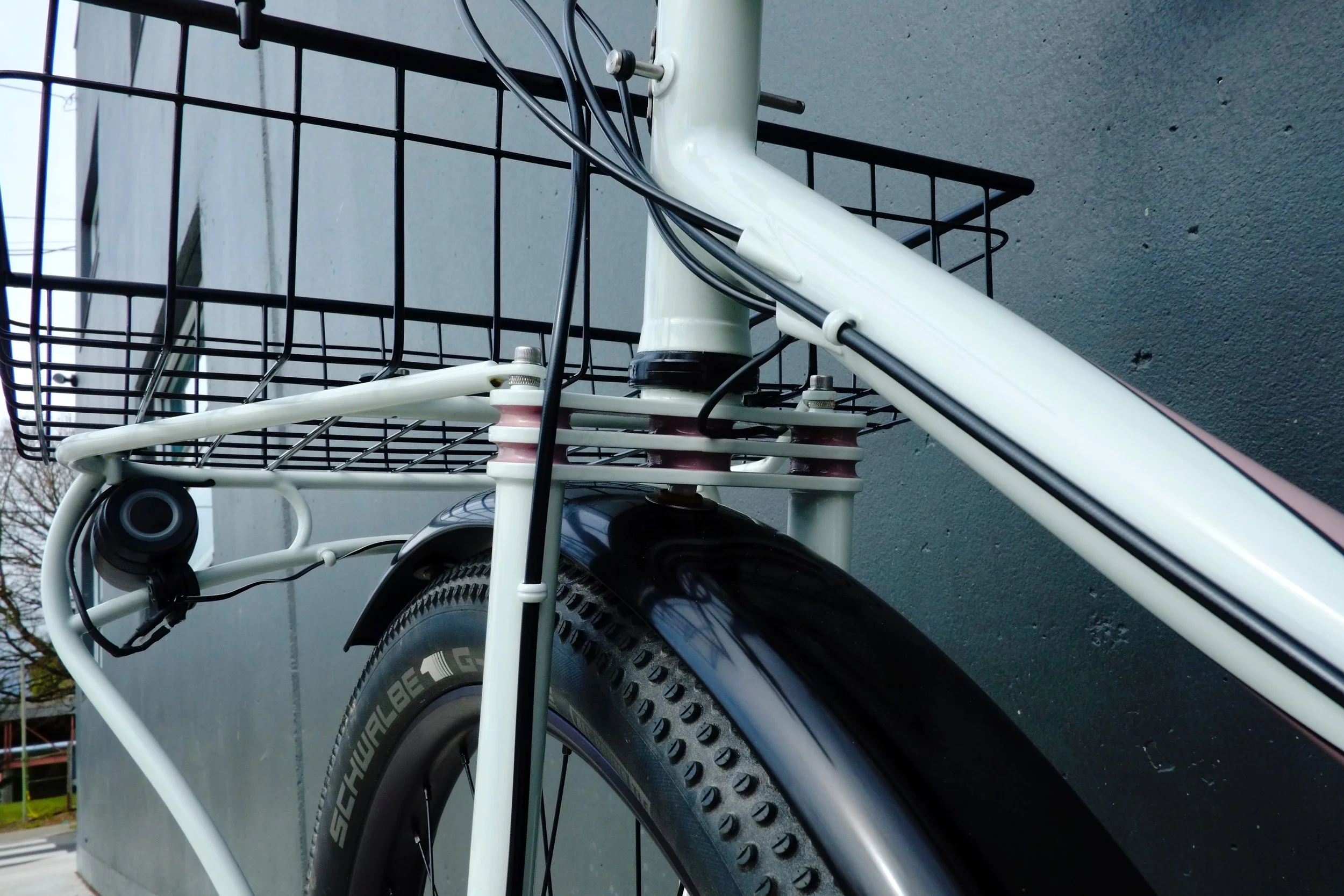
Three plate crown

Three plate crown

Why can’t we have a Brand of One?

What is the Primary Concern, and what is Digression?

In the world of hand made bicycles, brand identity is a builder’s reputation. I have to work hard to build the best bicycles I can, and I have to stay true, and pay attention to every detail, from raw material to final, rolling product — this is what makes my name what it is.

What about one-off bikes, artifacts of their own classification? A brand digression, outside the norm. A stand-alone piece. How do we separate, to some degree, the builder from the bike? Not a prototype, but a fully formed idea that starts and ends in one moment; it goes out into the world with a totally unique identity. 

I think there should be a place in the world for such artifacts. Especially in the world of bicycles. 

Staying within tradition shows respect, and implies there’s integrity that goes beyond the individual object, connecting this bicycle to all the bicycles that came before it.

But, I made this by hand. It is unlike any other bicycle in the world.

 It is; and then again, it isn’t. 

Hand Made

Hand Made

When does following tradition stifle a person’s creativity? When we build bikes, are we meant to be creative, or just crafty? They say everything has already been done. Why, then, would I try anything new, if I believed nothing new existed? 

Tradition implies limitation. A set of parameters within which we are expected to stay. Who wrote the rulebook, anyway? Why shouldn’t I amend it, make it my own? Wouldn’t this exploration help me define my own relationship to tradition? 

I’m a bike person; I want freedom. 

I don’t ride bikes because I want to stay on the main roads.

How Ahearne Became Ahearne Cycles

Joseph Ahearne6 Comments
Rotated stainless logo 2.jpeg

What Not to Name Your Bikes

When I first started building bikes, I wasn’t doing it for the business of it. I didn’t know or even think about creating a brand. I did it because I wanted to make cool stuff, to play with fire and steel. But a year or so in, after having made several bikes (for the cost of tubes — my labor mostly free), and custom racks, I needed to figure out something to call my bikes. A brand was forming, whether I wanted to admit it or not. I most loved the look of the un-branded bike — no language at all on the parts or the frame. But the idea that someone would pay me for a bicycle I built with my own hands was a revelation that was beginning to dawn. Just amazing, I thought. But I needed some way for people to to find me, to find know my work. I needed to name my bikes, and name my business. It seems so obvious now, and so easy, but holy hell, that was one of the most difficult decisions of my life. 

Hand made bikes are traditionally branded with the name of the builder. In the 1980s & 90s, as the industry grew in the USA, mainly because of the rise in popularity of mountain biking, the way of naming bike brands shifted, becoming more like that of cars — naming them for “things” rather than the people who made them. 

Of course, naming bikes after people continued, but what were bicycle business owners to do if their names didn’t lend themselves to bicycle branding? Often bike branding includes elements of what is “cool,” or somehow implies speed or strength. But what were you to do if your last name was something average, pedestrian, or was in competition with other brand names? For example, what if your last name was Smith, and you had to compete with a much larger maker of eyewear? Or what if your name was Johnson? Who could keep a straight face when asked what kind of bike they ride?

“Oh, I ride a Johnson.” 

Hm, I bet you do. You can see how well this might go over with weekend warriors and racer A-types out to conquer the competition, all muscle-hustle and panting in their spandex.

As a side note, and speaking of Johnsons, if you haven’t seen The Big Lebowski, then I’d suggest you do so in a great hurry, for you are missing out on some classic American cinema. 

As a double side note, in regard to bike names, I did for a moment consider calling my company Nihilist Bikes, although I can’t recall if this name was inspired by the Lebowski film. Abide Bikes, though, definitely was. White Russian Frames & Forks. Dead Donny Bikes. I could keep going. Shall I keep going?

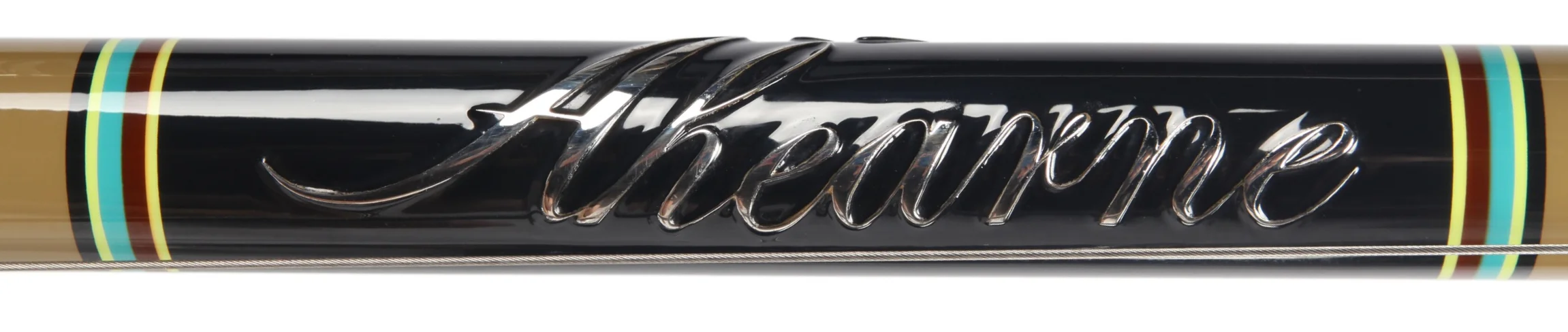
I was so resistant to using my last name. Nothing about the name Ahearne seemed right for bikes. It didn’t point toward anything like speed or strength, royalty, flight, elegance. I felt like there was no ring to it. It has too many vowels; and how was it pronounced, anyway? Accent on the A, or accent on the hearne? (For the record, for my name, accent is on the A. Other people with the same name may pronounce it differently, though. Even within my own family. Call it Irish American confusion, I don’t know…). 

Logo image red.jpeg

Another thing was, I could be insecure when it came to anything that sounded personally boastful, and what could be more boastful than associating my name with a brand, and something I hoped was (or would become) high quality? I was just discovering the nature of the business I was building — I could hardly admit to myself I was building a business at all. But there it was: I wanted to make a product that people would talk about, and want to buy, and calling it by my own name was somehow a lot to ask. It’s a strange and self-defeating insecurity, I know, but I’d be lying if I said it didn’t factor in.

What the name Ahearne had going for it, though, was that it was unique enough in America that I didn’t risk overstepping some boundary with another brand, and it didn’t point at some cultural reference that might embarrass anyone. But still, it just sounded weird to me.  

In my resistance I experimented with a lot of other bike names. I tried Grimace Fabrication, because I frowned a lot, but people told me it reminded them of this purple cartoon character in the fast food world. The Grimace idea went far enough that a friend, Evan, hand cut a couple of Grimace logos from vinyl, kind of graffiti style, and I stuck them on the down tube of at least one bike. Maybe two. Today, thinking about Grimace makes me wince, and then smile, alternately, which is good for toning muscles in the face.  

Another idea I toyed with: When I was born my parents had, for a minute, considered nicknaming me Mojo. I thought, Could this work? Mojo Bicycle Manufacturing, perhaps; or MJM Studios, as another quasi-Hollywood reference. Like the nickname, though, the Mojo idea got quashed. I got called Joey instead. Which, no, never mind.  

I thought about Sour Head Bikes and Apocalypse Bikes. Blank Stare Frames. Fisher Price Bikes (as a decoy). Stolen Bikes, until I learned a BMX company already thought of it. Could I steal it back? Some names just got silly: Pistol Grip Frames; Big Dick Bikes; Monster Attack Custom Fabrication; Sad Life Bikes; And so on. I could do this for hours. 

What eventually happened was, I built a bike for this guy, Mike Wolfson, a friend from the bike shop where I worked. It was maybe my fifth or sixth frame, an unbranded single speed, lugged, with a smokey clear powder coat. I’d ordered frame materials from this obscure distributor in England, and the lugs had long barbed points that sleeved over the tubes and made the bike look gothic and tough — it was by far the coolest thing I’d built. 

When the bike was all finished, before giving it to Mike, I put it in the work stand in my garage-shop, drank probably eight beers and just stared at the frame for hours, touching it, stepping back, shifting the light, looking at it from different angles. 

“I made this,” I kept thinking. “With my own hands.” It was a moment of personal astonishment, of almost disbelief, that I could produce something so beautiful. I was finally gaining a bit of confidence in my skills. I saw my progress as a bike builder, it felt like I learned so much every time I lit the torch. 

But by this time, more than a year into this business, I still wasn’t officially a business, and I was distraught about not having a name. How would anyone every find me? No name, no website, just a bunch of anonymous tubes with wheels. If I didn’t name my bikes soon, I felt like I was going to die.

When I delivered the bike I told Mike Wolfson my troubles. “I can’t figure it out,” I said. “There just isn’t any name that sounds right.” He knew I’d put Grimace on a bike or two, but he’d told me from the beginning that he wouldn’t have that name on the bike I built for him. I was a little sheepish about it because I knew it was a stupid name. 

Vertical Logo

Vertical Logo

The day he got his bike, Mike finally said it: “Dude, your bikes are called Ahearne. It’s your name. It’s your bike name.” 

Simple as that. I needed to hear this, but I was like, Easy for you to say. You’ve got the cool name

Son of a Wolf. 

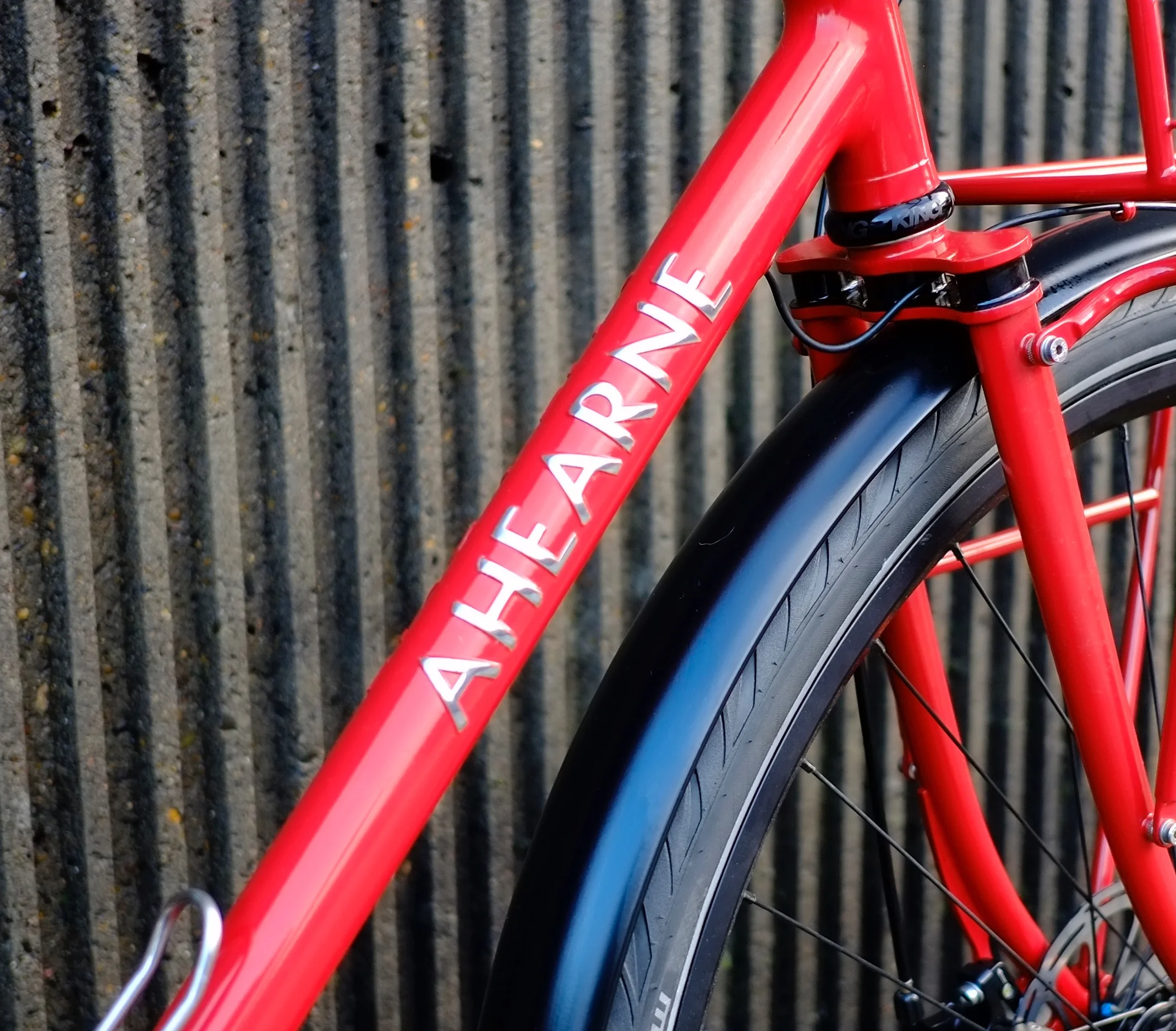
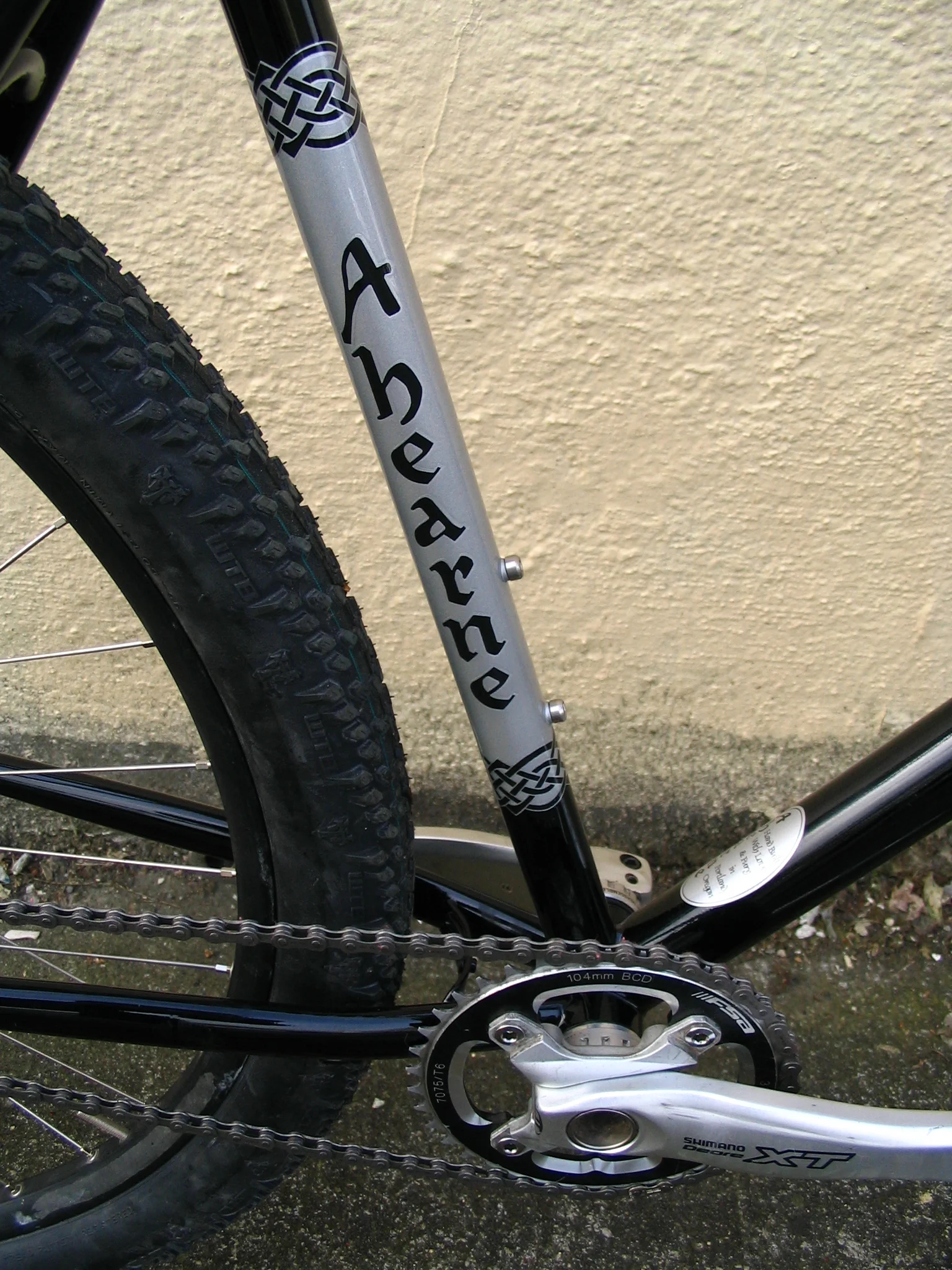
This was it, though. I knew he was right and I couldn’t avoid it anymore. I went to Sign Wizards that same week, picked through a giant font book until I found an Old English-style lettering I liked. Karla, a graphic designer, helped me by adjusting the size and letter orientation. I had a name, but I was still too much of a punk to want to put the logo on the down tube, as per tradition. I asked Karla to set the lettering vertically, stacked one on top of another, so I could put the logo on the seat tube. I had her keep it kind of small, but it was a start. I needed to warm to the idea. I ordered five sets of high quality vinyl logos in black.

Tradition or not, though, this was it; This made it official. I had a name. I had my name. 

My bike company was now called Ahearne Cycles. 

Written By Hand

Joseph Ahearne3 Comments
IMG_4838.jpg

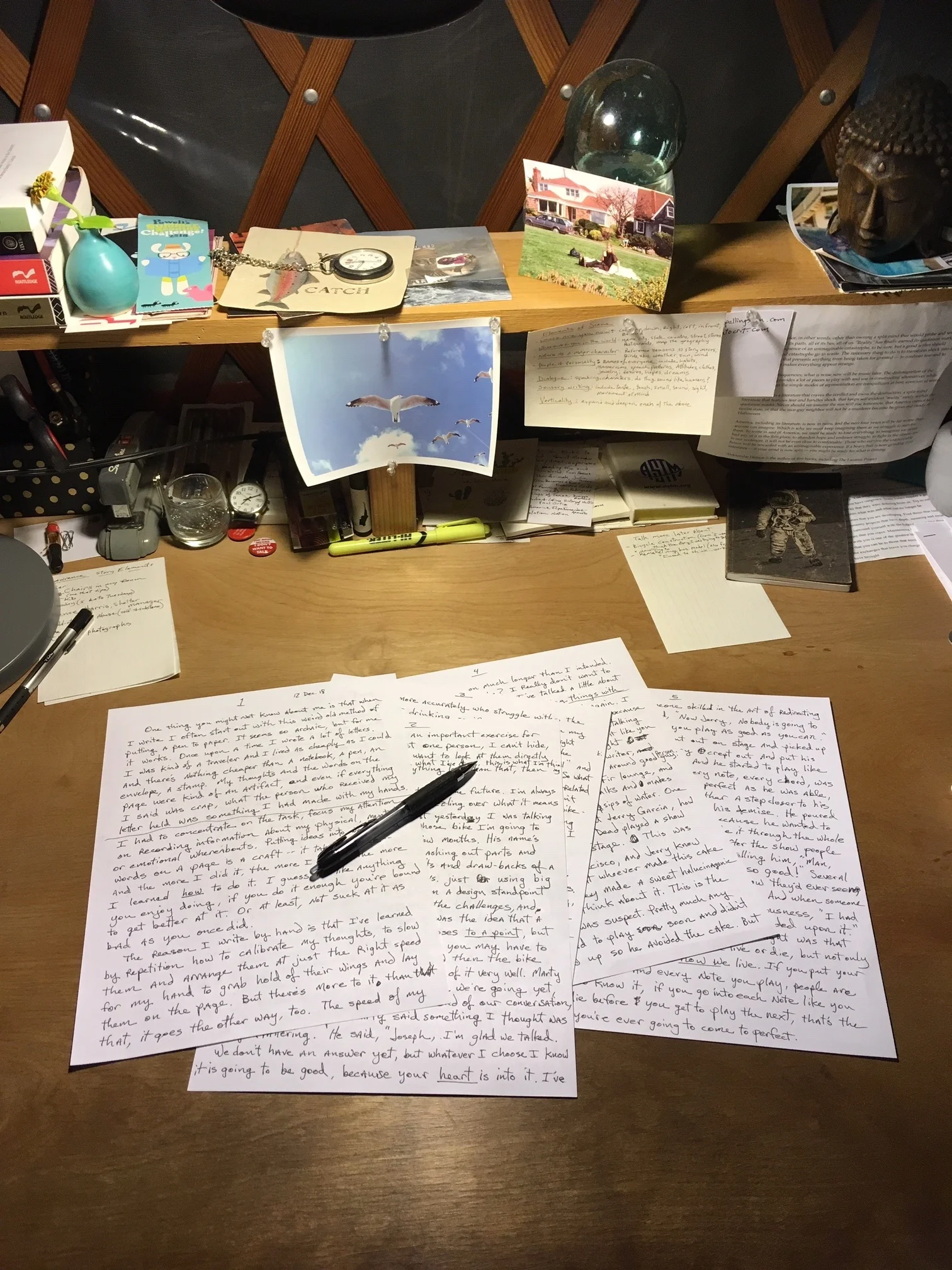
One thing you might not know about me is that when I sit down to write I often begin with this weird old method of putting a pen to paper. Maybe it seems archaic, but for me it works. I hand write the words, think about them, maybe scribbled edits, and then I transcribe them onto my computer. I guess it makes sense, because I seem to be the kind of person who uses his hands to make stuff. Like a lot of things in my life, there’s a story behind my preferred writing method.

Once upon a time I wrote a lot of letters. I was a traveler, meaning, I rarely stayed in the same place for more than a few days, weeks, months. I lived like this for a lot of years — you probably didn’t know this about me, either. I lived as cheaply as I could, and I’ve done a lot of jobs, lived in a lot of places — Portland, Seattle, New York, Kansas City, Boulder/Denver, New Orleans, Texas, Alaska, New Haven, and then in Ireland for a year, mostly in Galway; Barcelona for a few weeks; a couple of years in Italy, mostly in the town of Padova. I’ve also spent a bunch of time in Mexico and Central America. Just wandering, mostly. It’s a long story, which, I’m getting to it.

This was about a dozen years of my life, and for the first few years I hadn’t even heard of email (yes, I’m that old). I don’t remember exactly what year it was that I got my first email account, sometime in about 1995 or ’96. I wasn’t necessarily slow to take to it, but there weren’t often internet cafes in the places I went. In fact, my preference was to go to places where there wasn’t even dependable electricity. The way I kept in contact with people, mostly, was through letters. It made sense to me, because all I needed was a notebook, a pen, an envelope (which, in a pinch, I could make one), a stamp, a friend with an address to whom I could send it.

This was also before digital cameras, and I had some interesting ideas about photographs. I told myself (and others, if they’d listen) that I carried all the images I needed in my head. I said that cameras were just laziness, an excuse not to pay close attention to what you were looking at. I argued that if you exercised your mind, and looked carefully you wouldn’t need a camera, that memory is only as strong as you make it, and only functions well if you use it. I thought remembering things was like exercise, like you could take memory to the gym or something, force it into shape by doing reps, squats, crunches. I was kind of a dick about it. It was a bull-headed, pre-Instagram notion that I’ve mostly gotten past. I see what my point was, but still. I’ve learned that if you make yourself unlikable people probably aren’t going to listen to you. And besides, age has taught me about memory loss, and what few photos I have of my traveling days, I cherish, wishing I had at least just few more.

But so instead of photos I wrote letters. And one of my goals with letters was to use words to describe the scenery. Being like any other young traveler, I was searching for myself as much as I wanted to learn about this planet on which we live, its people and places. I was very existential, so a lot of the landscape I described in my letters — too much, I’d say — was located on the inside of my head.

The important point here isn’t that I may have been a crappy, self involved writer. What’s important is that my thoughts were transformed into words on the page, and these pages were artifacts, whether I thought about it this way or not. I think these letters were my first real practice of hand making something that I shared with others. And I like to think I got better at it over the years. In any case — I think this is the same with any practice — the more I wrote, the more I learned how to write. And the reason I kept doing it was, first, because I enjoyed it. Not always, but in my best moments I took a lot of care in the writing, and I mean a ridiculous amount of care, and I did learn that when I really put myself into what I was writing it maximized the joy I got out of it. And I’d like to think that it was these careful letters that my people connected with most, got the best imagery from, the most accurate portrait of how I was, where I was, and who, in whatever crazy situation I was in. Sometimes, but not always, I got it right.

The practice of writing by hand has stayed with me. I think the reason I still do it is that I’ve learned, over all the years, how to slow my thoughts enough that my hand can grab hold of their wings and lay them on the page. There’s more to it than that, of course, and it goes the other way, too: The speed of my hand helps rein in the spastic nature of my thoughts. It gives them some parameters so they’re not bouncing all over the place. If you’ve ever read anything about Buddhist philosophy you’ve probably heard mention of the concept of ‘Monkey Mind’. I feel like this is about the best metaphor for my thoughts — they jump around, get into things, are rabidly curious and impulsive, toss stuff aside, break the delicate things, swing from the rafters, eat all the cookies, crap on the counter and then run off, etc..

IMG_4842.jpg

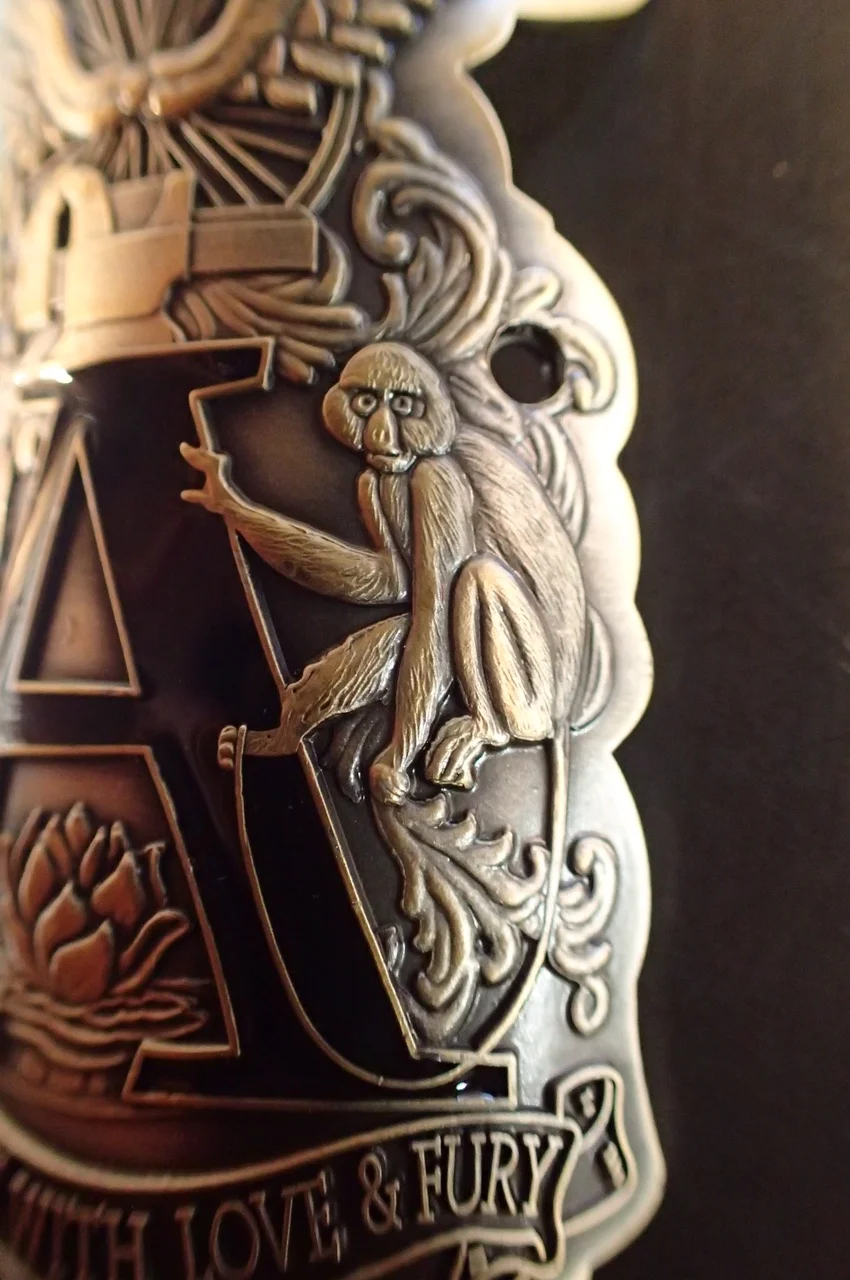
The image of the monkey on my head badge was taken directly from this concept. It’s a symbol of all that runs wild in my head, but do you notice how calmly the monkey sits? And that piece of his own tail in his hand? I like to think of it as a symbol of him holding a pen, of him writing with his own body, a way of recording himself, his stories. Although, it could be that it’s a pacifier of sorts: Holding onto a piece of himself as a reminder that he exists. But come to think of it, is there any real difference?

The forced effort of sitting with a pen can help calm my erratic thoughts. It gives them a job to do; it allows freedom through some sort of discipline — I can write about whatever I want to write about, but the deal I’ve made with myself is, if I’m going to make the effort, then I don’t want to write gibberish. If I translate my brain’s erratic mess directly to the page, if I could write or type at the speed of thought, there wouldn’t be anything worth reading. It’d be like a Rorschach blot, just a splash of language without any through line. So my hand writes as fast as it can and still be legible, and my mind slows the language down enough to be comprehensible, and somewhere in the middle the twain shall meet, and throw a little party.