Ahearne Cycles

A First and the Last

Joseph Ahearne2 Comments

This week is a landmark for me — I’ve finished work on the final frame I will make at the Page Street workshop. As I wrote in the last post, I’m going to be moving my workshop to the town of Newport, on the Oregon Coast. The move is coming September 1.

I have a couple of smaller projects to complete before packing my tools, and have a few parts assemblies to finish when frames return from paint. But it’s kind of wild to say it — No more frames will be built on Page Street.
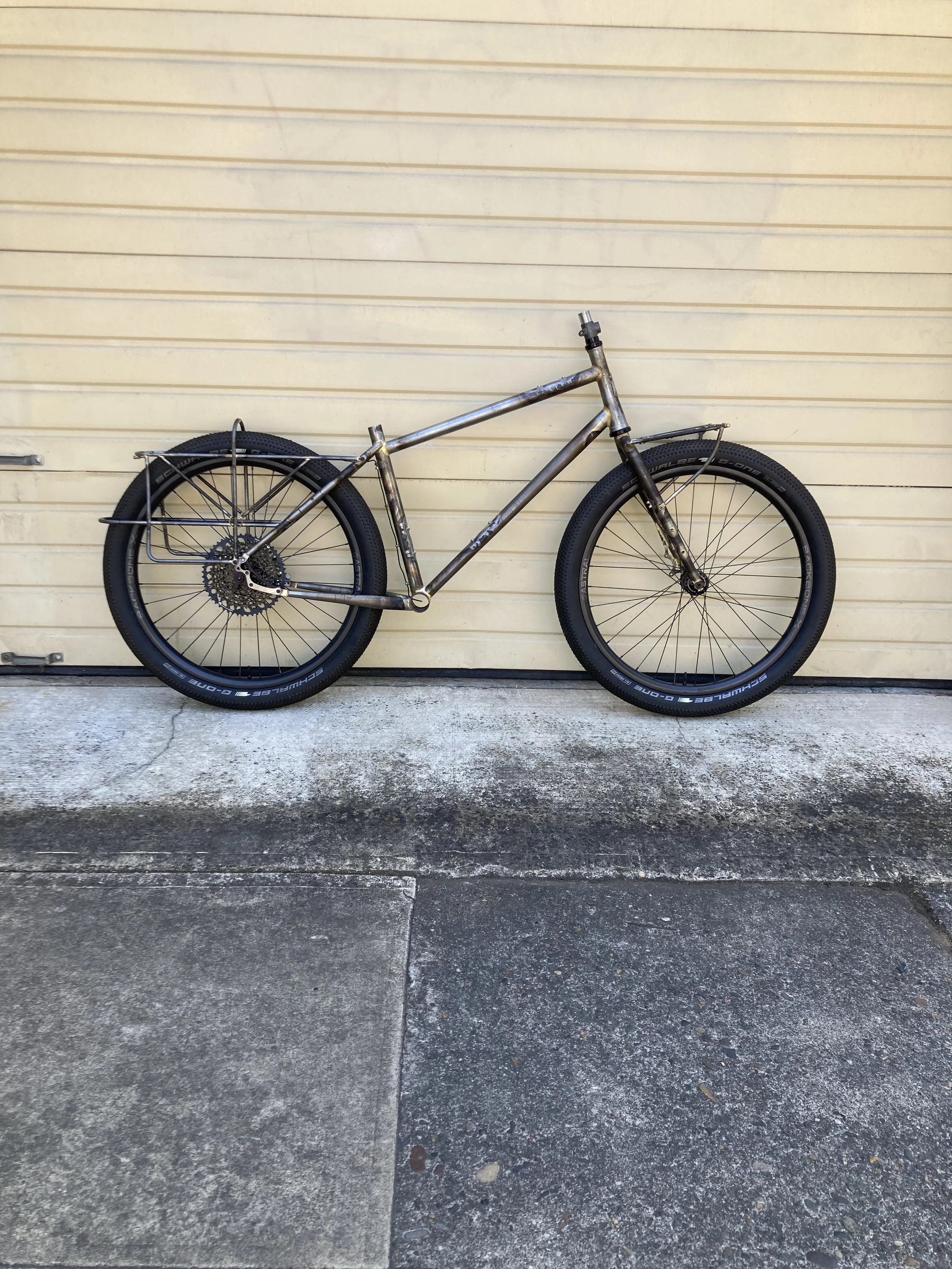
This last one…

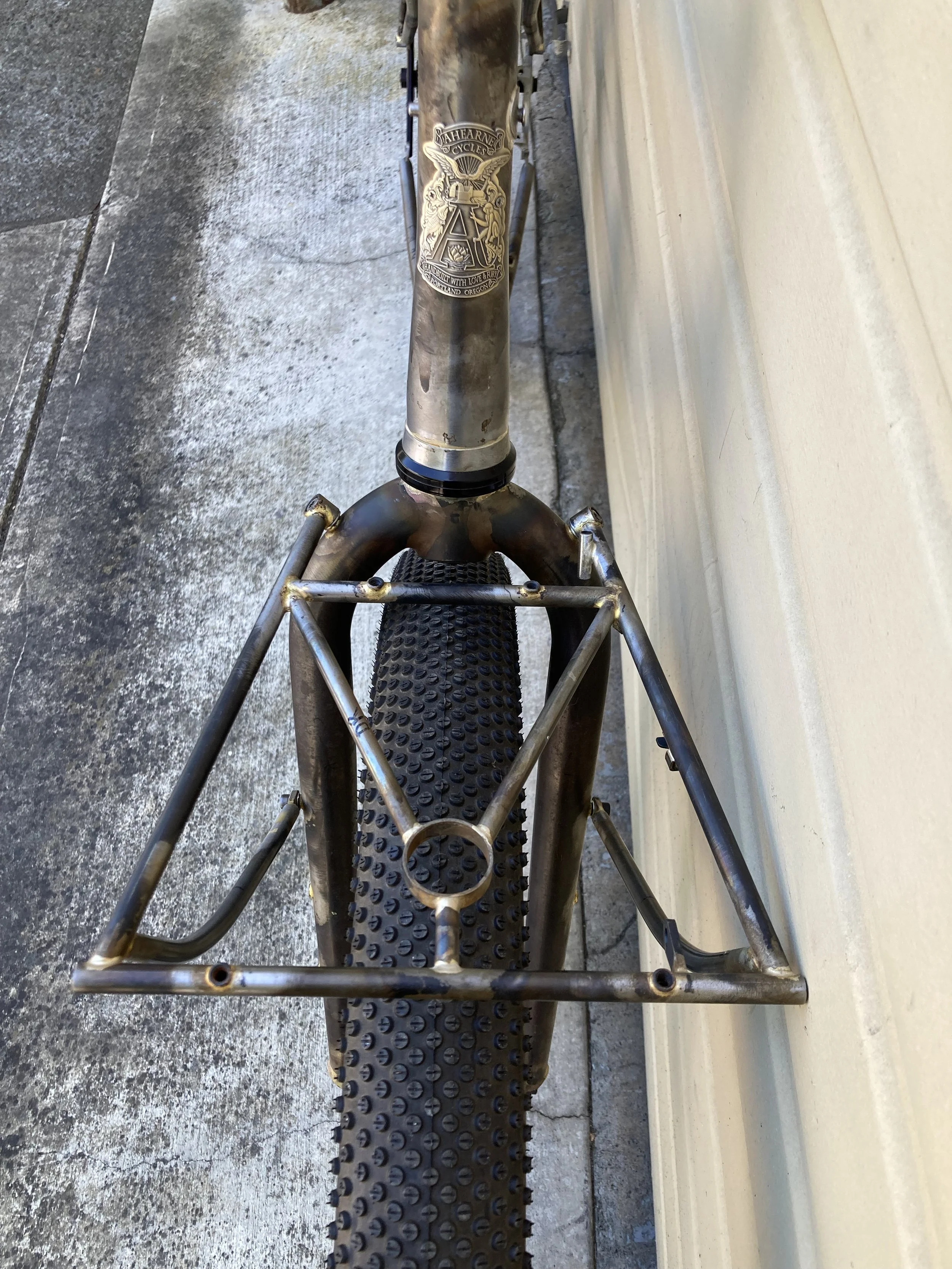
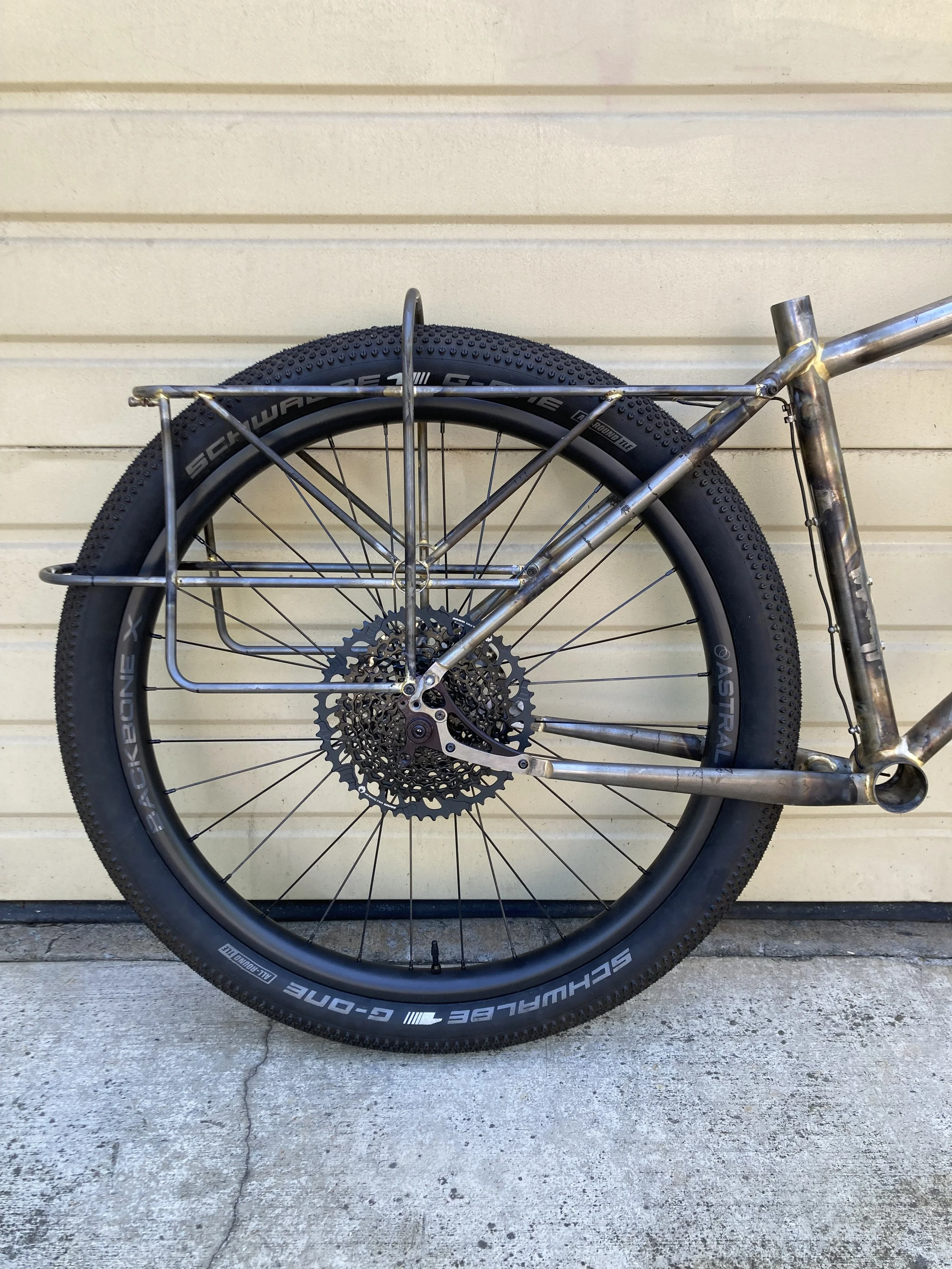
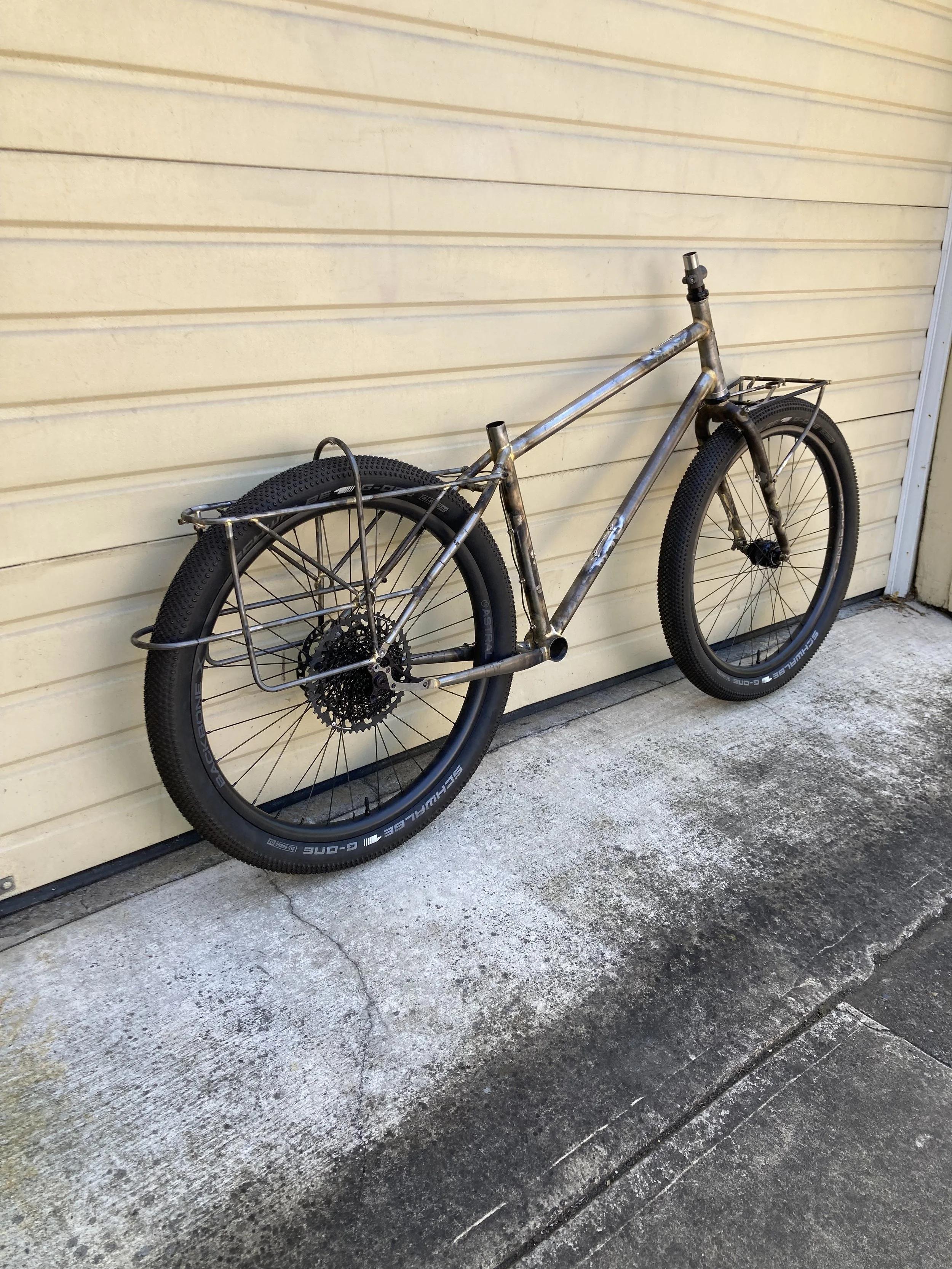
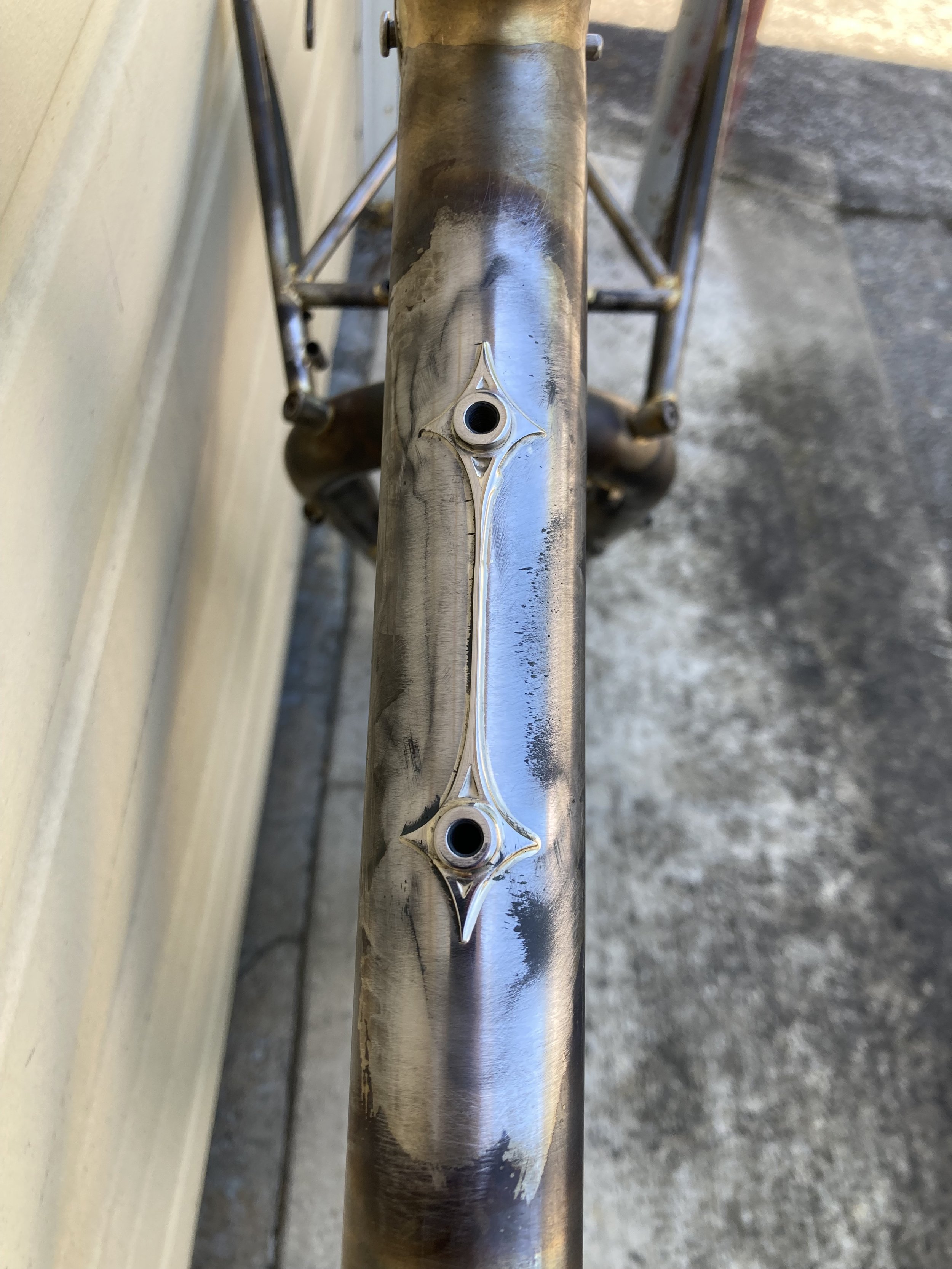
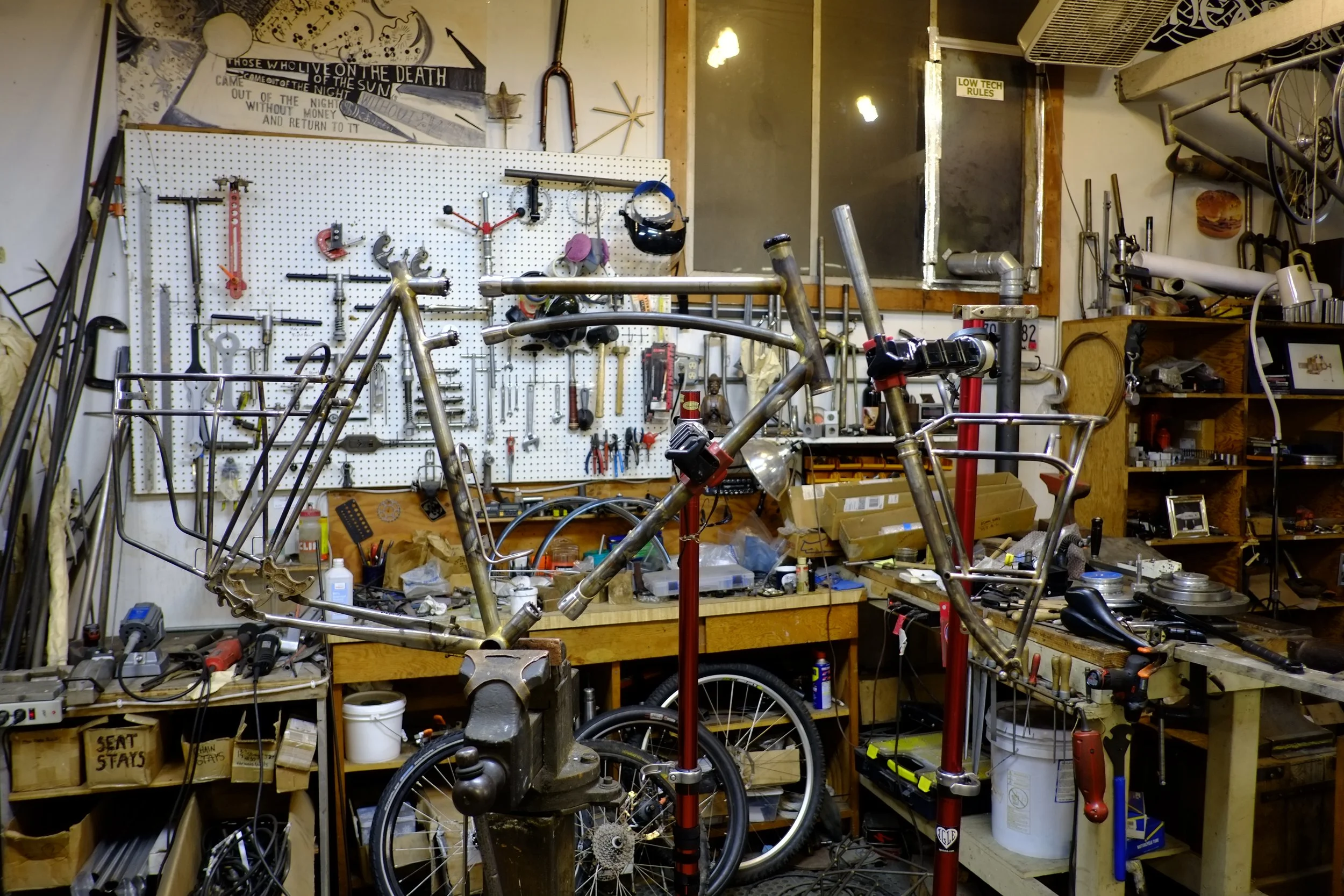
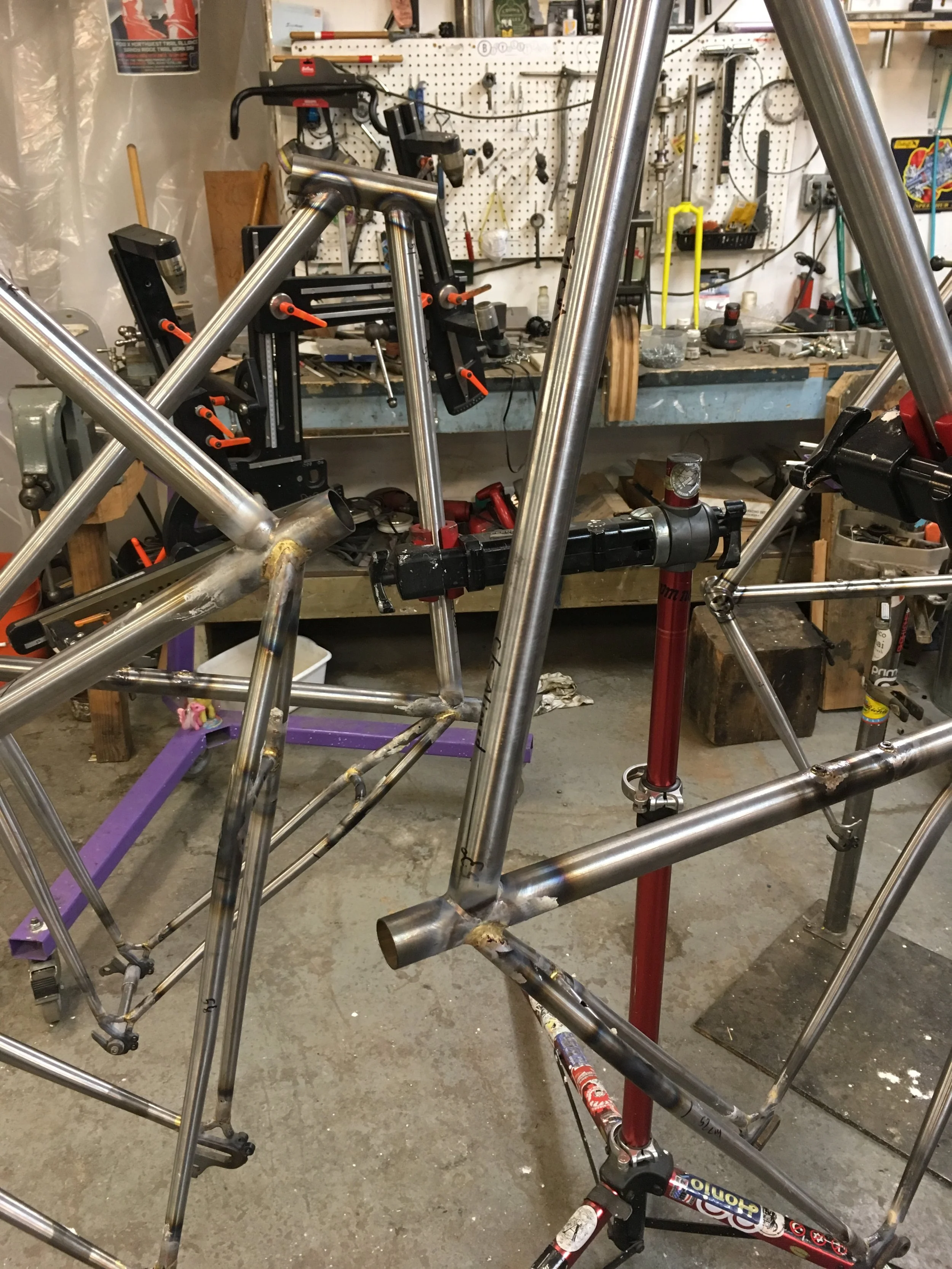
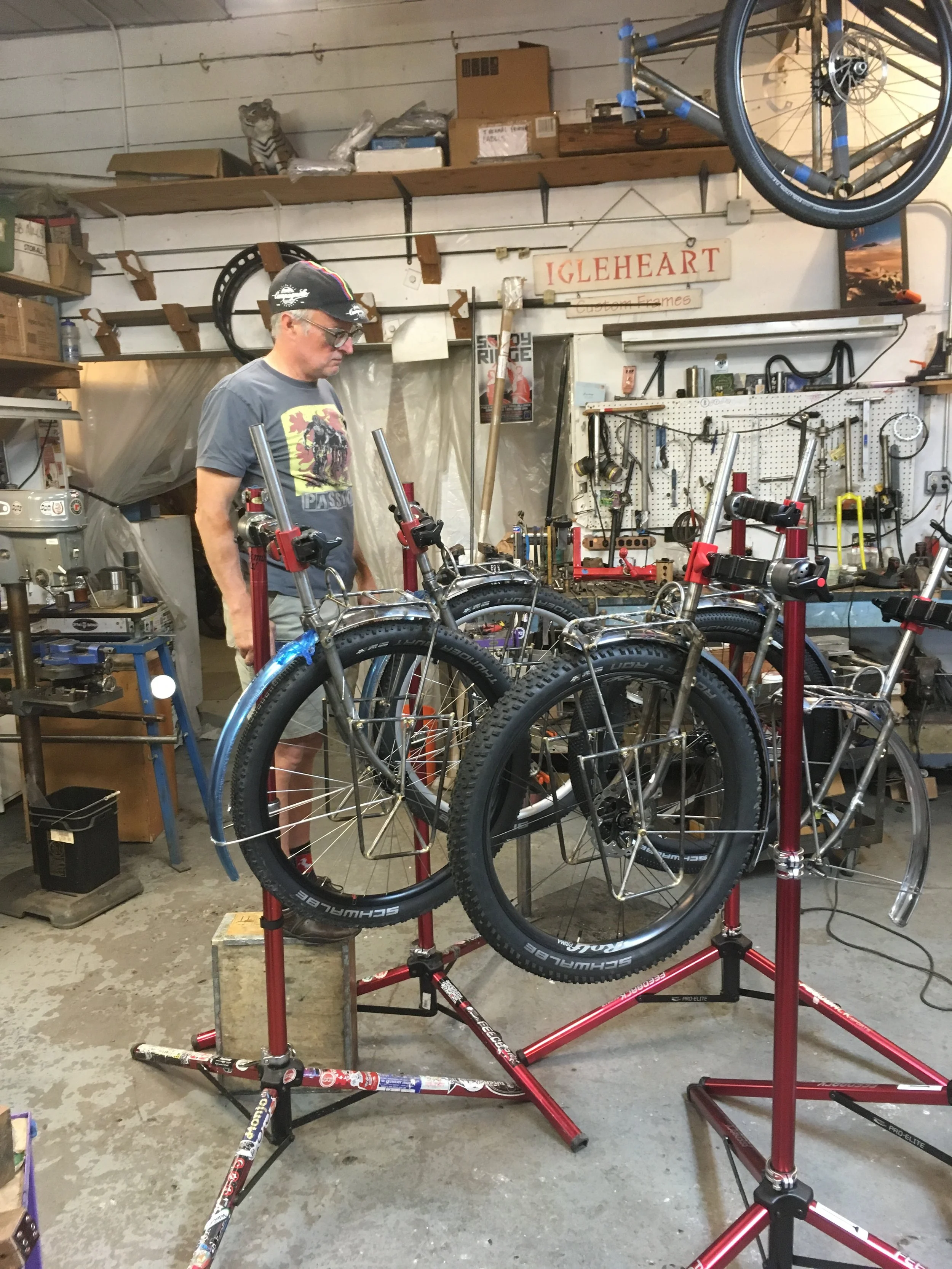
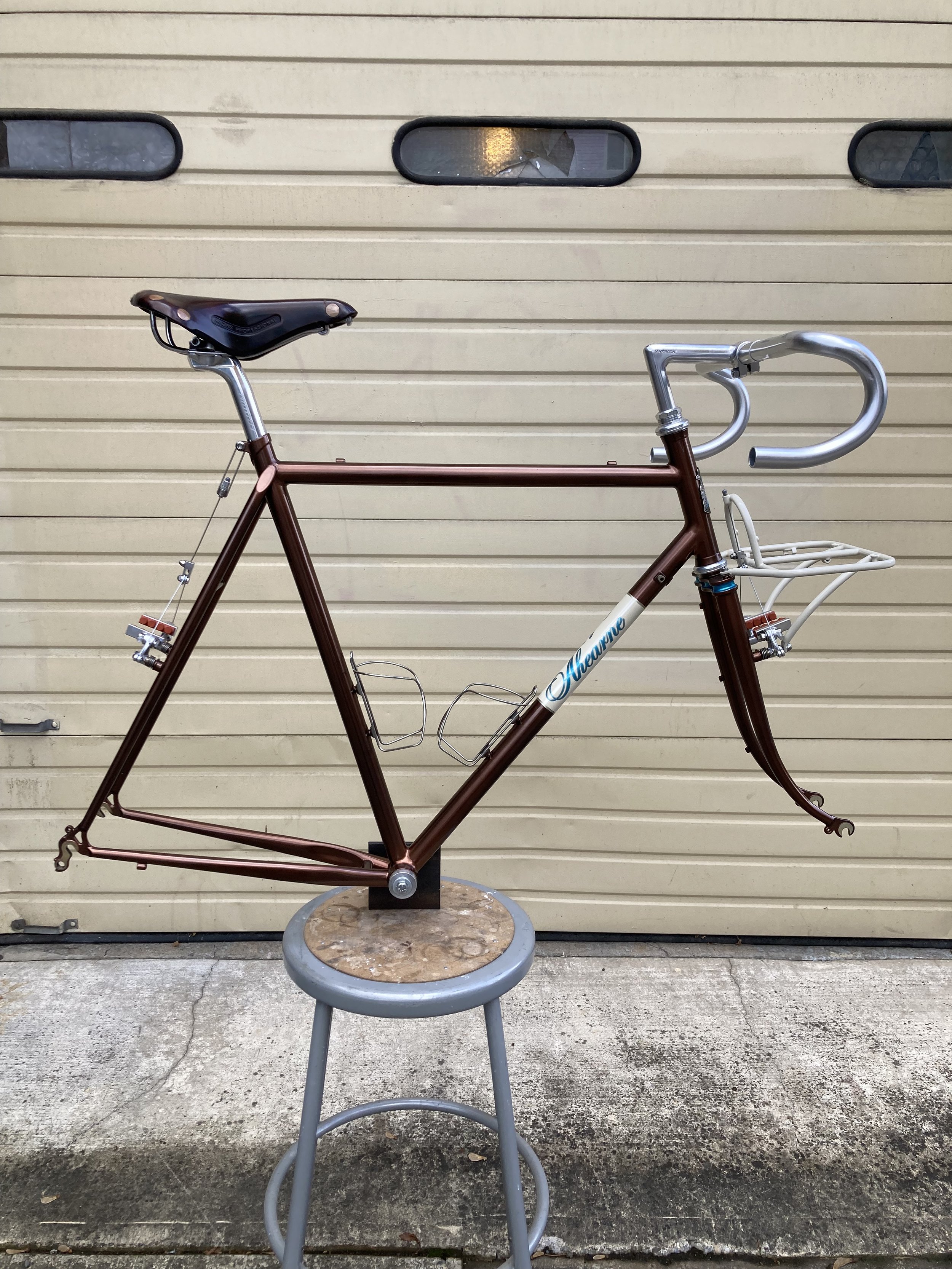
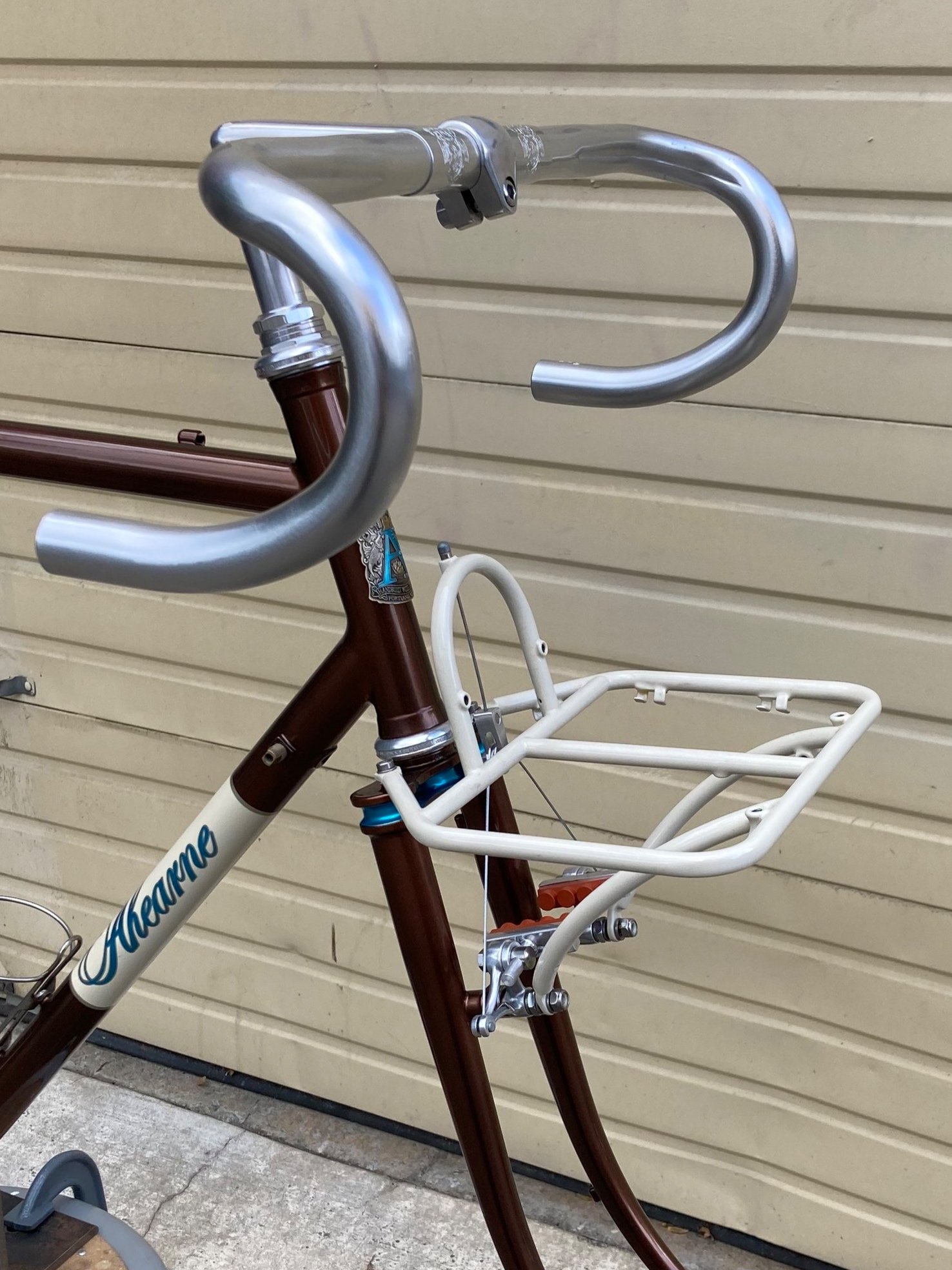
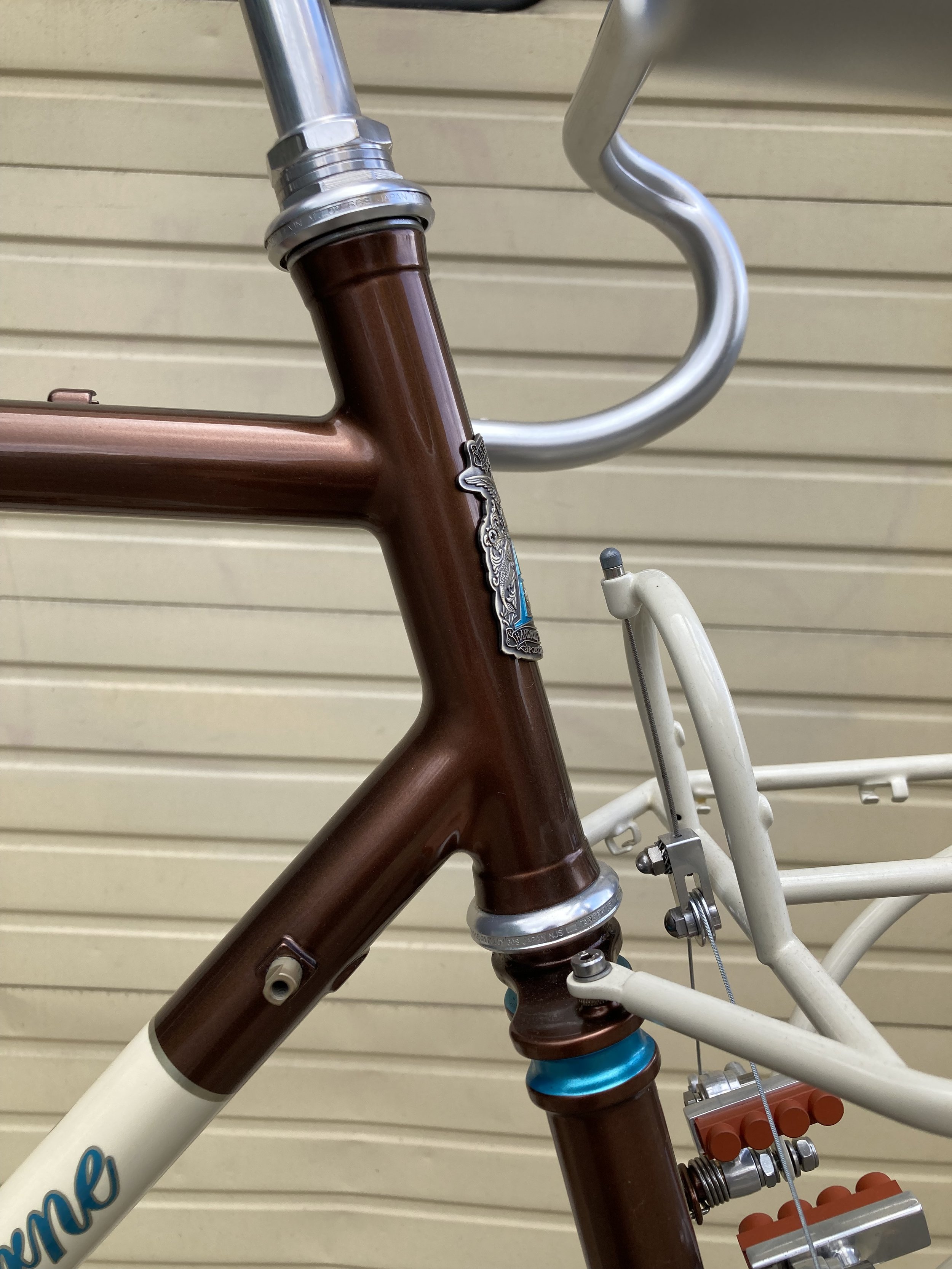
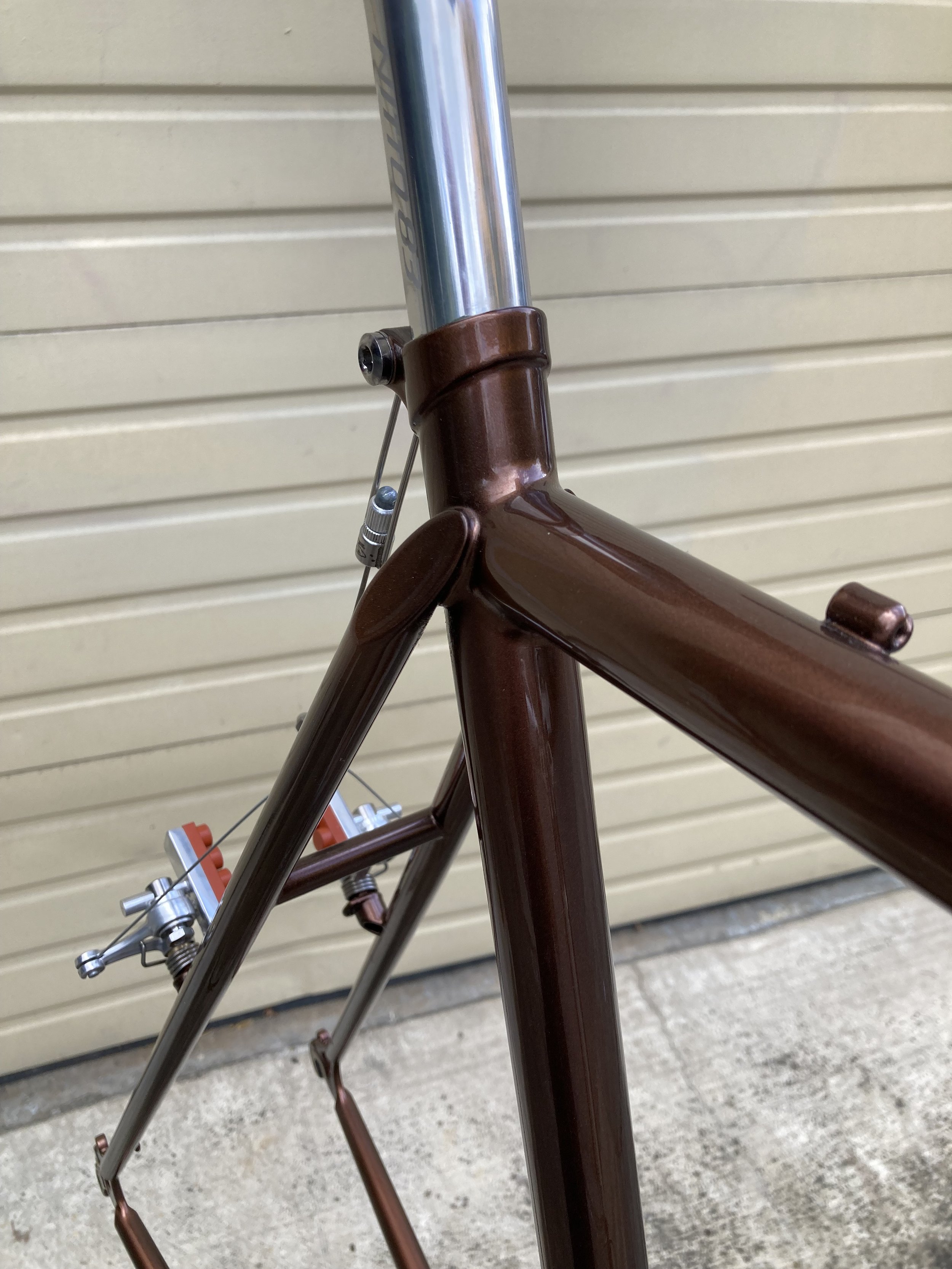
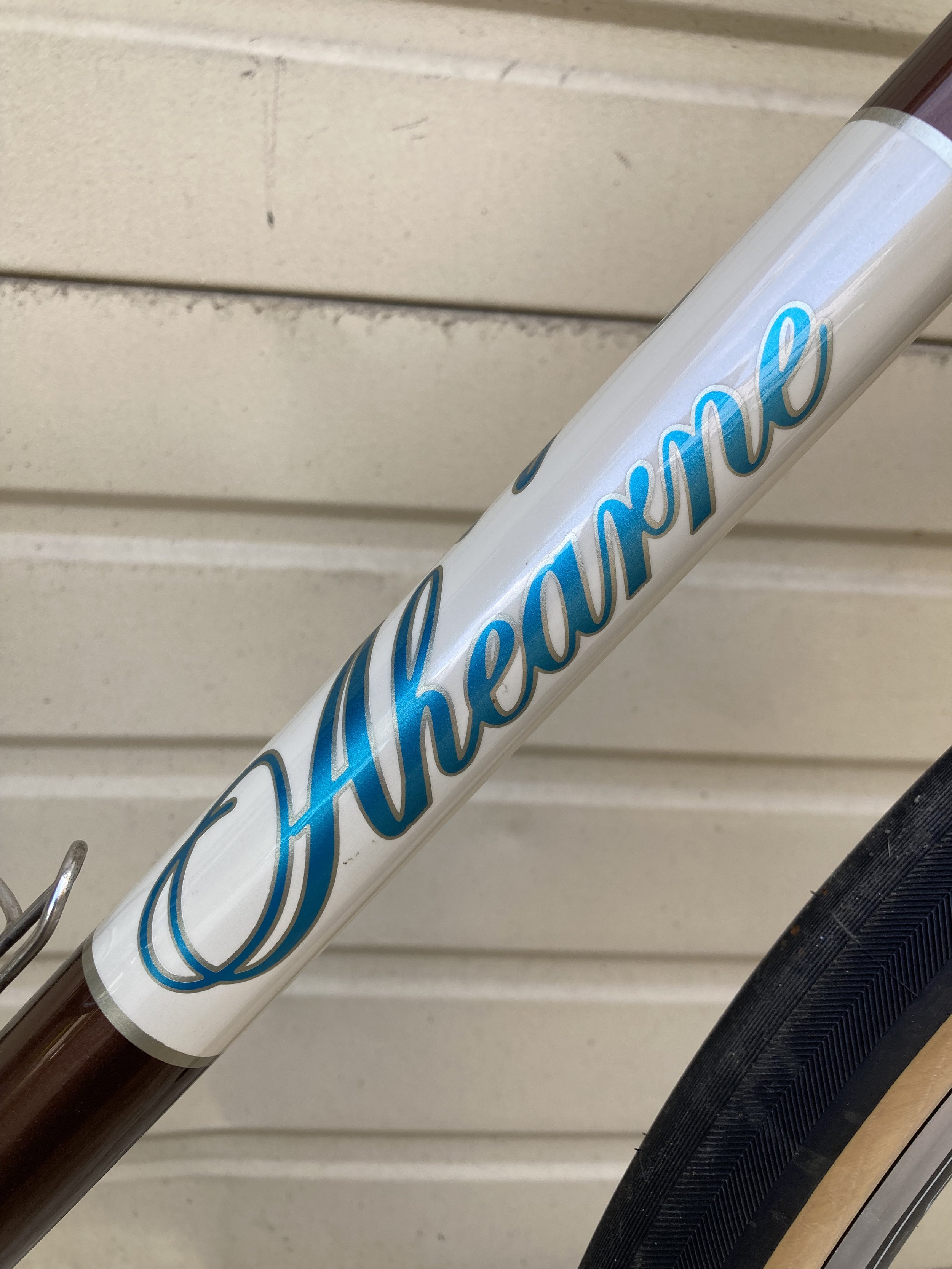
I’ll be bringing this frame to the Made PDX bike show in August. It’s going to be such a bad ass all-rounder, all-road bike, and yes, it will be for sale. It’s one of those projects that’s been brewing in my head for a while. I had some interesting tubes (Pegoretti tapered top tube, Reynolds shaped 853 down tube, True Temper unicrown fork legs) and wanted to make something that would fit 3” tires and fenders, that could go anywhere and do anything. And these racks! It’s always a bit of an experiment when I start an unconventional rack set and it’s so gratifying when I’m done and feel like I nailed it.
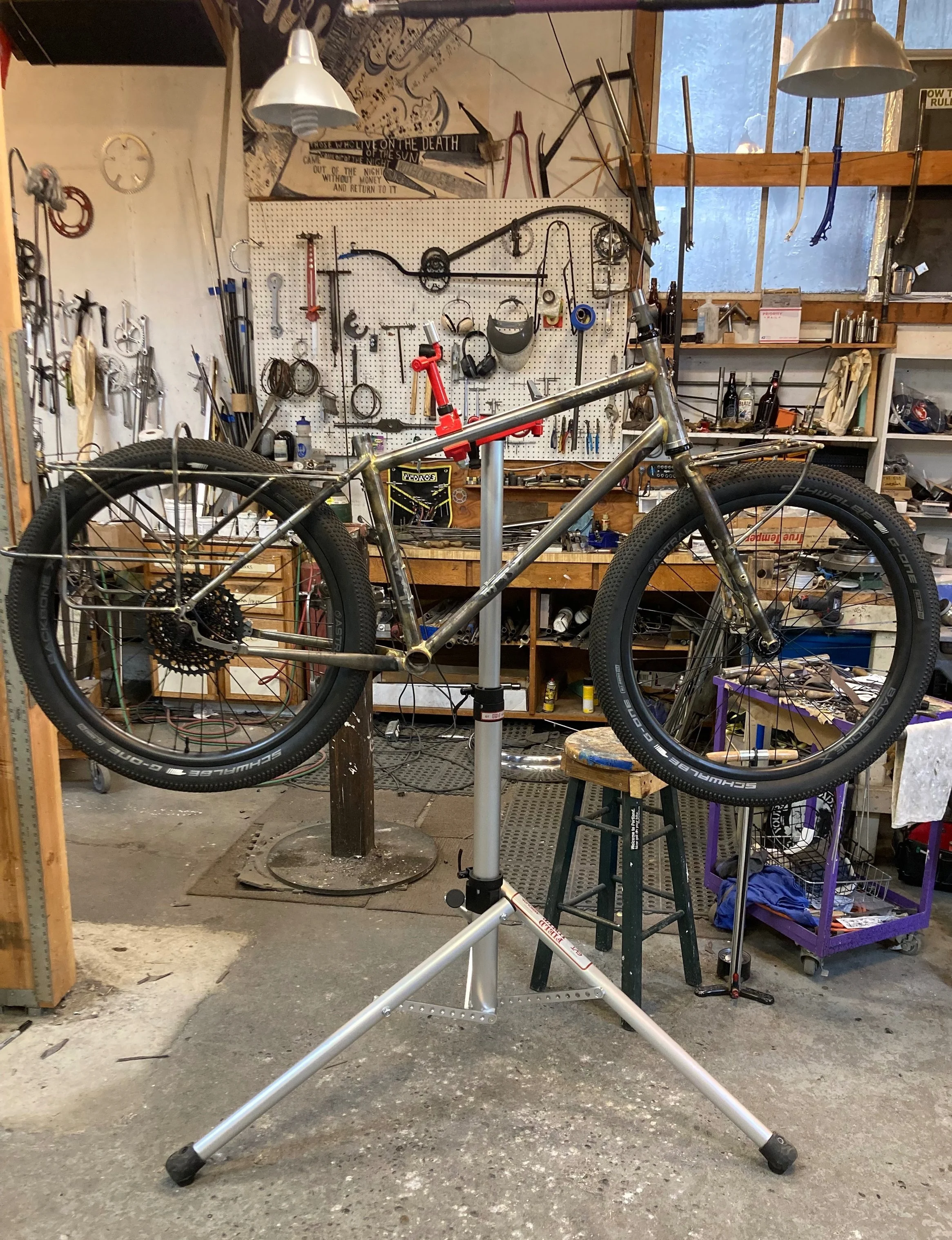
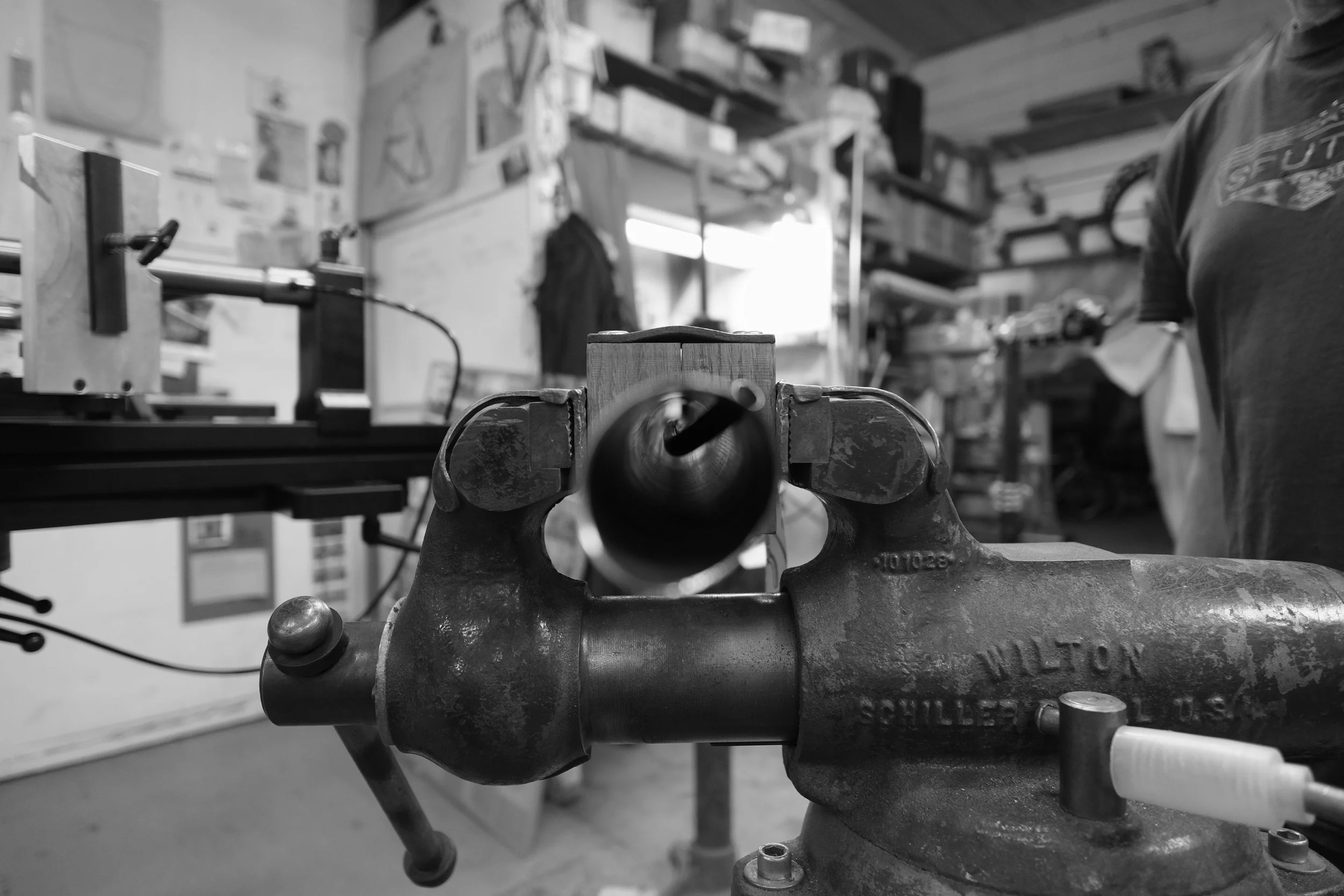
Last bike made on Page St. in a Field Unit Portable Work Stand

If you’ve been thinking about a bike for touring on roads and trails where cars don’t go, or something for year-round commuting, this bike is going to be top notch. Price TBD — it depends on what parts I finish it with. The frame is sized to fit someone between about 5’9 and 6’2 depending on your reach. Because of the sloped top tube it will be good for a wide range of leg lengths, even someone with a shorter inseam. For reference, the effective top tube length is 600 mm, and the standover height is about 760 mm (measurement taken with 2.8” tires, as shown in the photos).

If you’re seriously considering it, send me a message in the next week or so and we could talk about having it painted your favorite color. I currently have some color ideas but I’m happy to discuss it with you. Also, I have some parts I’m planning to use, but not all of them. We could talk about options for handlebars, brakes, cranks, saddle, pedals, and a few other things.


That’s the last, and here’s the first…
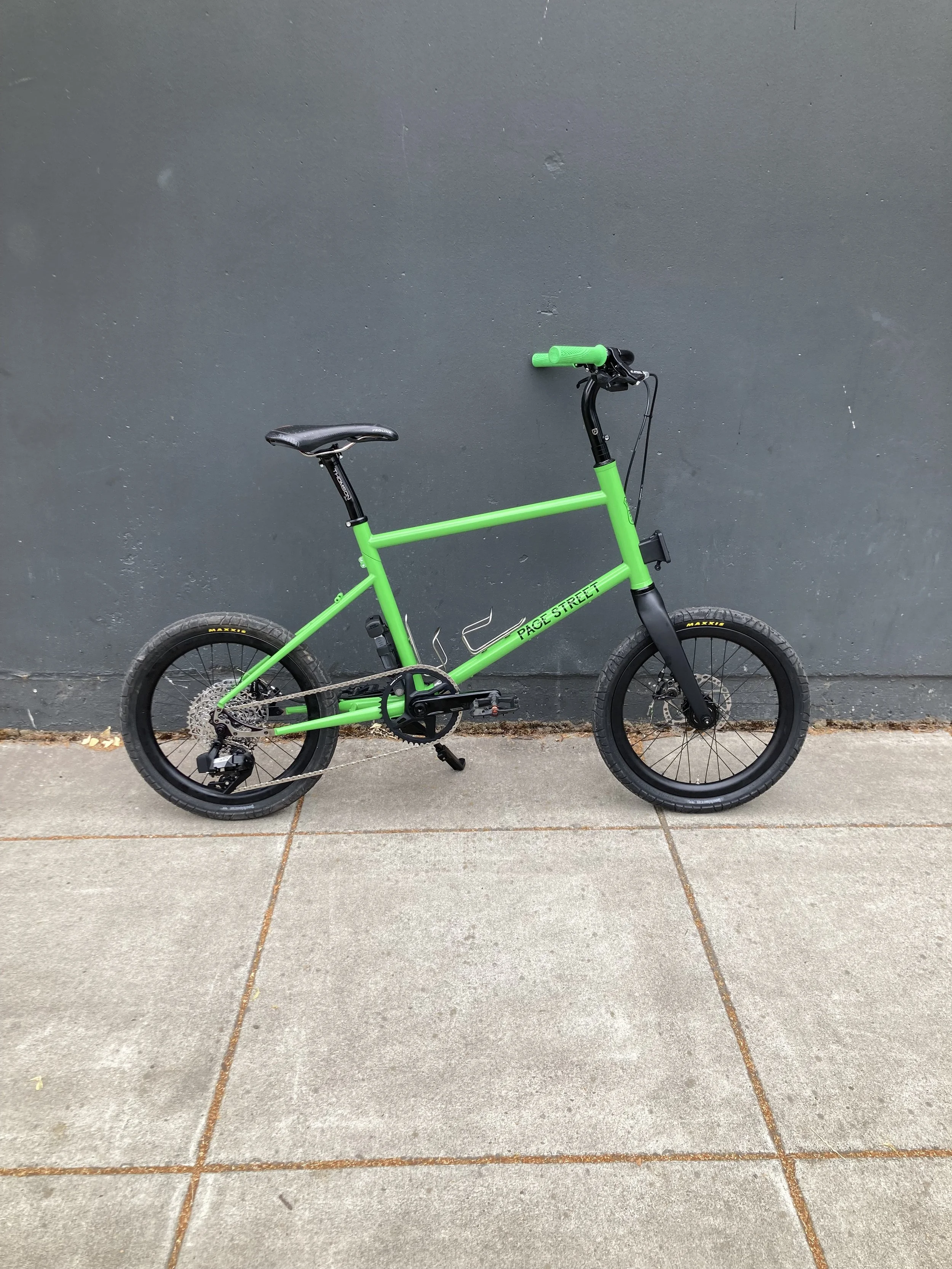
This bike is ready to ride and It’s for Sale!

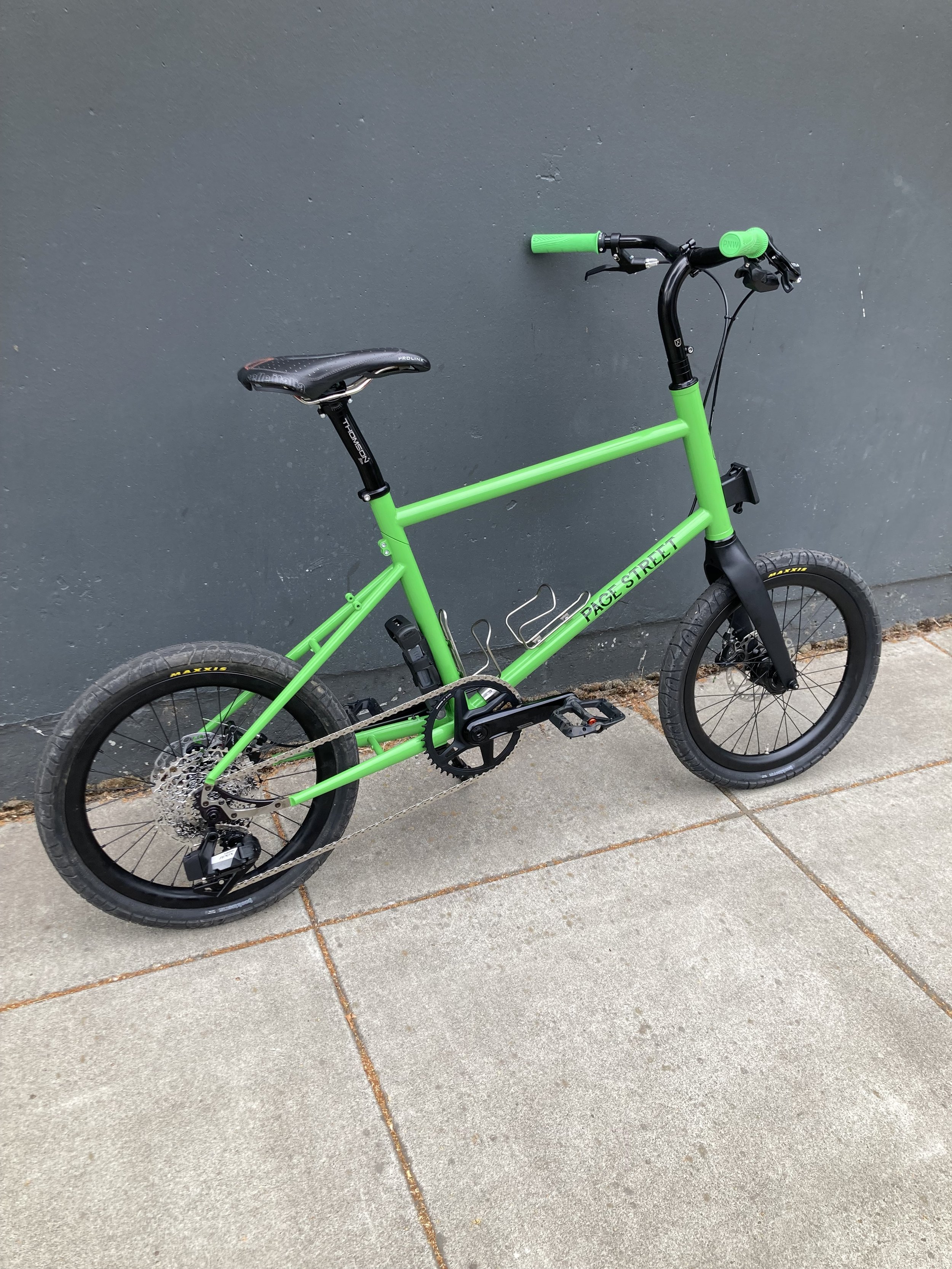
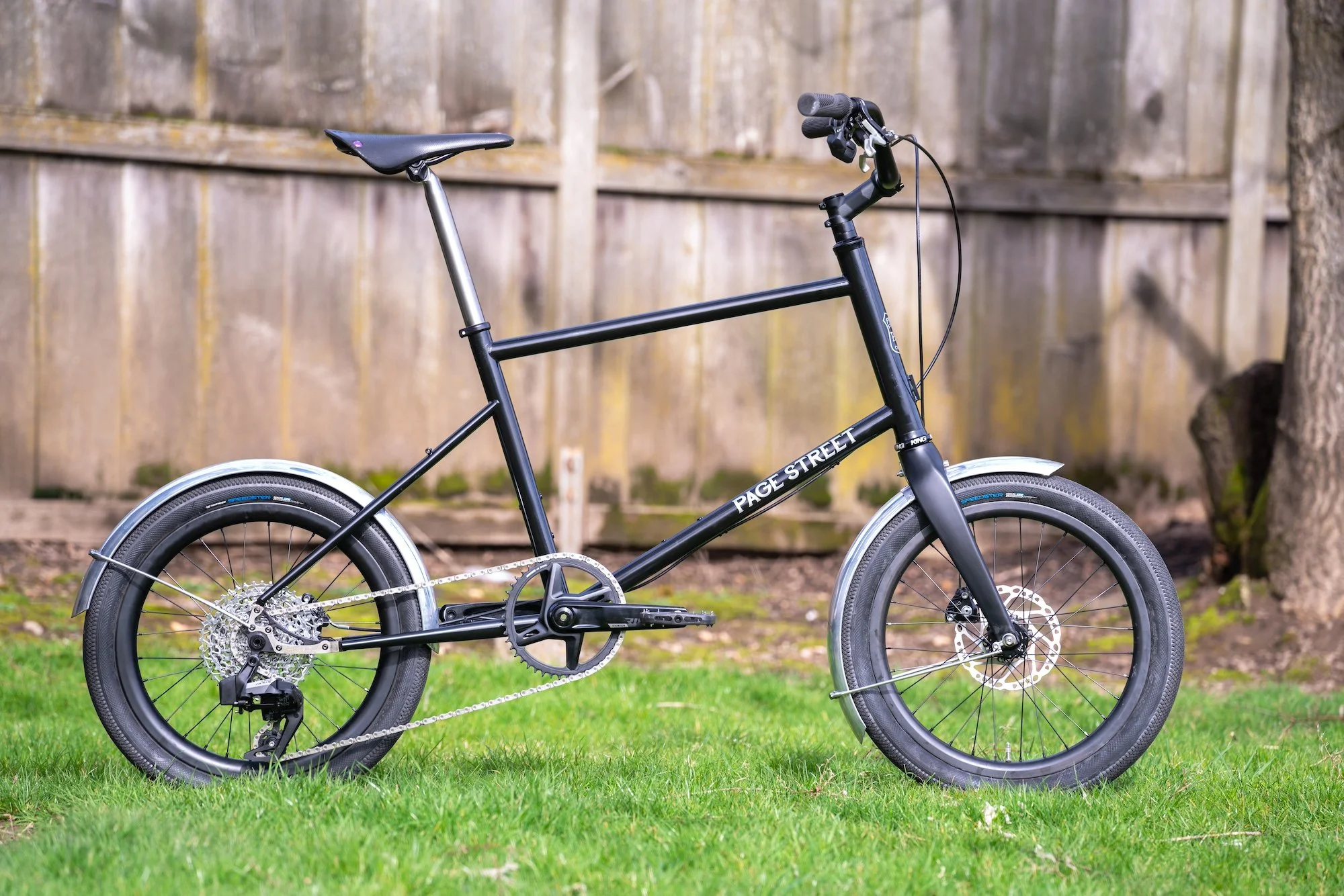
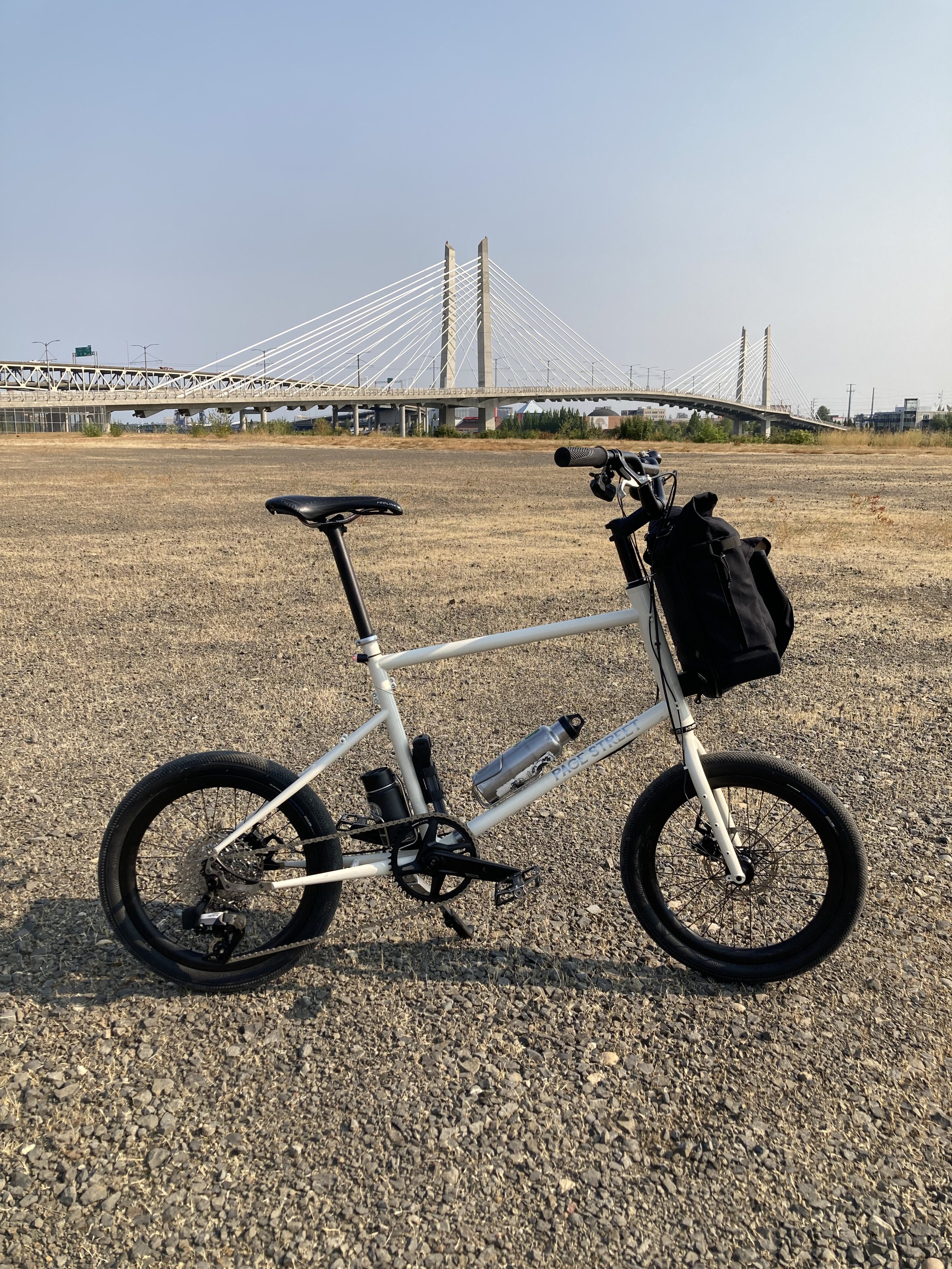
This past week I finished assembling the first prototype small/medium-sized travel bike, the Page Street Viajero. Everything is the same as the large except the shorter top tube: 580 mm and a lower standover height: 705 mm.

I’m incredibly excited about this bike.

I love collaborating with others and a few of us have worked hard dialing in the design. I think this is a great option for anyone who wants to travel and have a bike with them.

I am now taking preorders for the Viajero.

The cost for a Viajero frame set is $3150.

The frame is designed and built here in Portland, Oregon. It includes a coupler system to break the frame down for packing into a standard size suitcase. The frame is made from top shelf bike tubing: Reynolds 853 heat treated chain stays and down tube (where it counts), Reynolds 631 air hardening tubes elsewhere. This also includes a single-color powder coat, and yes, a coupler wrench.

Deposit for a frame is $1000.

Message me to get on the list. Turnaround time for this first batch is going to be about 2-4 months for frame sets (no parts, or with wheels only), or 5-6 months for complete bikes ready to ride (this includes the time needed to move my workshop. After the move, lead times will hopefully shorten).
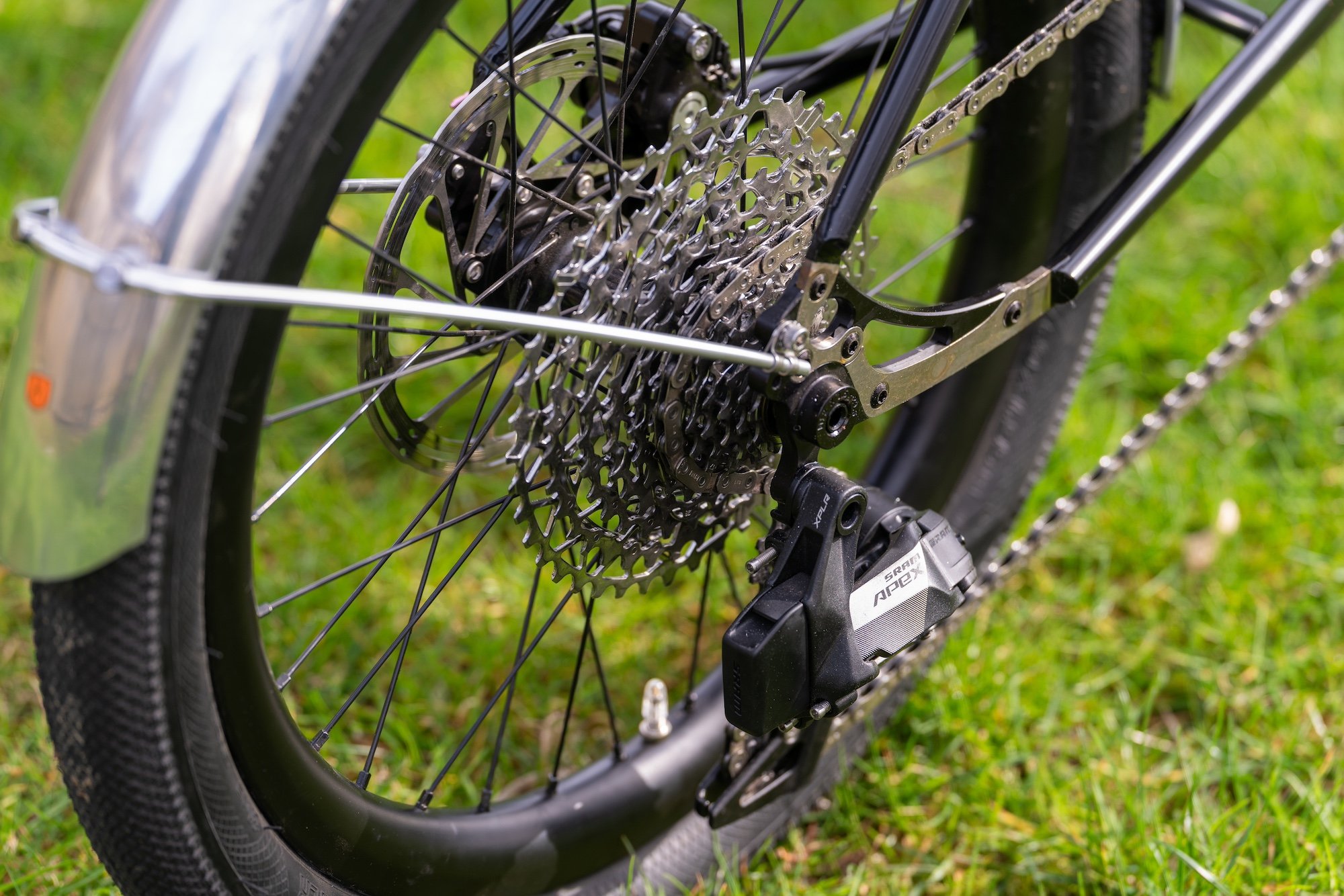
Sram AXS parts — no cables makes packing easier

For now the only complete parts package I’m offering includes Sram AXS with 1x12 drive train, electronic shifting (no cables, except for the rear brake), and Schmidt headlight and tail light. I’m not going to be very flexible with parts — I’ve figured out the kit that I believe works best for this bike and to some degree the bike is made around it. I don’t list a price here because the cost for the parts will fluctuate a bit depending on the market and component availability. Again, get in touch for details.

If you’d like to supply parts I’m happy to share all the relevant frame specs before you order.
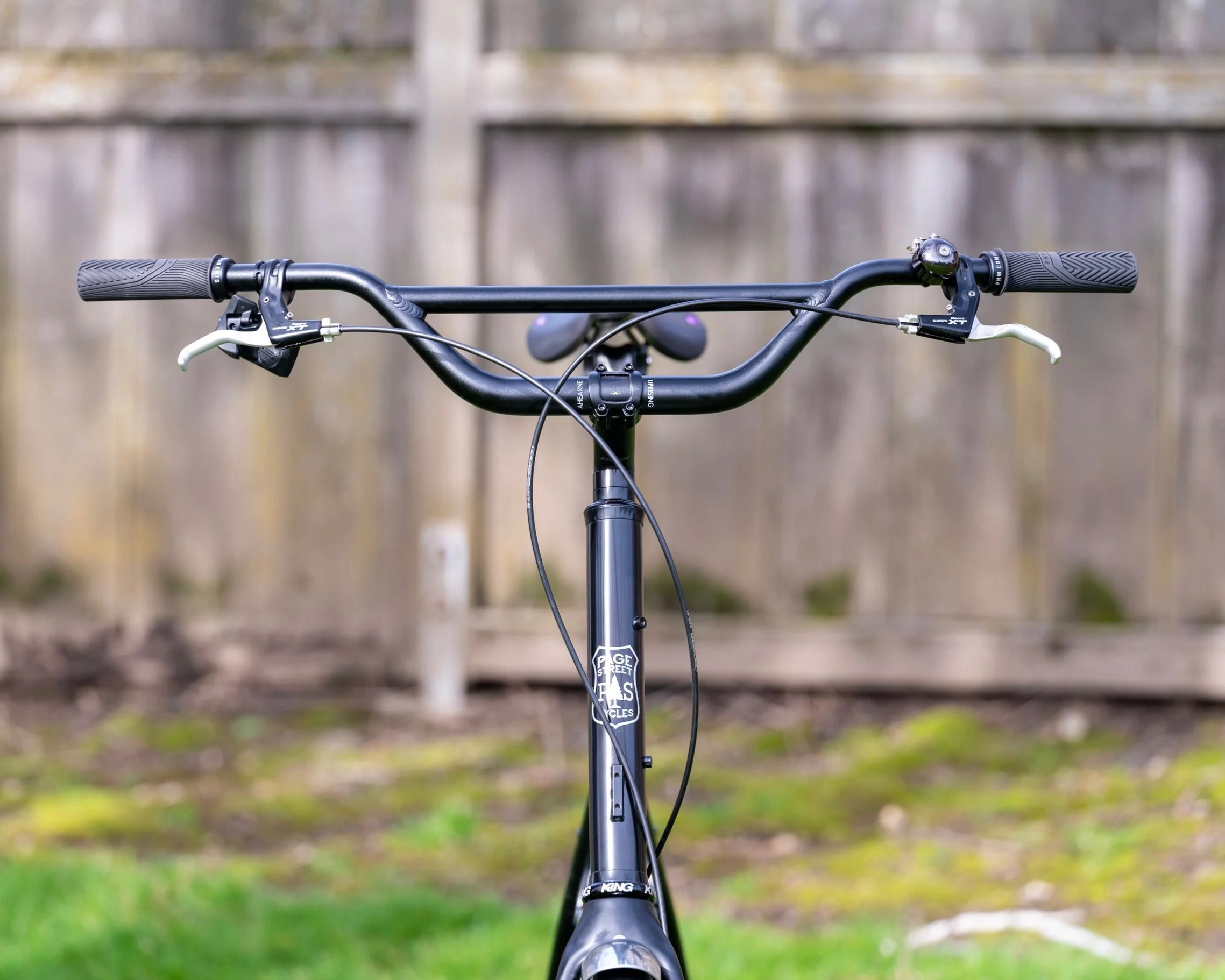
Or, if you want a wheel set only, so you can build the rest of the bike up to your specs, I can do this, as well. The wheel set I sell has a front generator hub by Shutter Precision, a thru-axle sealed bearing rear hub, carbon rims, double-butted spokes, hand laced here in Portland.

Wheel set costs $950.  

These hubs work great, but there are hub upgrades available upon request.

Soon I will post something more comprehensive about the travel bikes, including drawings, specs, a parts list, and options. All this information will eventually be available on the Page Street website.

If you don’t want to wait for the next post, please send me a message and I will share all the information and answer any questions you may have.

Thank you for reading!
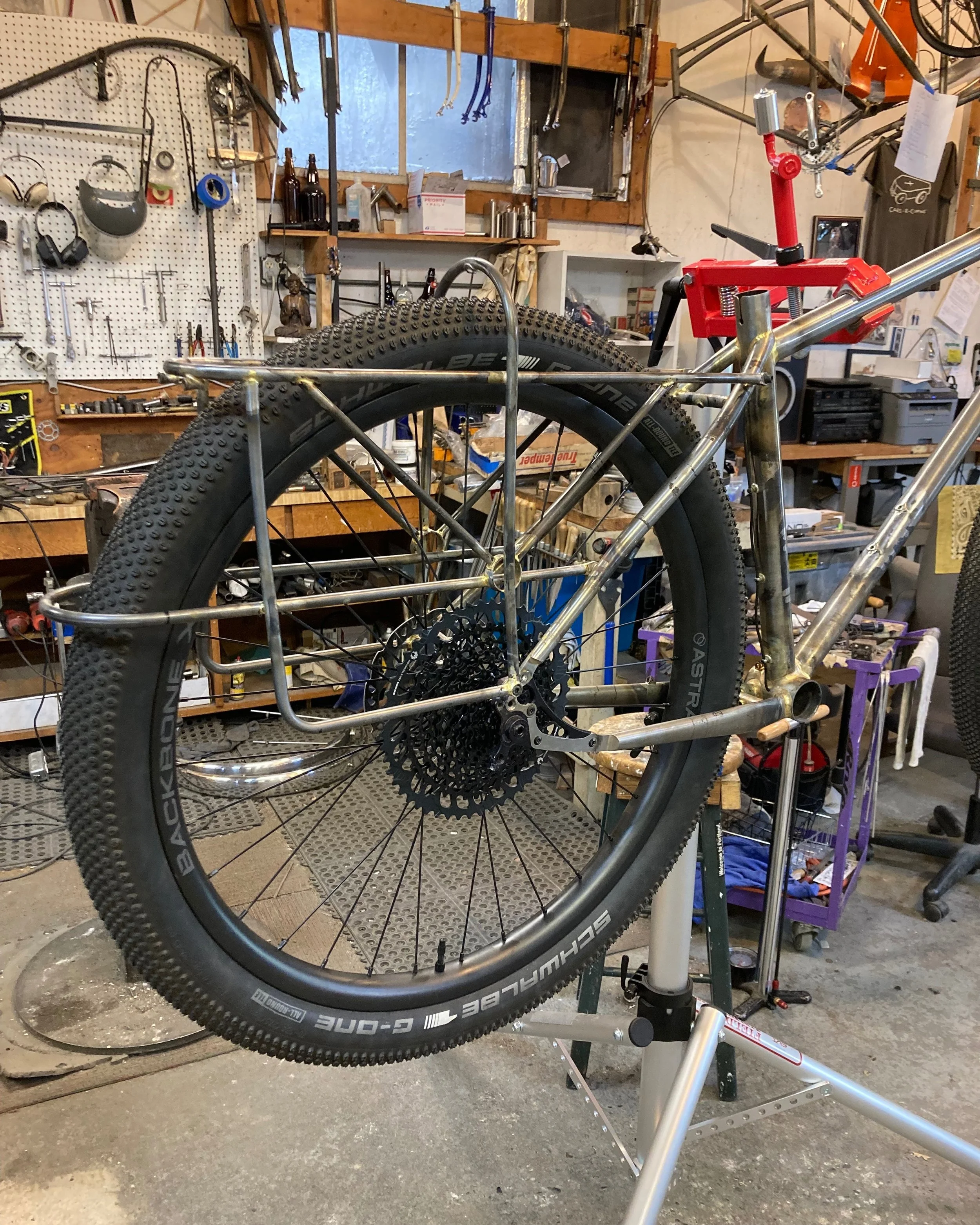
The Final Touring Rack Made on Page Street
Turning the Page

Joseph Ahearne6 Comments

The workshop on Page Street has been my base of operations for more than eighteen years. Like all good things must do, it is coming to an end. I’ll be moving my workshop this coming September. Here are some things you ought to know, and a few of my thoughts about what’s coming.
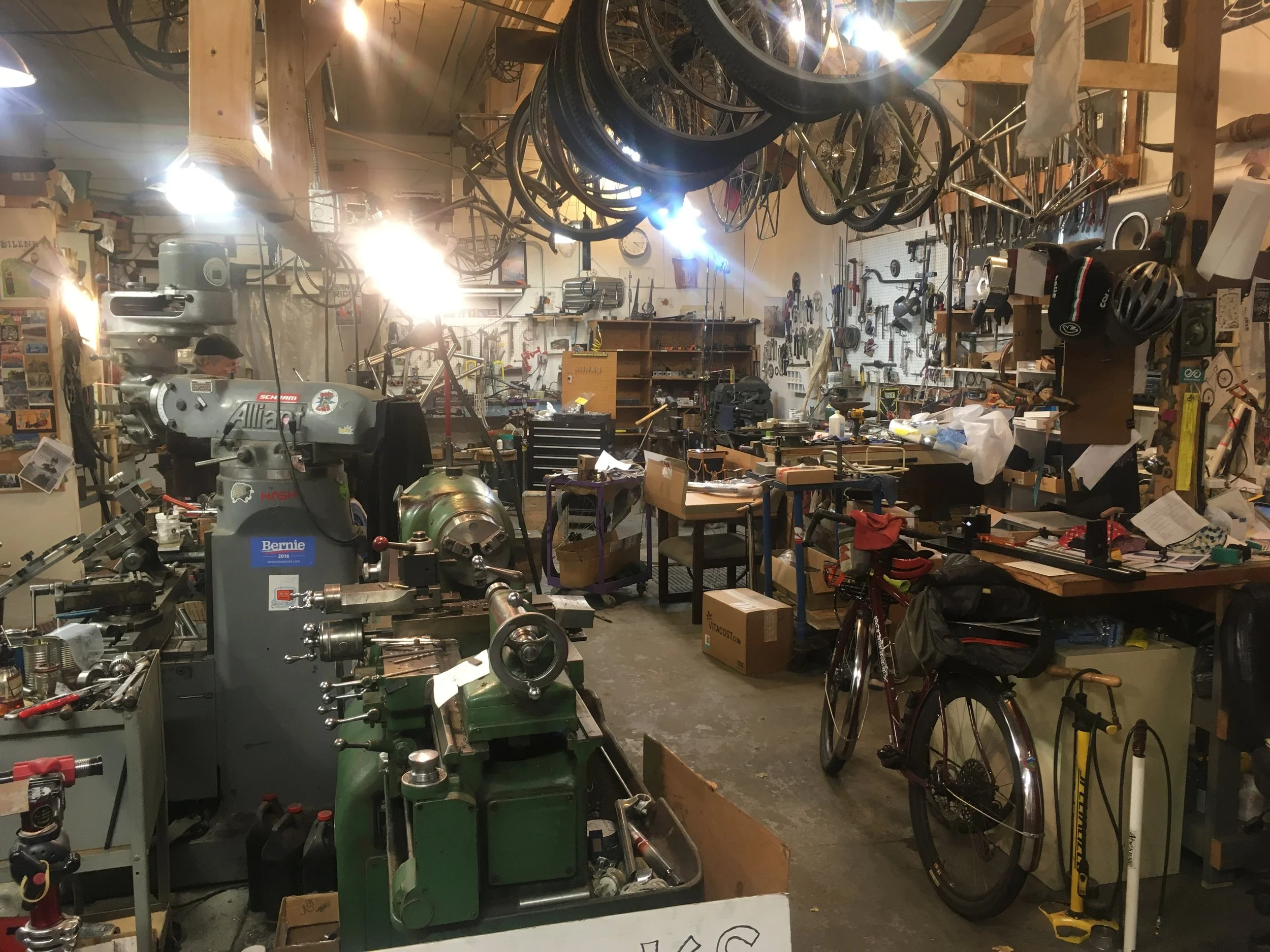
18 Years of Accumulation

First, so we’re clear: Both bicycle brands I lead — Ahearne Cycles and Page Street Cycles —  will continue as they have for the past many years. With Ahearne Cycles, I will continue making fully custom, one-off bicycles and racks, and Page Street Cycles will stay focused on production models that are collaboratively built.
For those of you who already have deposits in, there will be some delays while I make the transition, but the plan is to unbuild from my current shop, to rebuild into the new shop and be fully up and running by November/December.

As a side note, more information on progress with the Viajero travel bike is coming soon. This bike is unique enough that before offering it to people I first want to make sure everything is dialed in. There is a lot happening in general and I’m devoting what time and resources I can to the project. It’s amazing to see how much interest there’s been. A lot of people get it — these bikes satisfy the itch any cyclist has when you travel and want a bike with you. The Viajero is not necessarily for bike-centric trips and bike tours, but to some degree it could be. I picture it being most useful for trips where you land in a place for a few days or a couple of weeks and want a bike with you to explore a town or commute on. It’s designed to be stable, quick handling, and ride like a “regular” bike, while being easy to break down and pack in a suitcase-sized travel case. It’s not a folding bike. The focus has been on ride quality first, then weight and packability. The goal is for it to take maybe 10-20 minutes to set up or break down while using minimal tools and with only basic technical knowledge. We all know there’s no better way of checking out a new location than by wandering the streets on a bicycle. The Viajero is another tool for the quiver that does its job in the best way possible. It’s portable and fun to ride. Thank you for being patient while I get the bike design dialed in and work through a move. I’ll be opening up for pre-orders as soon as the time is right.

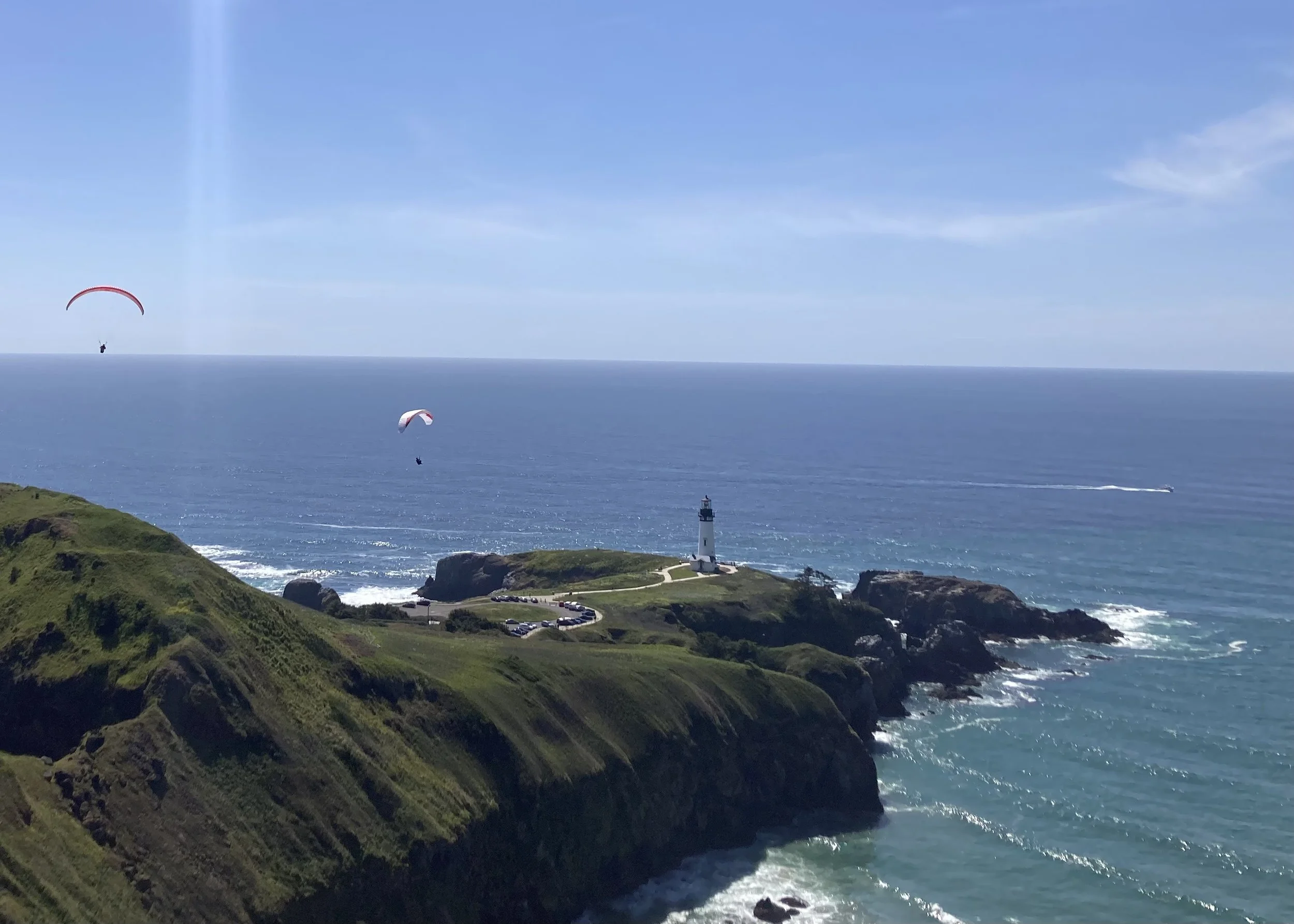
My new neighborhood lighthouse

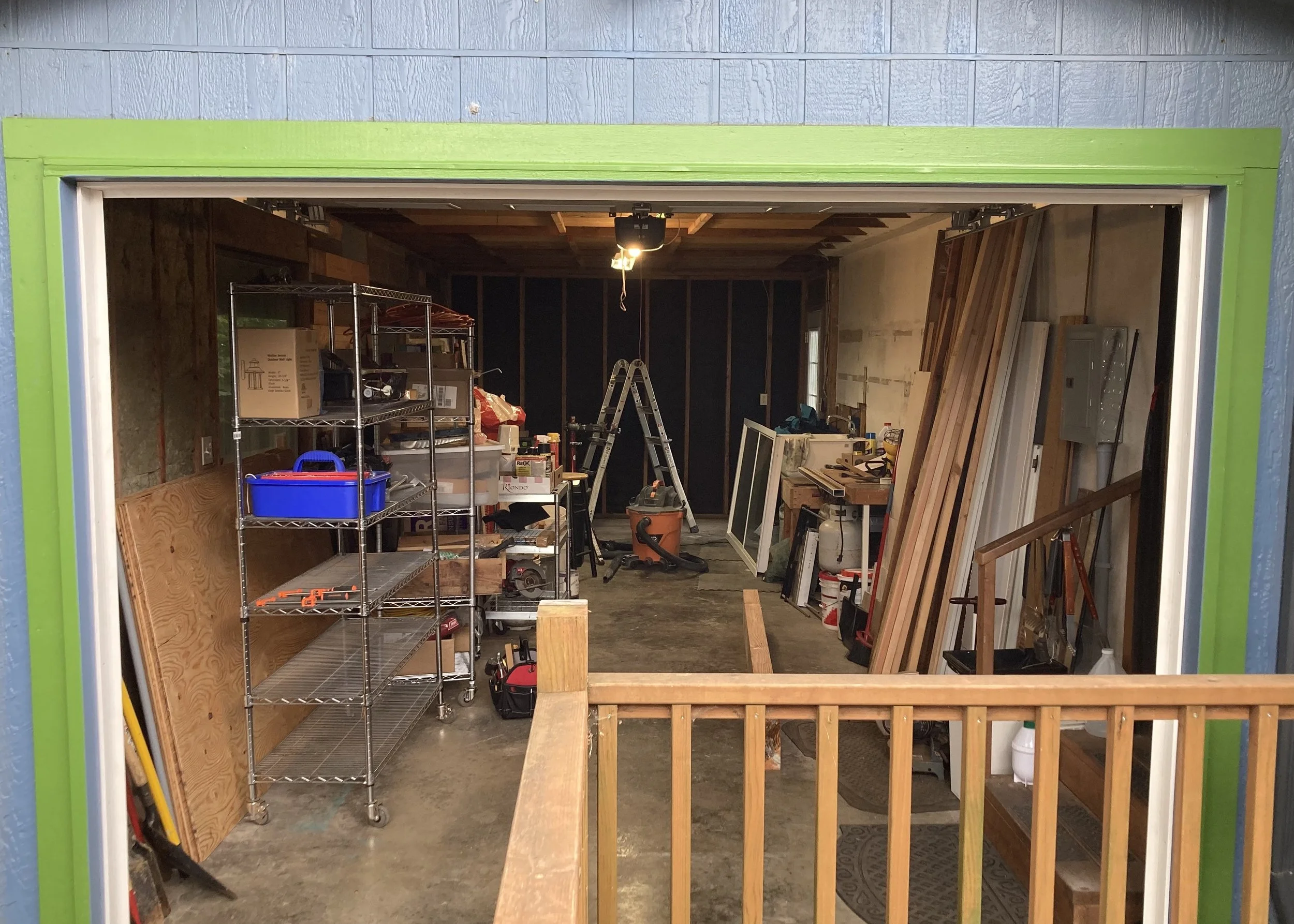
Next relevant piece of information regards where I’m moving to. A few of you know I own a house in Newport, on the Oregon Coast. The house is nothing fancy, but it has a garage that is large enough to house a small operation like mine. This is where my workshop is headed. It will be a significant reduction in square footage — from almost 3000 sq. ft. to a little over 300 — but the most salient point here is that I own it (well…the bank technically owns it, but you get what I’m saying).

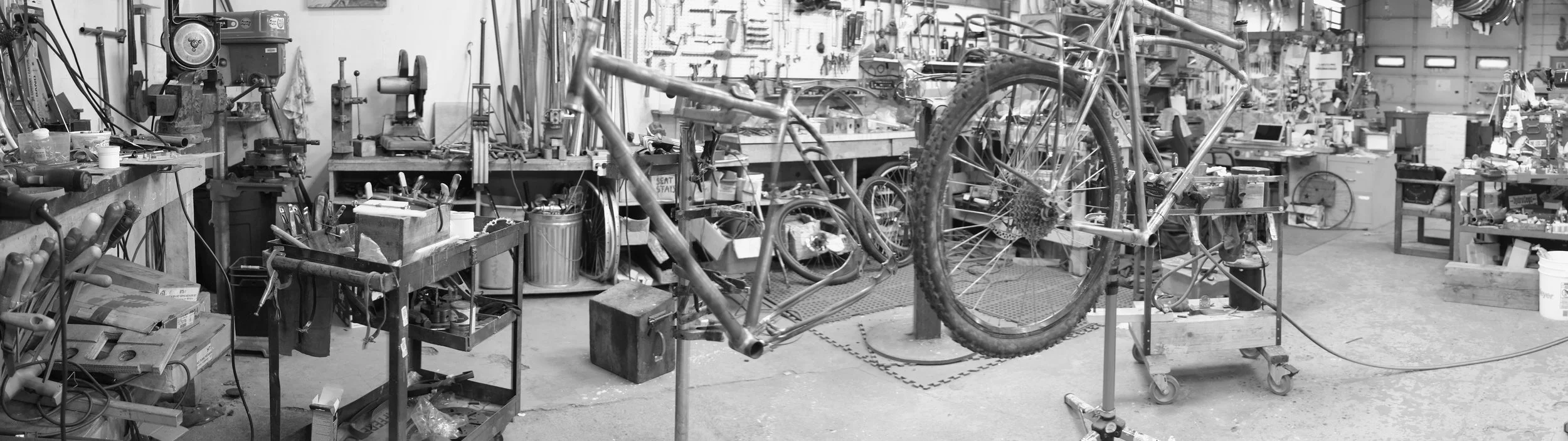
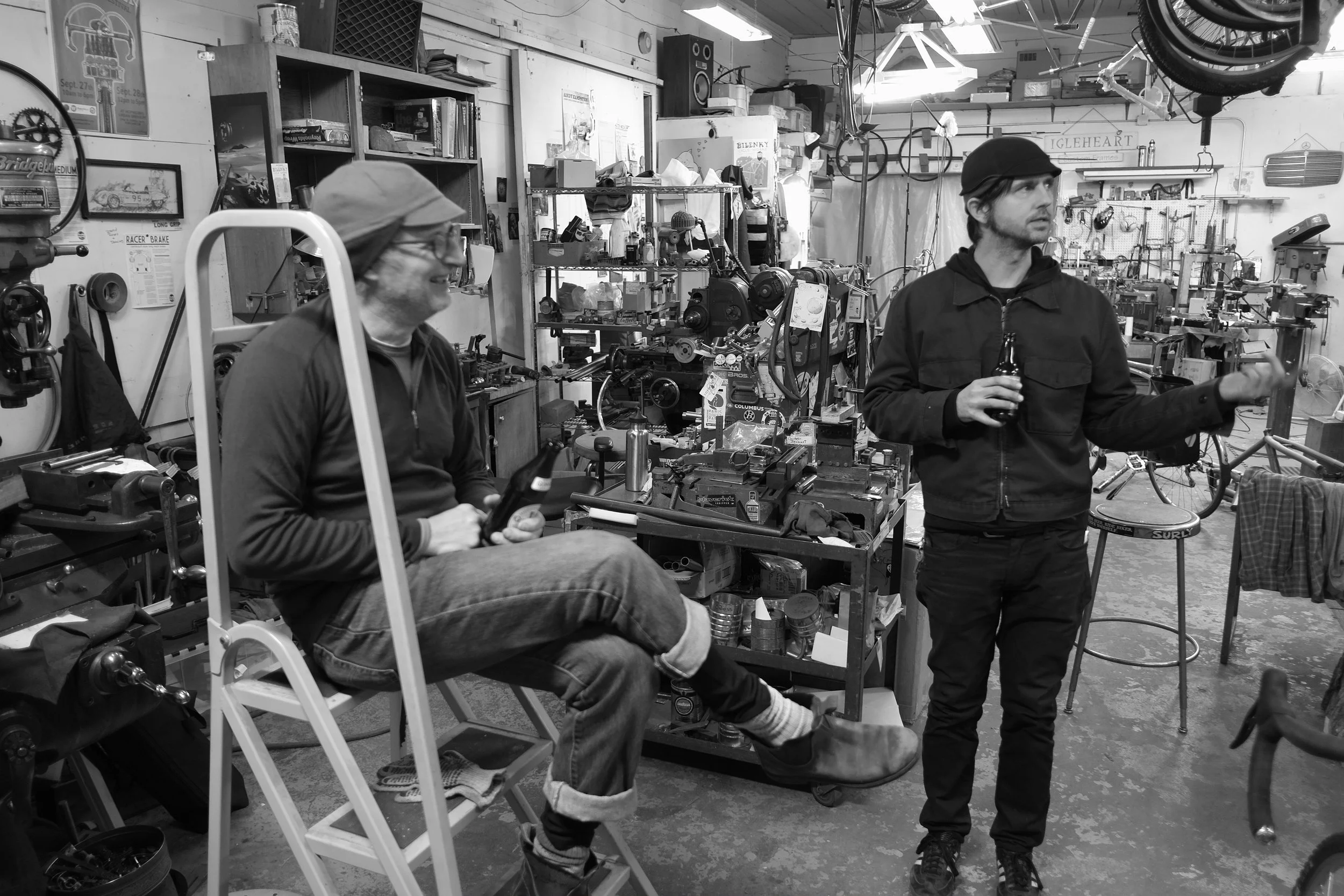
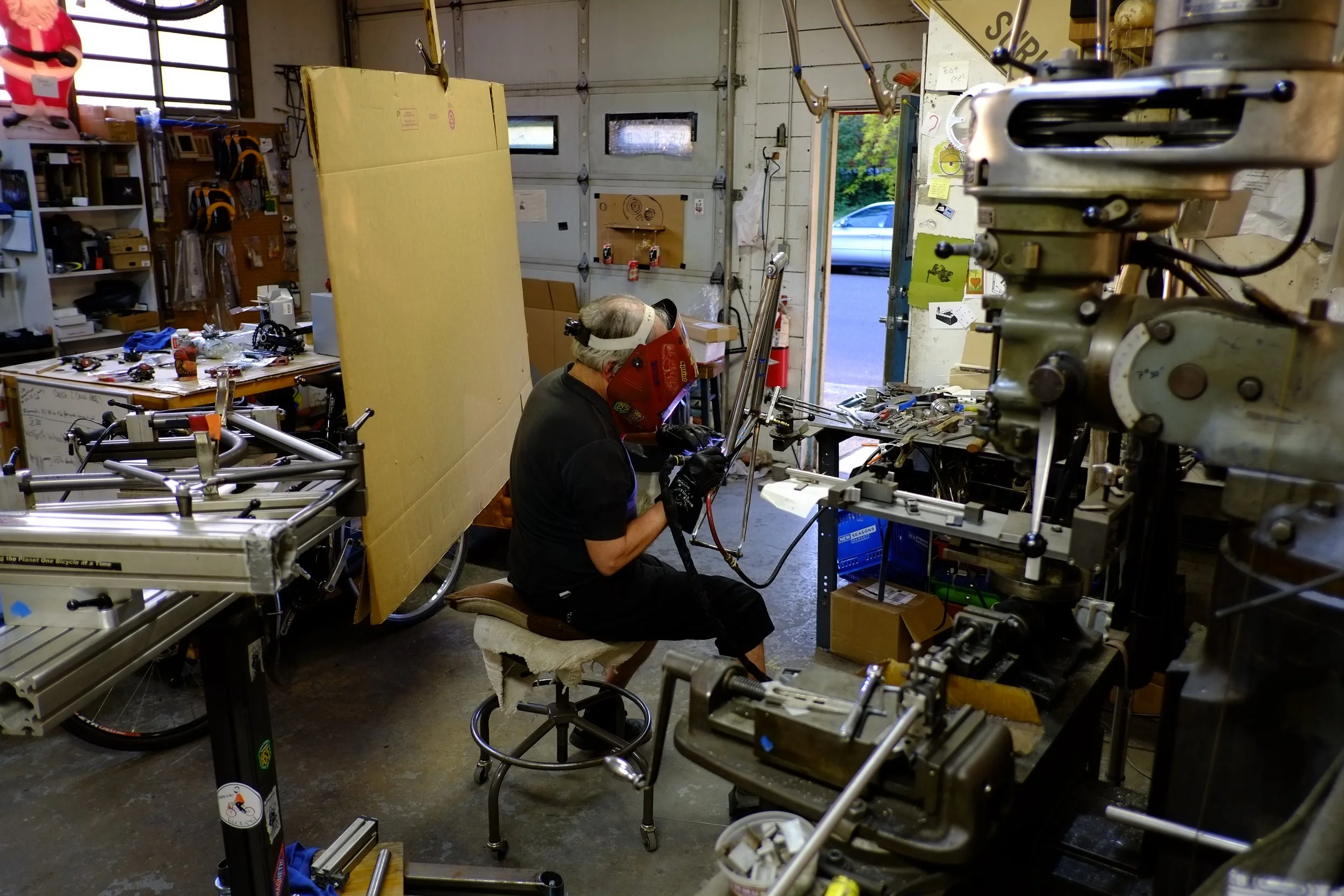
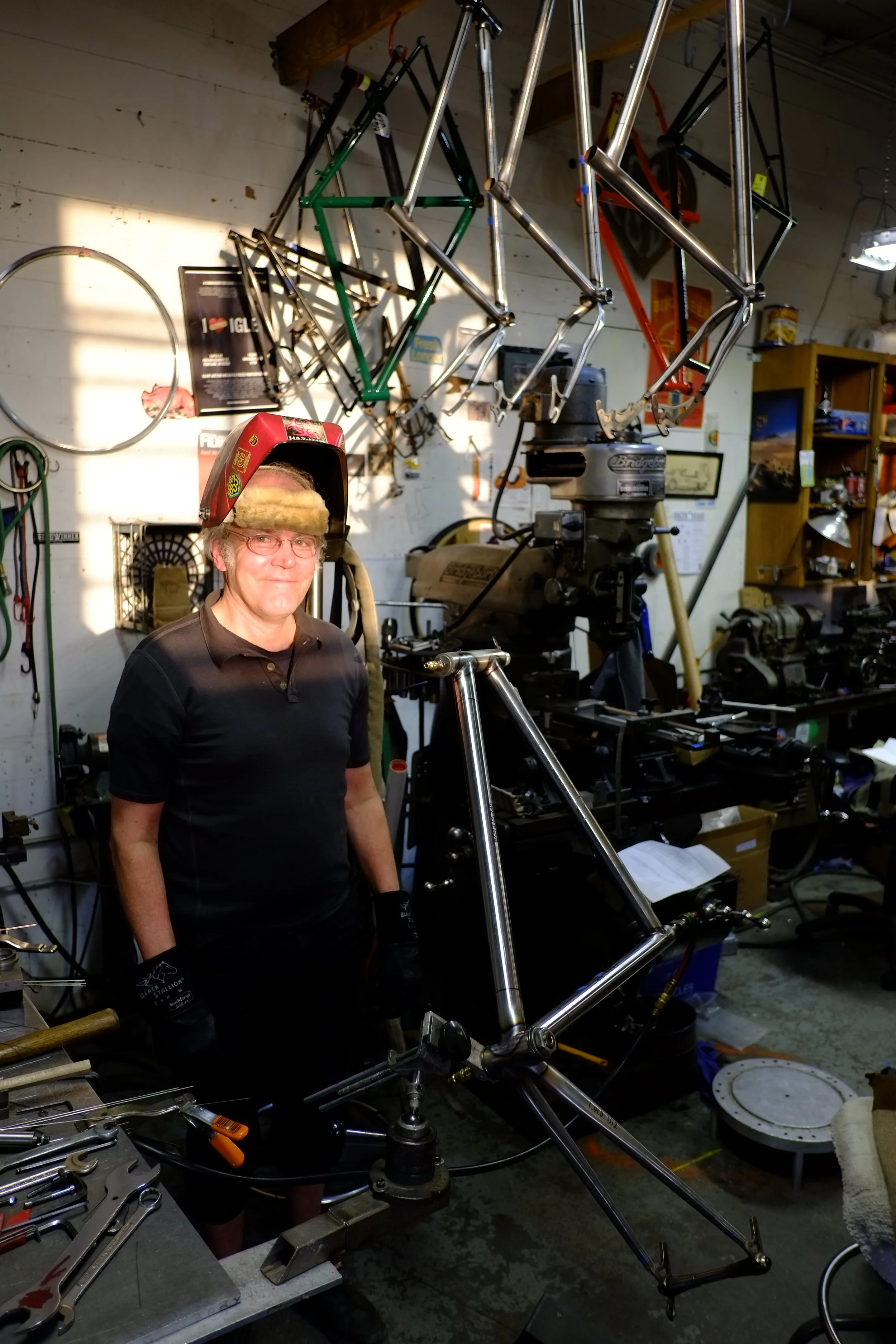
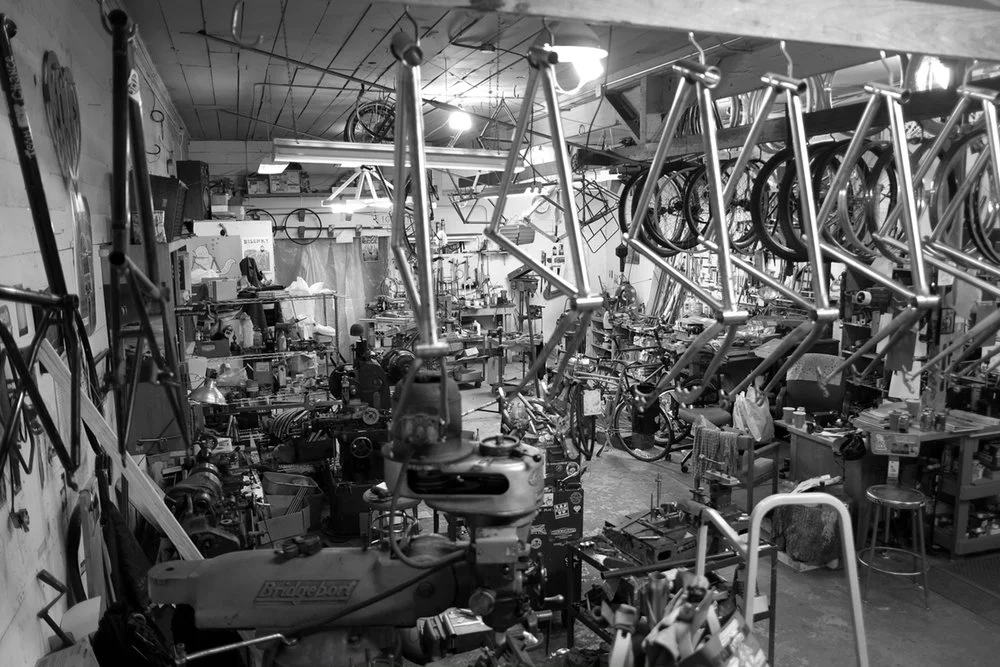
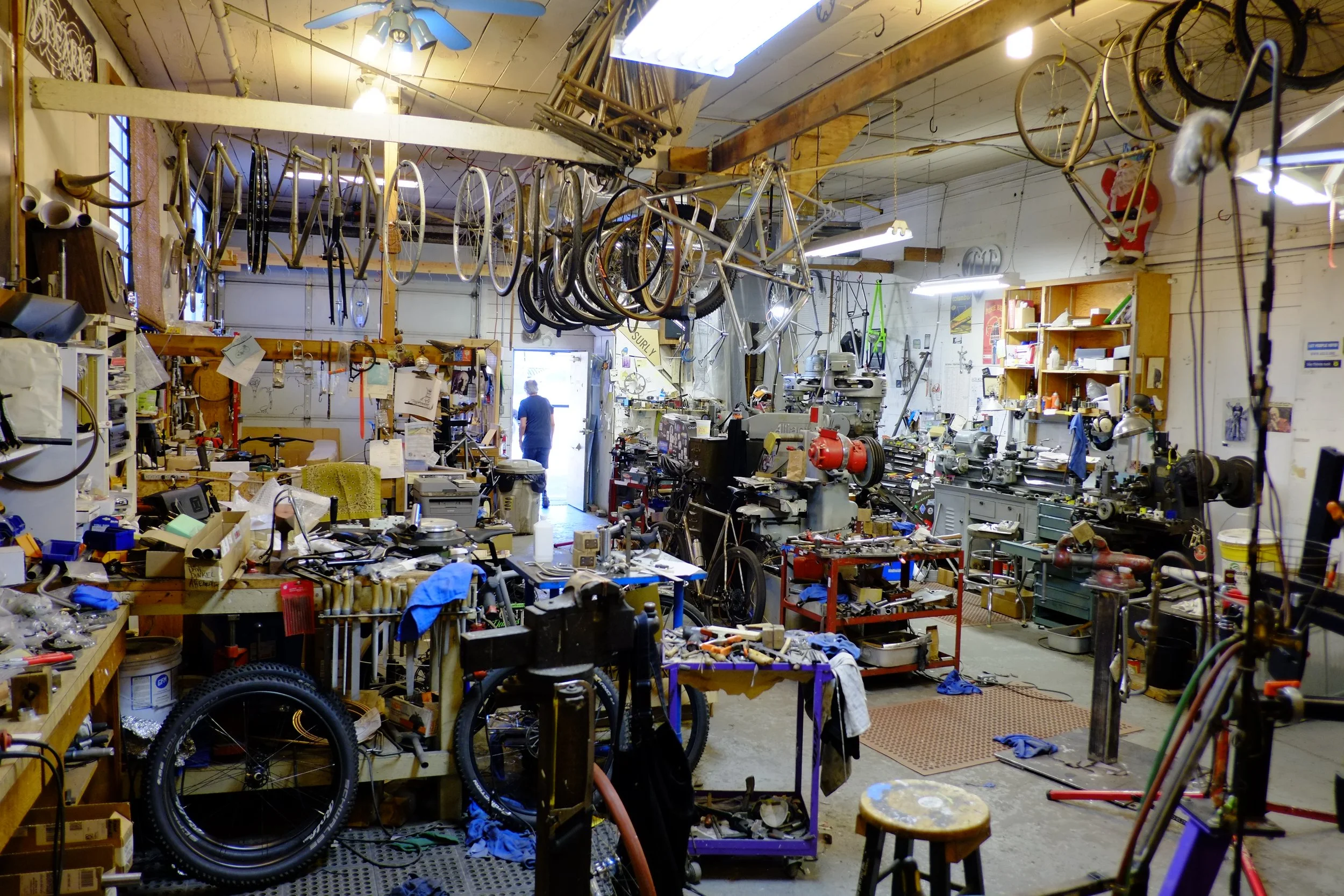
Less space means consolidation — of tools, of “stuff” in general. I’ll need to be way more intensional about what I have, how and where things are placed. Anyone who’s ever visited the Page Street workshop knows how much crap is there. A hodgepodge of visual stimulation — bikes, machine tools, hand tools, steel, noise and dirt, buckets, wheels, clashing lights, parts and frames, stuff everywhere, filling the floor, up the walls, across the ceiling.
I wish I had a time-lapse of the way the shop has changed shape over the years. It would look like a living being, something with tides or respiration, shifting about like a cluster of hungry cells. Part of me loves it, has loved it, but damn it’s a lot! Like the inside of my head has spilled out and sculpted itself into this giant mess of a workspace. Bless it, it’s time for a purge. The process of getting rid of stuff has been so satisfying — each item that goes out the door and out of my life gives me such a great sense of lightness, like my whole soul lost another tether.

Many Frames

The other side of this story is what it means to me to build out a new space. For the first time in my life I am in a position, both personally and pragmatically, in which I get to start from scratch and set everything up with intention and understanding of what I need — and what I don’t. Does this mean I’m growing up? Now that I’ve got better than five decades of experience on this planet, more than two of them at this job? Maybe, maybe not.

The Page Street workshop has been exceptionally good to me. When I moved in, my business was a mere toddler. Rent was cheap and the space plentiful. This allowed my business to grow, for me to keep practicing the craft of bike making without being overly haunted by financial stress. In a practical sense low overhead was key. More subtly, though, I learned how important, how vital, the community around me has been. This has everything to do with my general sanity and well-being. The shop mates whose company I shared for years — Tall Jay, Mitch of MAP Bikes, and for over a decade, until his retirement, my good buddy Christopher Igleheart — these people feel like family to me. Not to mention the folks next door, Bradley and Archie and all the rad people at Metropolis Cycles, and the amazing and creative women working with Mary Carroll Ceramics. Also, my friends at Sugar Wheel Works, and the recently transformed Breadwinner Cycles.
The community expands further, to all the neighboring businesses, both bike-related and not: the cabinet shop, the print shop, the packaging warehouse, hardware store, coffee shops, the bank, the post, and so on. Moving away from all this great company is something that gives me serious pause. When thinking about how much this is going to change things for me I become verklempt. But all the same I know the time has come, and I am ready.

Building a home shop

So to Newport, and making a home shop. It’s been gratifying considering what tools I want to bring, the reduced space forcing me to pare down to the essentials, mapping the footprint of each cart, bench, vice and machine tool, deciding what goes where. There’s an empty 100 amp electrical panel just waiting. Once each tool finds its place I’ll run power, embed lights in the ceiling, fill in the blanks with workbenches and shelves, bolt work stands to the concrete floor, and so on. I have to think about work flow, what makes the most sense, how to arrange things like a Swiss Army knife rather than the whole bank of cutlery.

Gratitude is the best medicine

When I first started building bikes I was in North Portland, not far from Ainsworth and N Greeley. This feels like a hundred years ago. I didn’t comprehend how fortunate I was, how the stars were aligning, until hindsight came along.

I rented an upstairs bedroom in my friend William’s house and, after taking a class with Tim Paterek and buying his frame building equipment, I set up shop in the garage. Talk about low overhead, I gave William an extra $50 a month for the space. I built a workbench, mounted a vice to it and got started. I didn’t have more than the most basic tools and shared the garage with a wood pile, a push mower, bags of potting soil, and some bent up wire tomato cages. I had maybe 100 square feet to work in, and at the time that was just fine.

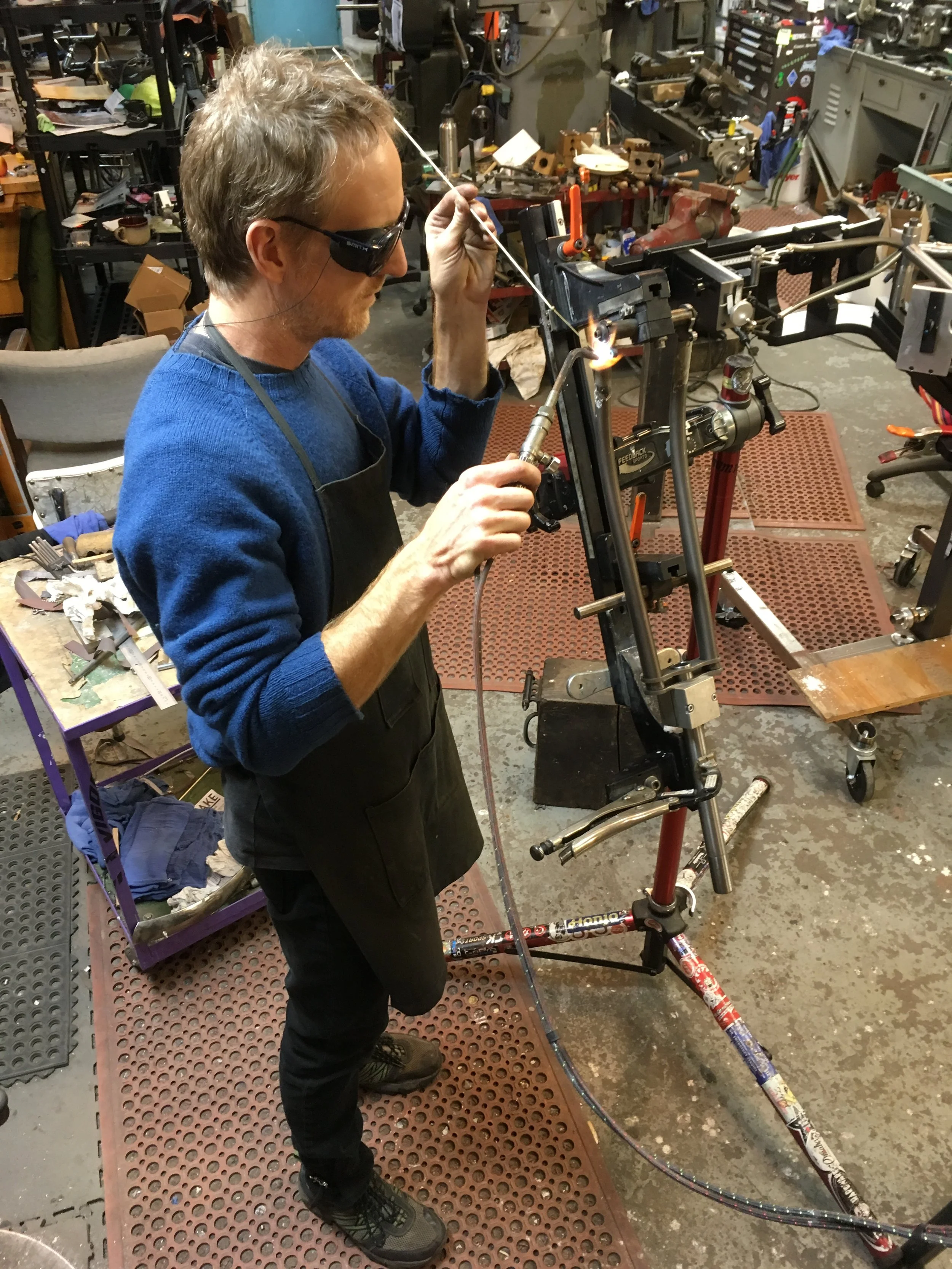
It was a detached one-car garage, the walls weren’t insulated and there was no heater. I had a bare-bulb overhead light and a single outlet with two plugs. The only electric tools I owned were a drill, a die grinder, and a 1960s era bench grinder. I cut and mitered tubes by hand, bled a little on every frame and told myself it was good voodoo. And maybe it was, who knows? I sucked at it, but oh my how I wanted to learn. I didn’t know anything about business and didn’t really care, I just wanted to make stuff with tools and fire. I had a job at River City Bikes that paid my rent, and it was enough for me at the time. I loved bikes and found a way to engage with them that was more than just riding. For me it changed everything. It’s hard to believe I’m still doing this crazy job, still making things with these two hands, and even better, still enjoying myself.

Deep Archeological History

It’s true to say the end of the Page Street workshop is the end of an era. Right now, to me, it feels monumental and kind of scary. But I know you have to close one door to be able to open the next, and it reminds me there is a larger story happening. This excites me because I realize I’m not yet to the end of the book. I’m just turning a page, starting a new chapter.
So many good things are coming, I can hardly wait.

At the door

Things you need to know, in summary:

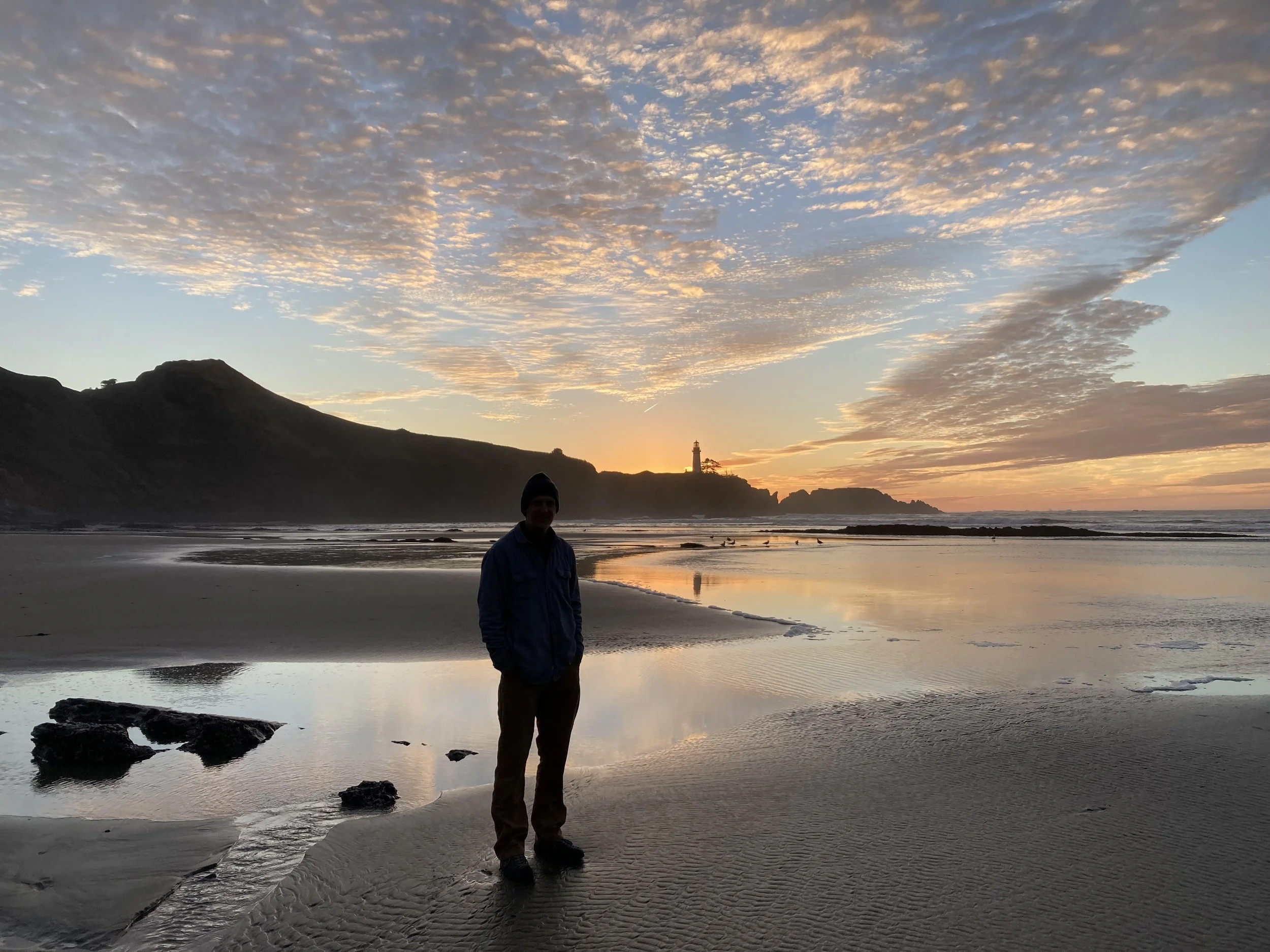
— September 1st I’m moving out of the Page Street workshop — me and my tools are heading to the Oregon Coast to live in Newport, near a lighthouse.
— Ahearne Cycles and Page Street Cycles will continue more or less as they have for the past many years. If anything, being in a well considered home workshop, under reduced stress, the bikes that come out of it will be better than ever.
— There may be some delays before I’m fully up and running again, but it shouldn’t be more than a few months. Targeting the end of this year. My current wait time for a bike is (including the move) about 16-18 months.

— I will still be in and out of Portland fairly regularly, and can set appointments to meet with people who are already on the list or interested in getting a bike. We can talk about design, parts, figure out sizing, etc. Much of this can be done over the computer as well. Contact me with questions.

— I currently have bikes for sale that I won’t have space for when I move. Please get in touch if there’s anything you’re interested in. The prices are not set in stone — all reasonable offers will be considered.

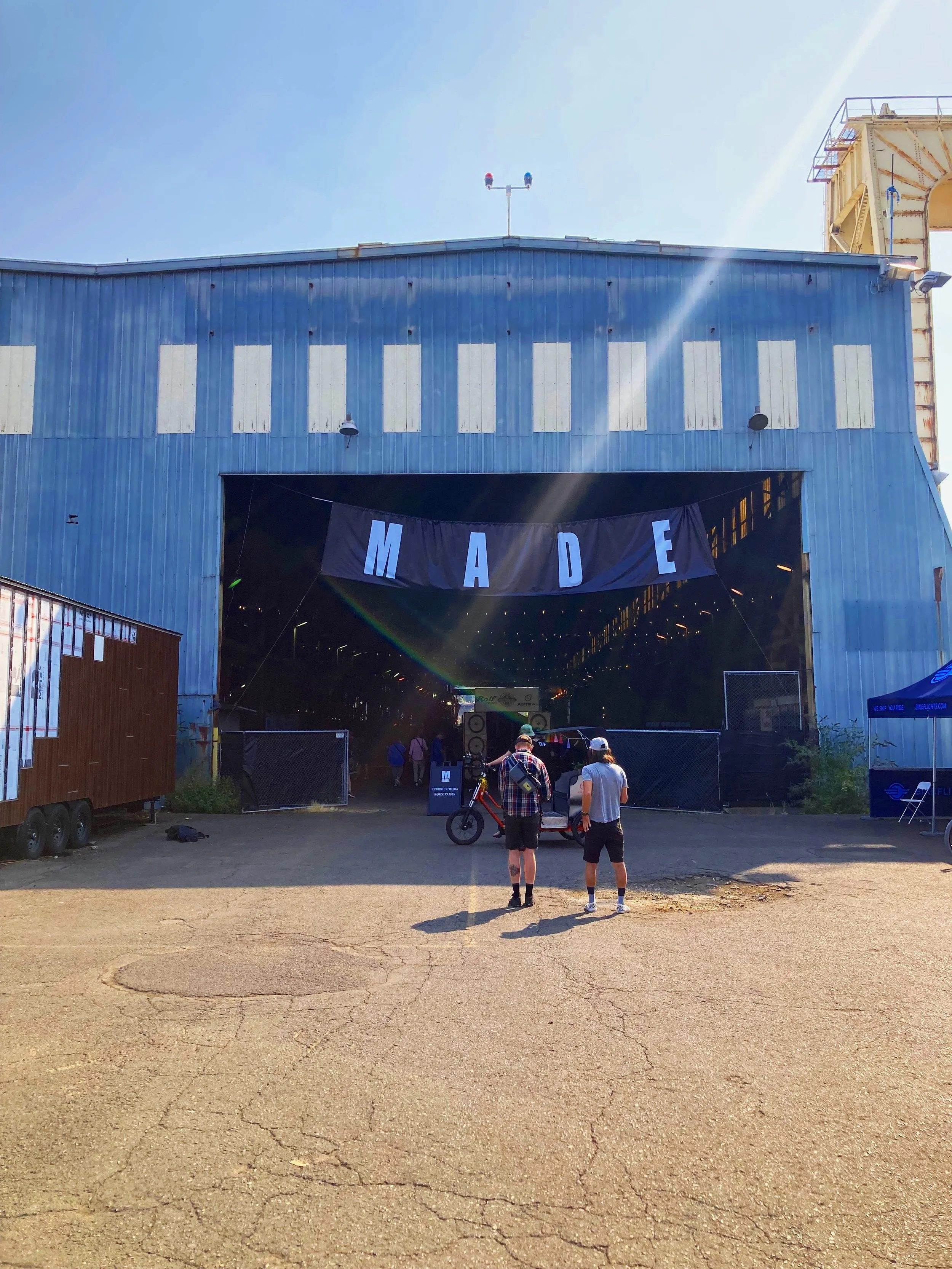
— I’ll be at the Made PDX bike show, which runs August 23-25. Please come say hi.

Standing On a Beach

Twenty Years -- and then some

Joseph Ahearne5 Comments

Thoughts and Updates

Made PDX

Made PDX happened toward the end of August. It was the first bike show I’d been to — most of us had been to — in a lot of years. By everyone’s reckoning, it was a success. I heard some bike news that this was the most attended handmade bike show in North America — ever! True or not, more than 5,000 attendees came through and the place was a-buzz with enthusiasm.

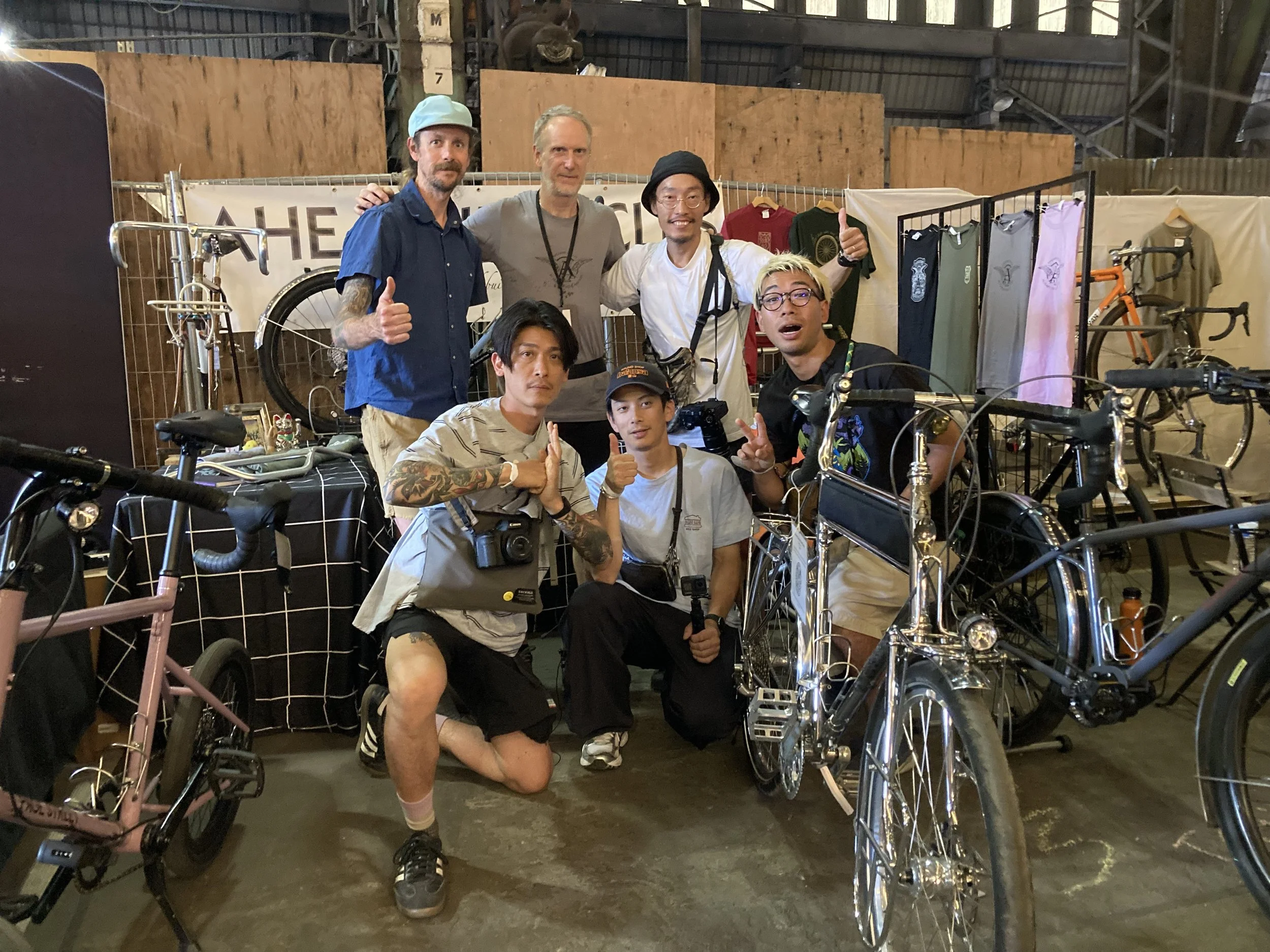
Friends from Blue Lug Bike Shop

Another event:

This year marks my twenty-year anniversary of making bicycle frames. I tried to pretend that Made PDX was partially a celebration of this, a giant gathering of new and old friends to acknowledge two decades of my practicing the craft of bike making.

Twenty years!

“Not dead yet!”

I think this almost qualifies me for being considered one of the old-timers. How did I even get here? So many bespoke frame makers have come and gone over the years, and at some point it comes down to who’s left standing. As my old shopmate liked to say, “Not dead yet!”

I’m not saying I’m better than anyone. I honestly don’t know if it’s a virtue of persistence that keeps me doing this, or if I have some sort of barrier to higher thinking, like a chronic mental deficiency. None of the is job easy, the struggles are real. Do it long enough and the struggles will change, but they never go away. One quality, perhaps more than all the others, that one must have to survive as a frame builder is mulishness. Being like a mule. Undying determination. Not considered the smartest creature, but tenacious to the end. Is that me, the ass?

Each person who made bikes and then stopped making bikes had their reasons.

Igleheart retired after like forty years of doing it, and moved with his wife to France.

Mitch lost all his equipment, not to mention his home, in the Paradise fire.

Bruce died.

Tim did well for himself for a number of years, but being a school teacher and receiving a steady paycheck, health insurance, and a decent retirement package was a much wiser choice, really a no-brainer.

Natalie became a mother of two, which is more than enough work to keep one busy.

Aaron realized he could make more money if he went back to being a graphic designer.

Sean needed to focus on being a dad and to free up space in his garage. And besides I don’t think he really liked dealing with customers.

Sacha’s mustache got in the way. The last anyone heard he used it to paddle out to sea and never came back.

Making things to make a living is hard work

Matt got into grad school and his partner Nate didn’t want to keep doing it solo.

Other people I’ve known started out just wanting to make some frames and were never really keen on the business side of things. And who can blame them? If you’ve got another job or another source of income, sure, OK, make bike frames as a hobby.

As one’s sole employment, though, it almost doesn’t make sense. The numbers hardly pencil out unless you arrange your whole life around it, and not everyone is willing to do that. I did it, I’ve done it, but I again refer you back to what I was saying earlier about the mule and dysfunction of the brain.

Just to acknowledge it, though: After twenty years I can still honestly say that I enjoy making bikes. I really do. I like designing something cool, letting my hands do what they know how to do. I like problem-solving and using a torch and files to construct something that I know is going to be good, functionally and aesthetically. I like working for myself, answering to no one except for my customers. I like taking an idea, building it into steel and then passing it along to its new owner. In a way it feels like I get to open a door for someone, invite them to come inside and join a banquet. Not in my honor, but in theirs. Of course I have to get paid, but in some ways it still feels like I’m giving a gift.

A new bicycle is like a promise. It goes out into the world, hopefully to be ridden a lot, to make new stories on the road — of travel, of speed, of fun and engagement. I get to make something that contributes to a person’s health and happiness, that’s kind to the environment. These are the things that fuel me, gratify me, and make me feel stoked. All this is its own sort of capital, impossible to measure in linear terms.

A Great Book, Not Mine


Anyway, off the soapbox, there are a couple of other things to note…

One, I wrote a book! Not that this is a recent development — I’ve been working on this thing for ages. But earlier this year I was accepted into a program to have high-caliber writers read what I’ve written and do a full manuscript review. It’s the next big step towards crafting something that will (hopefully, eventually) be put out into the world. You’ll hear more about this in the coming months.

New T-shirts!


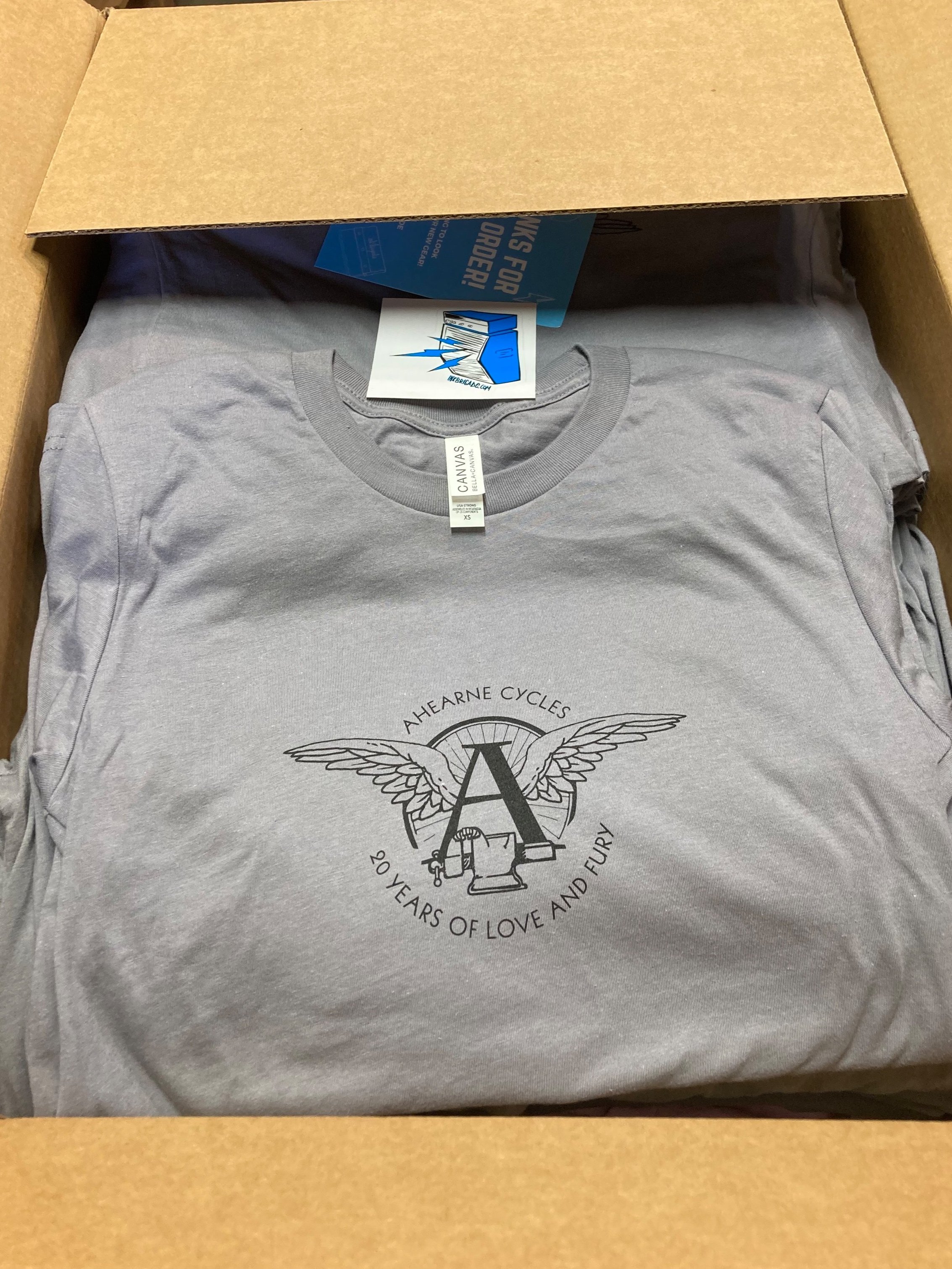
Next thing: There’ll be t-shirts for sale on the Ahearne website soon. Commemorative and possibly historic designs, etc. Colors, sizes, options. I sold some at the show, they’re nice, you’ll like them. Thanks Brian, Maggie, and Mary Lou for pushing to make this happen!

And lastly (for now): If you hadn’t heard, Page Street Cycles is still a thing. It’s going through a transformation, and there is a website being flushed out as I write this.
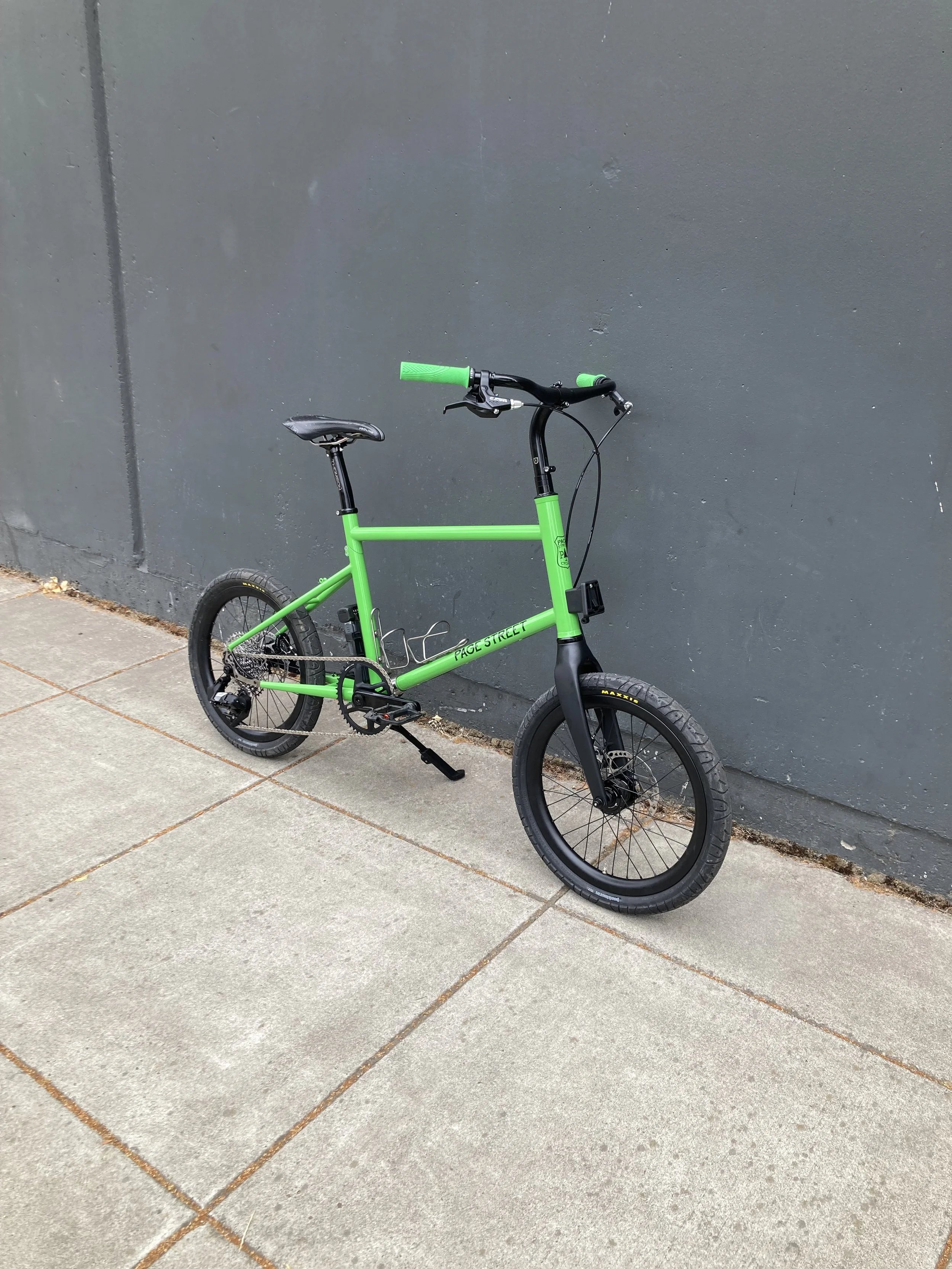
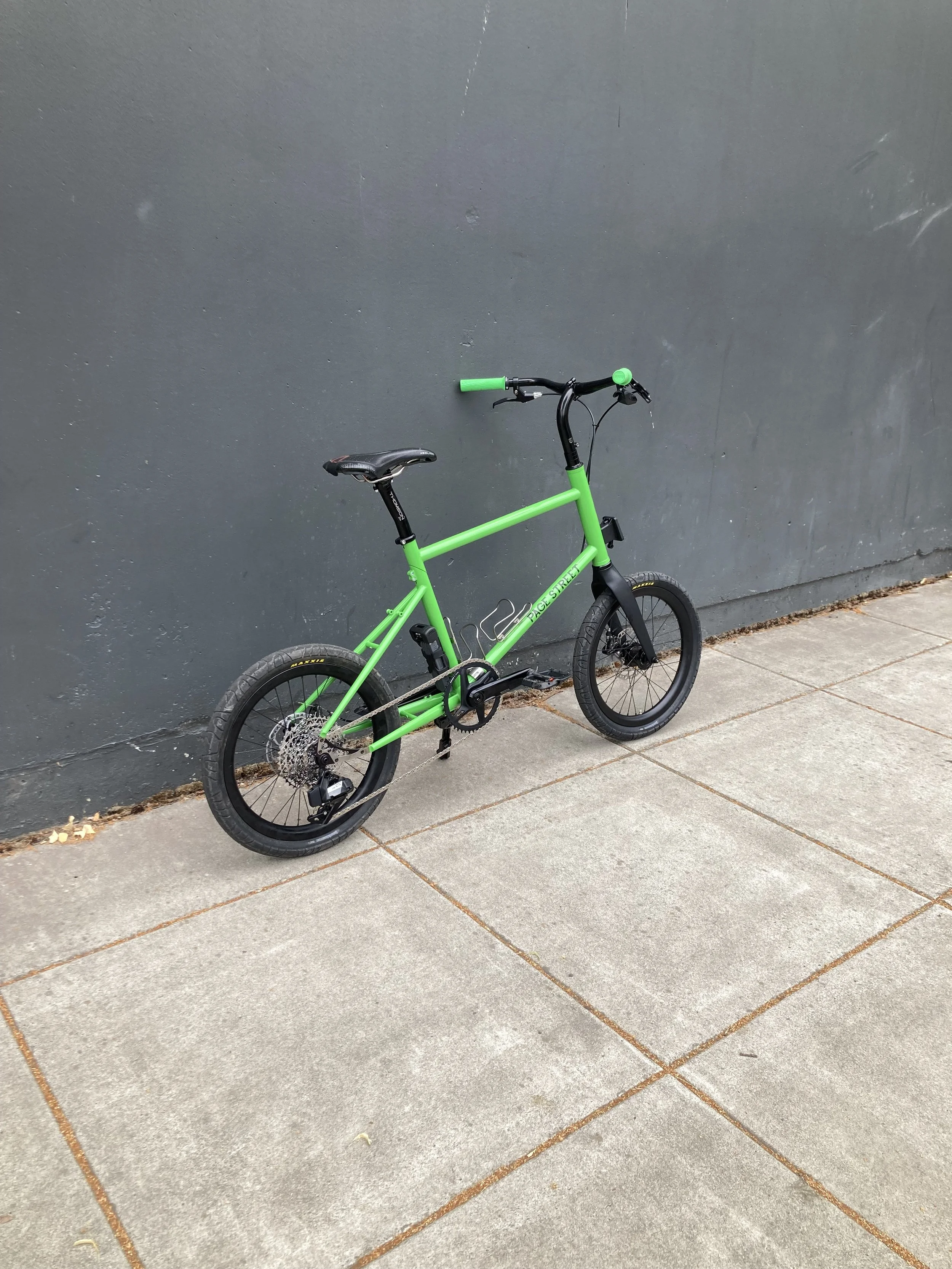
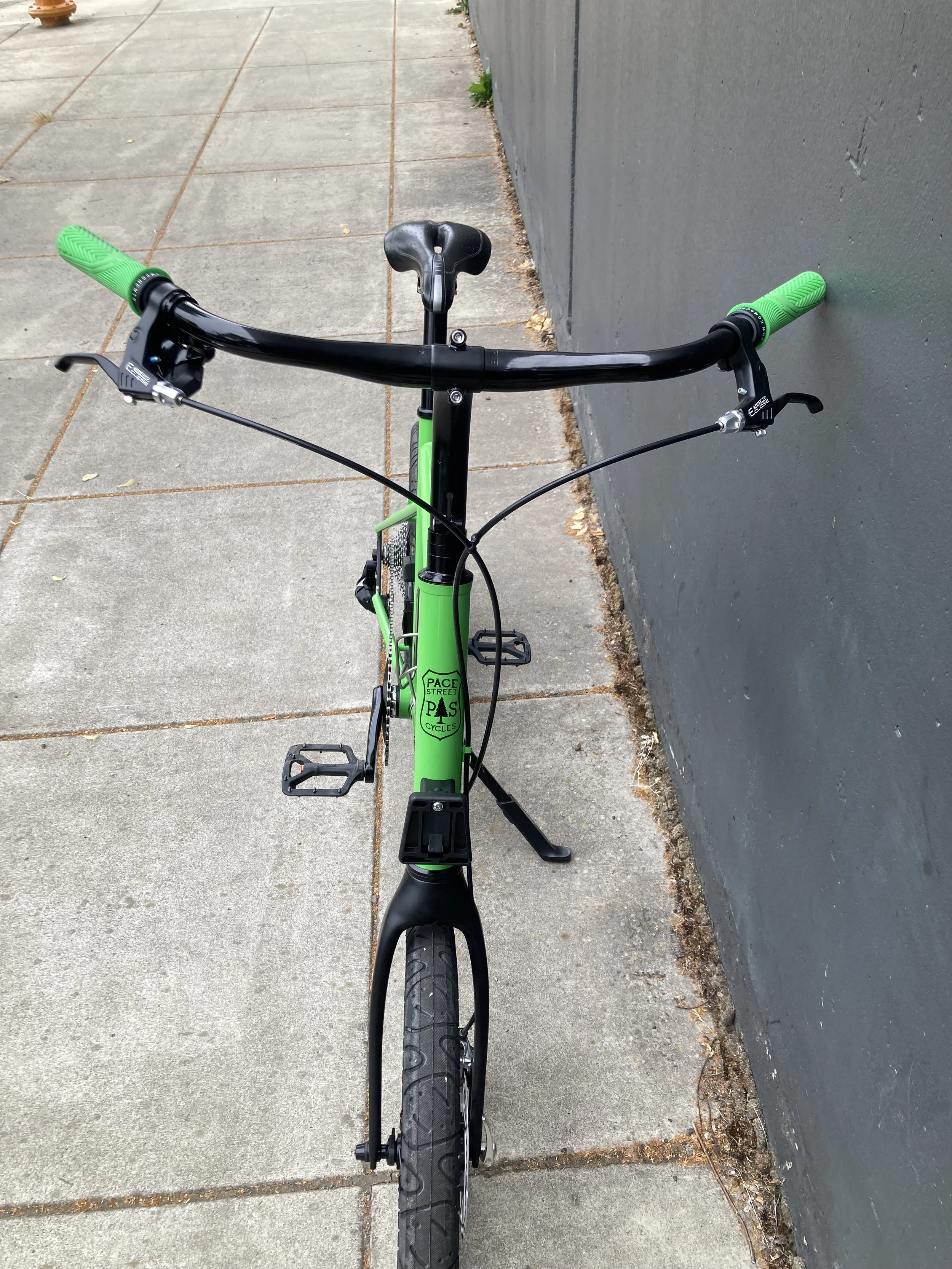
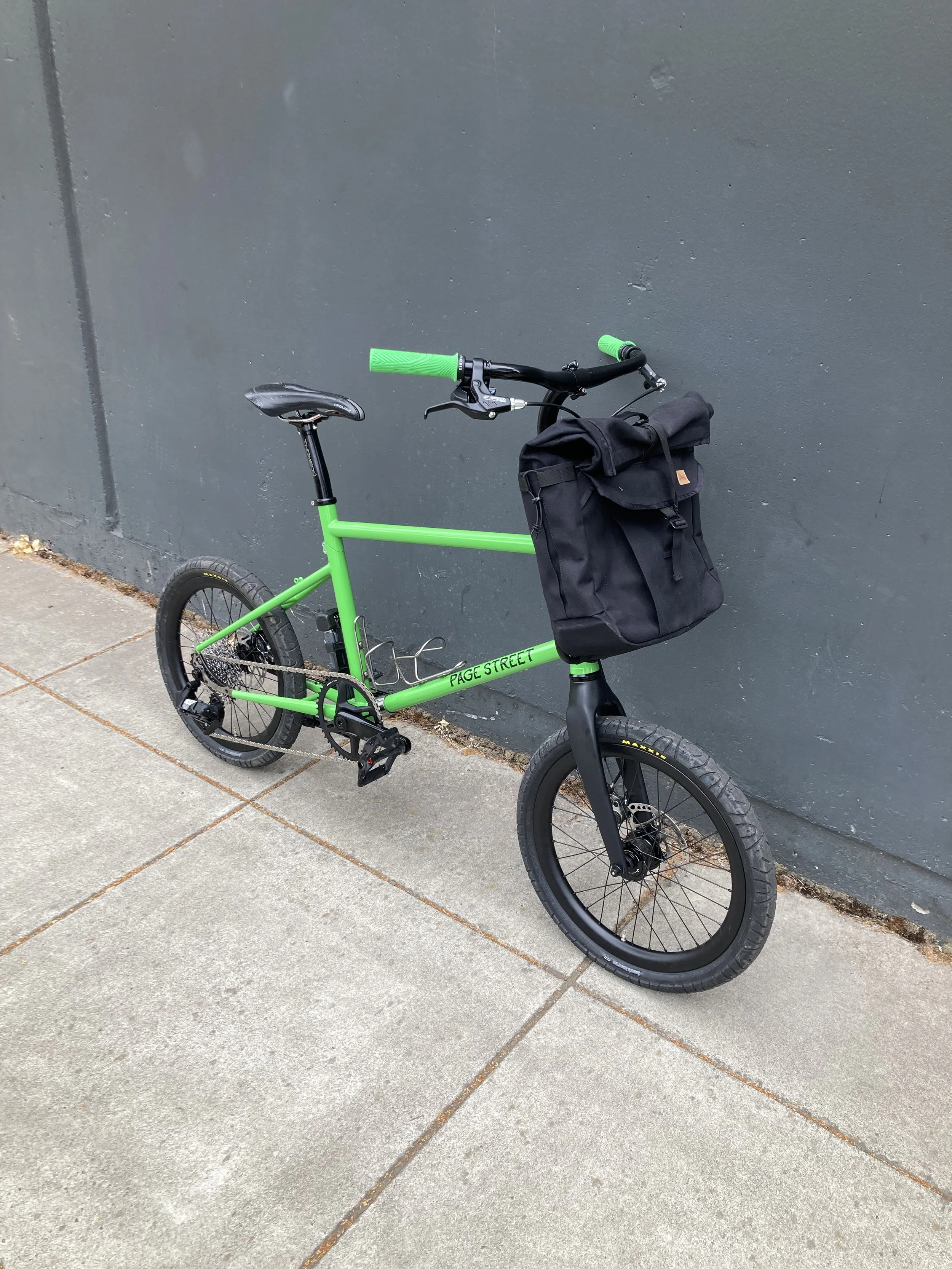
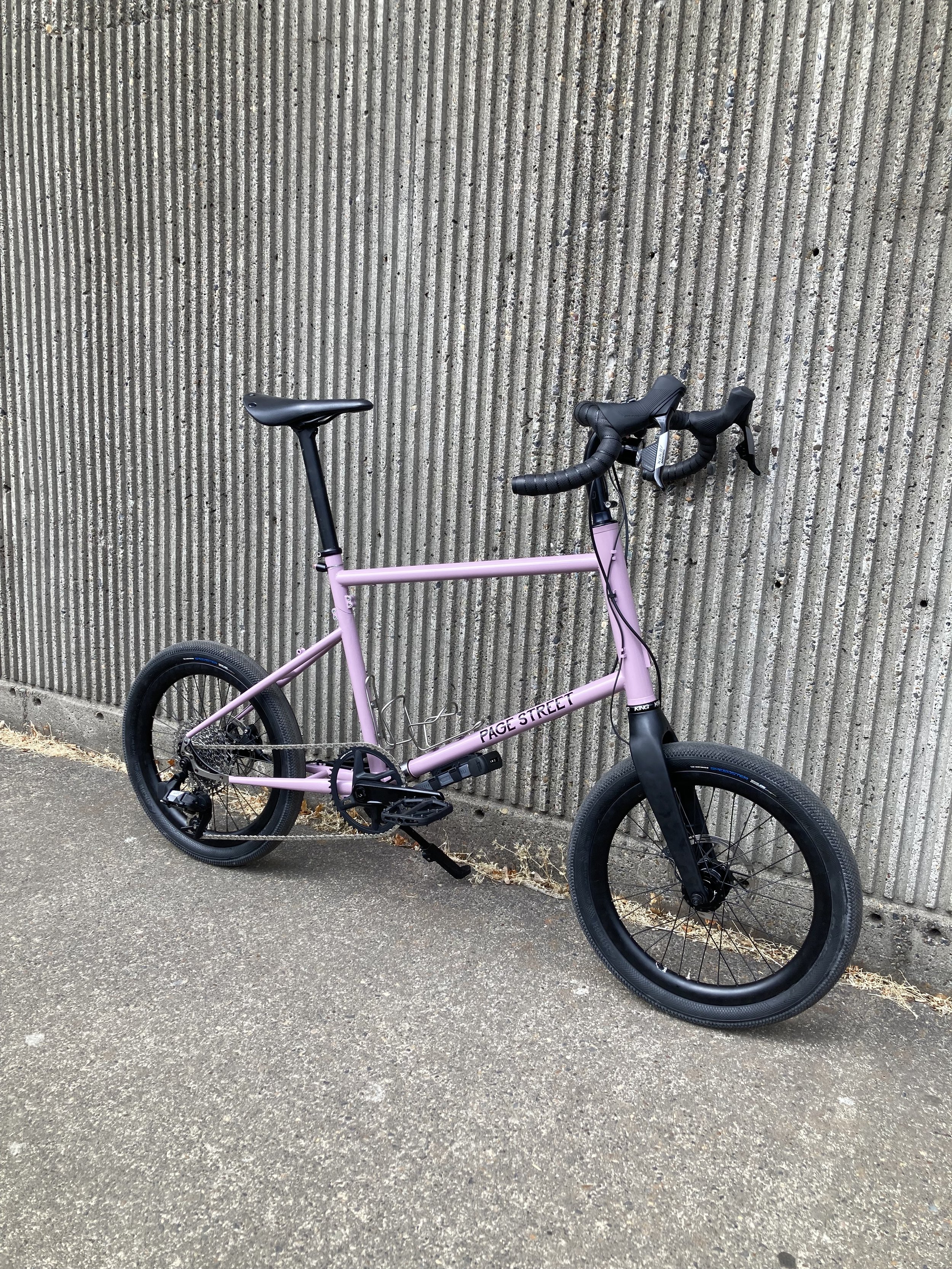
At Made PDX I introduced the newest Page Street model, a mini velo travel bike called the Viajero (Spanish for “the traveler”). Prototypes have been up and running for a few months, the design is getting dialed in, costs determined. You can read a bit about it in The Radavist (scroll down through the other cool bikes to see it).
I’ll admit, the Viajero is one fun bicycle. The way it breaks down it will be an amazing bike for taking with you when you head off to far-away places. It’s not a folding bike for instant break-down. The goal is to have something that rides, handles, and feels like a “normal” bike and that easily packs down into a suitcase within airline regulations, or to fit in the trunk of a car. I picture it being for people who travel, a few days here, a week there, and want to take a bike with them that’s easy to manage. I’m building it so it’ll be stable enough to bike tour on if you wanted. Like, I could see doing a mixed train-and-trail tour across Europe on this bike. That’d be a riot.

I won’t go into it further just now. Suffice it to say I’m excited about this bike. I’ve been riding one for the past couple of months and it’s been a real treat. It’s zippy and quick handling, intuitive, and just a blast to ride. I love atypical bikes that serve a specific purpose and do it well. And these bikes rip. I’ve gotten quite a bit of interest already, and plan to start taking pre-orders as soon as the details are figured out.

If you’re interested in knowing more about the Viajero and staying in the loop as things progress you can email pagestreetcycles@gmail.com and ask to receive notifications. I’ll have a sign-up list soon, but for now this will get you started. I promise I won’t share your email with anyone, and I will only message you when there’s real news about the bike.
That’s it for the moment. Thank you for reading this, and cheers to everyone who made it to the Made PDX bike show. Especially Billy Souphorse — seeing the need and taking it on. Seriously, give you and your crew a pat on the back.

And, most importantly, thanks to everyone who’s supported me in what I do, and have done, for the past twenty years. What a ride!

Time to chill.

Or, as some hippy once said:

What a loooooong strange trip it’s been.

Getting Into 2023

Joseph Ahearne11 Comments

Over the years people have periodically asked me how I started building bicycle frames. Like with any story, there’s a short version and there’s a long version. The short version is, I took a class, bought some tools, practiced and practiced and practiced, got better at it, got a few lucky breaks, kept doing it and lo and behold, twenty years have passed and here I am. This version of the story leaves out most of the interesting stuff, though. So if you’d like to hear the beginning of the longer version, please keep reading.

When I was a kid I wanted to fly airplanes. The fast kind, not so much passenger planes. My dad was a pilot, he was licensed to fly single-engine prop planes and sometimes he would take my mom and I out. This was back in the early 1970s when you could rent a Cessna for like $30 a day, and fuel cost next to nothing.

We lived in Kansas City, Missouri, and story has it that one time we flew down to the Bahamas. I don’t remember the Bahamas, but apparently while there I got a sunburn. This sounds plausible, my hair was coppery red (it’s since gone brownish-gray), my skin fair and readily sun-burnable. Another time we went to Tucson to visit some relatives, where it’s likely I again got a sunburn. I’m sure there were other flights, less goal oriented, just for the sake of being up there. I was so young I don’t know where the memories overlap with photos and stories I’ve heard. And I guess it doesn’t matter — something got into my blood and the desire to fly stayed with me.

Maybe a decade later, I’d mostly forgotten about being a pilot. I wasn’t sure what I wanted to be, but there were a lot of things I was sure I didn’t want to be, most of which had to do with being average. I was a teenager in the midwest, I wanted to break the mold and be somebody totally unique, do something amazing. I wanted to become something that the world had never yet beheld, anything but being your average Joe.

People still asked me what I wanted to be when I grew up, especially as I got closer to college age, but I had no idea. Just to have something to say I said I wanted to be a writer. I mean, I wrote, I liked writing,  it was about the only constructive thing I could figure out to do with all my confusion. And as a byproduct of practicing it I discovered that in its best moments writing was kind of like flying. But that came later.

At the time most of what I wrote was so bad it gave me physical pain, both to write it, and then to read it. Seriously, woe was me. Most of what I knew about expressing myself in writing came through punk and metal song lyrics and the poetry of Charles Bukowski. The thing about writing is you can’t hide how phony you are on the page. The only way I could think of to hide that was to hide my writing.

And so I did. I vowed to never show anyone what I’d written. I was going to be one of those secret writers who disappeared inside of black clothes and only ever got discovered by accident. Usually only after they’re dead. I thought by then it might be OK to let people read my work. I’d give it time. If somehow I accidentally got old (whoops! crap!) and if I still totally sucked I could always burn everything I’d written before dying, thereby immortalizing myself as a Secret Writer Forever.

Anyway, I was not a natural-born writer. I was so young, I had so little living under my belt. I needed experiences to write about. I picked away at college, but my heart wasn’t into it. Too expensive, and what was college for except to get a job? I didn’t want a job. I wanted a life, on my own terms. Remember, whatever I was going to do, it was going to be amazing. It took a couple of false starts and 3 colleges over a handful of years to come to terms with what I thought freedom was and how I wanted to pursue it.

That was when, like a ghost of Jack Kerouac, I went on the road. It was late 80s into the 90s. Punk rock was the thing, then grunge. I kept to the margins of the margins, a full time imposter, kind of a tentative, poorly designed punk. I didn’t know how to fit with the cool kids but I liked the music. I wore the uniform of my brethren — tattered clothes that were, once upon a time, all black, but with continual wear went kind of greenish brown. I smelled bad and became immune to it.  I mean, I was on the road.

I went from place to place, didn’t stay in anywhere for long, from menial job to seasonal job, to whatever job, to no job, always just barely getting by. I had a bike sometimes, and sometimes I didn’t. I worked on the salmon boats in Alaska, traveled for months down in Mexico and Central America. Was a bike messenger in Portland; worked at an animal shelter in Lawrence, Kansas, just down the road from where William Burroughs lived. I saw punk bands play: Gwar in New Orleans; the Quincy Punx in LA; 2000 DS at CBGB in New York; Primus in Denver; No Means No in Padova, Italy.

Money was always very thin. Instead of coins I collected stories. They were my currency. I rode my bike cross country, moved a rich lady’s furniture from Aspen to Little Rock, met her father, whom, as a fully adult woman she still called, “daddy.” He was on oxygen and smoked cigarettes and sat there in this little cart glaring at me and another guy who loaded an unbelievable amount of furniture onto a truck. I traveled back to Alaska to fish, nearly sank the boat; went back to Mexico, back to Portland, back across the country. I worked at an independent bookstore in New Haven, Connecticut, and got a job shelving books at Sterling Memorial Library on the Yale University campus, a school I knew I would never attend. I lived in a squat in the East Village in Manhattan; lived in my tent and worked for a couple of months on Martha’s Vineyard; lived in a car here and there, until it ran out of gas and got towed. Went to Ireland for almost a year, Doolin and Galway, not really searching for my Irish roots, but practicing the old ways nonetheless — surviving on a few potatoes and casks of Guinness. Northern Spain for a few months; then to Italy for a couple of years teaching English, where I rode my bike over most of the northern half of the country, touring through parts of Croatia and Slovenia.

This went on for nearly a dozen years. But then I got older. At thirty, thirty-one, the stories that had put me on the road had changed, were no longer serving me. The way things were going I was never going to become that amazing creature I’d vaguely imagined. I was just going to wander until I was totally worn out and then lay down and die. The problem revealed itself: I always bought one-way tickets, I had nowhere to be.

Over a handful of years in the mid and late 1990s I’d been in and out of Portland, Oregon, staying sometimes weeks, sometimes months at a time. I was always planning my departure, but I liked being here. Its size, its trees, how unbelievably green it was, the flowers, the proximity to mountains, forest, and ocean. And the vibe here at the time was creative, DIY, it felt like you could craft your own way, try new things, and be around smart young people who were doing so for themselves. The point of connection for a certain crowd of us were bicycles. The infrastructure wasn’t here yet, but the layout of the city was good for getting around by bike.   

Looking back, my bicycle was one of my few reliable sources of happiness. I was so constrained by my system of beliefs (militant proto-punk ethos), but riding a bike got me out of my head, was good for quieting the internal chatter. Portland gave me plenty to explore, and whenever I went out wandering through the neighborhoods or up into Forest Park I felt better, felt alive. I mentally mapped larger and larger swaths of the city, and then beyond it. I didn’t care if it rained, I liked the rain. I just wanted to be out moving, always moving. But then at the end of the day to be able to return to my room, to whatever space I called home. This was important.

In the fall of 2002 I returned to Portland, this time ready to stay a while. That next spring I met a man named Tim P. who lived across the river in Washington. He held classes in his garage teaching people how to construct bicycle frames. He was a school teacher, had raced bikes in the 70s, built bikes through the 80s. He wrote The Paterek Manual for Bicycle Frame Builders, considered the Bible for would-be bike makers.

I worked two jobs (restaurant, bike shop), saved my pennies and took his class. While steering me through a build Tim told me he was retiring and wanted to clear out his garage. He offered to sell me his equipment at a good price, everything I would need to continue building bike frames on my own. For me, a case of being in the right place at the right time.

One of the biggest barriers to entry into making bike frames is gathering all the tools. Where do you even start? If you don’t have a certain number of set pieces you pretty much can’t do anything at all. And buying or making those pieces requires money, time, and know-how. At the bare minimum one needs a torch and regulators, some files, a hacksaw, a vice, tube blocks, jigs to hold things straight and in a plane, dummy axles, a few other things. Basic stuff, and this does not account for the time and practice required to bring your skills up. Especially if you’re like I was then — I hadn’t used many of these tools. Not ever. But it was a time in my life where I was desperate to do something that I found meaningful.

I had no plan to become a bike builder when I started. I just wanted to make things, to cut and burn metal and turn it into something cool and useful. Mainly to have fun. And it was fun, but it was work, also. And up to this point in my life work and fun had never been in the same room together unless I was doing something stupid or unethical. This meant that whenever I sold a bike or a rack it felt like I was getting away with something. A very weird feeling, totally novel, making something with my hands that someone is willing to pay for. It was kind of addictive. It took a few years to realize what I had going on and the potential for it. I had no background with business. My only business plan was the same one I’d always had — to survive from one meal to the next.

It’s hard to believe that was twenty years ago. And it’s kind of mind-blowing to think how sometimes things come to us when we really really need them. What a blessing, eh? It’s not just a neat, pithy summation to say that bicycles saved my life. I can be a very slow learner, and in some ways have a lot of resistance to new things; to change. Even when it’s good for me, or maybe especially when. This is something I’m working directly with in the New Year, in 2023 — my resistance. Recognizing it, acknowledging it while not letting it derail me from persevering on whatever path I may be pursuing. Not a resolution so much as an intention.

Here I’m thinking of my relationship to writing. I write a lot, but I still hold myself back from sharing. I ask myself, Who really needs to hear underdog stories from another white dude in America? There’s part of me that believes we’ve heard enough from people who look like me.

But there’s another part that knows I have a story to tell. Contemplating what makes a meaningful life is a way of pursuing a concept that transcends stereotypes. I was born here, I am who I am because of where I came from, what I look like, who I’ve been around — parents and peers and punks — how I’ve engaged, and the feedback I’ve gotten along the way. You might say I started under water. It took a lot of years swimming around to even begin to see the surface.

Anyway, bike building gradually became a full stop on my previous life. Rather than continuing to search outward, I went in. All in. The only way I could make it work, as a craft, and as a business, was to look at what my hands were doing, and at what my mind was saying, and start being fair to myself and to give new things an honest try. To practice. To start using tools that were helpful and admit what was hindering me and to begin learning how to undo these things and let them go. To fail and fail again. And, as I’ve heard said about writing — To fail better.

Luckily, I like making things and seem to have a bit of a knack for it. I believe in bicycles and thrive on problem solving, and temperamentally, I can be as stubborn as they come.

I think it is a baseline requirement for making a craft-based business work: The obstinance of a mule and the desire to keep doing what you’re doing, even when you don’t want to. Without these it will be very hard to continue going forth when hard times come. And hard times will come, like a perfectly calibrated test to discover your personal breaking point. Resist as much as you like, it will come, it will push you right on over the edge and shatter you, again and again.

Anyway, I’ve got stories. This is my way of trying to convince myself to begin telling you some of them.

So let’s get started on down the road in this New Year.